
Search Results
Keyword:fusion fuel cycle

U.S. Marathon Fusion Demonstrates Hydrogen and Lithium Isotope Enrichment Technology
U.S.-based Marathon Fusion announced on August 27 that it has successfully demonstrated hydrogen and lithium isotope enrichment technology using its proprietary plasma centrifuge. The company stated that this advancement addresses the fuel cycle needs of fusion energy and related isotope supply requirements. In the deuterium-tritium fusion pathway, hydrogen isotope processing is critical to the continuous operation of fusion devices, while lithium isotope enrichment is closely tied to tritium production. The U.S. Department of Energy (DOE) released its "Fusion Science and Technology Roadmap" in June of this year, which identifies tritium processing as one of the core challenges, noting that related progress is essential for achieving sustained deuterium-tritium fusion operation and validating fusion as a large-scale energy form...
2026-08-28
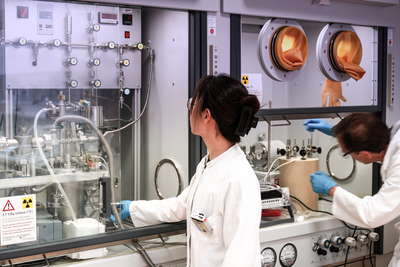
German team achieves first separation of tritium-containing hydrogen isotope mixtures using silver-exchanged zeolites
A team at the Helmholtz-Zentrum Dresden-Rossendorf (HZDR) and partners recently demonstrated a new method for separating hydrogen isotopes using silver-containing zeolites, successfully separating hydrogen isotope mixtures containing radioactive tritium through a porous solid material for the first time. The research findings were published in Nature Communications. Future fusion power plants will require not only high-temperature plasma and strong magnetic fields during operation, but also a stable fuel cycle system for recovering, separating, and reusing deuterium and tritium. Inside a fusion reactor, deuterium and tritium participate in reactions and release energy, but the fuel is not completely consumed, and the residual gas may also contain ordinary hydrogen (protium), forming a mixture of protium, deuterium, and tritium...
2026-08-07
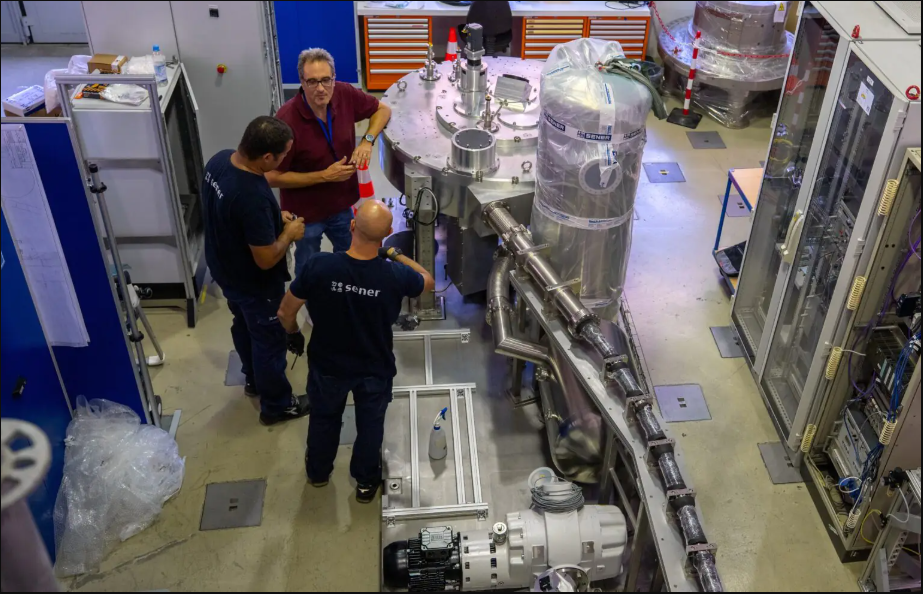
Europe Completes Manufacturing of JT-60SA Pellet Centrifuge Accelerator
The European Fusion Energy Organization (F4E) recently announced progress on key components of a new pellet injection system for the upgrade of the JT-60SA device. The centrifuge accelerator, manufactured by Sener, has been completed and delivered to the Max Planck Institute for Plasma Physics (IPP). It will subsequently be integrated with other components of the pellet injection system and undergo testing. The operation of fusion devices relies on the continuous supply of hydrogen isotope fuel. In devices such as JT-60SA and the International Thermonuclear Experimental Reactor (ITER), the pellet injection system is used to fuel the plasma and assist in controlling plasma instabilities. The system typically consists of three parts: preparation...
2026-07-29