
Europe Completes Manufacturing of JT-60SA Pellet Centrifuge Accelerator
 Scan to share
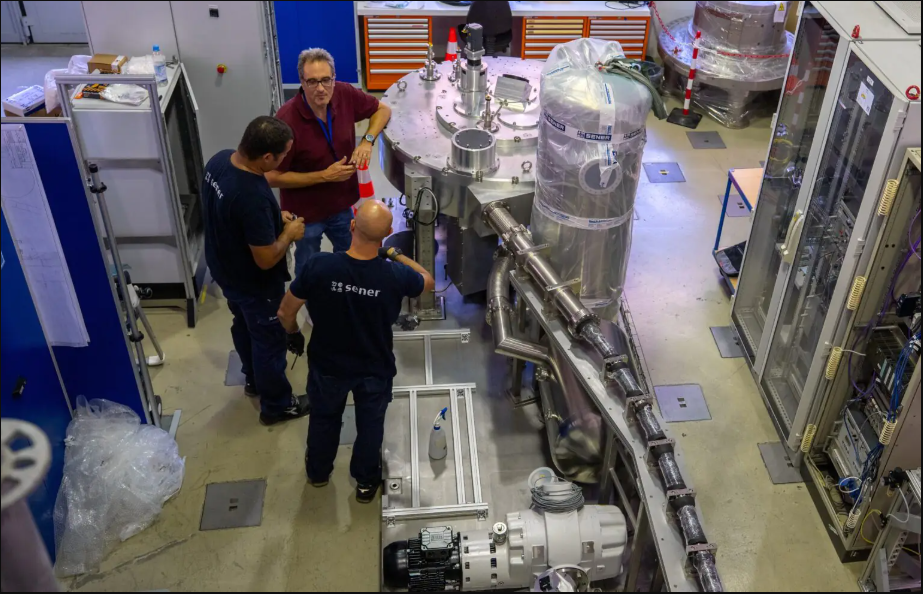
The European Fusion Energy Organization (F4E) recently announced progress on key components of a new pellet injection system for the upgrade of the JT-60SA device. The centrifuge accelerator, manufactured by Sener, has been completed and delivered to the Max Planck Institute for Plasma Physics (IPP). It will subsequently be integrated with other components of the pellet injection system and undergo testing.
The operation of fusion devices relies on the continuous supply of hydrogen isotope fuel. In devices such as JT-60SA and the International Thermonuclear Experimental Reactor (ITER), the pellet injection system is used to fuel the plasma and assist in controlling plasma instabilities. The system typically consists of three parts: an extrusion system for producing frozen hydrogen pellets, a centrifuge accelerator for accelerating the pellets to high speeds, and a transfer system for delivering the pellets into the plasma.
Related technologies have previously been advanced primarily by European research institutions such as the Spanish Center for Energy, Environmental and Technological Research (CIEMAT), the French Alternative Energies and Atomic Energy Commission (CEA), the Hungarian Research Network (HUN-REN), and the Max Planck Institute for Plasma Physics. F4E believes that industry experience in reactor-scale fuel cycle equipment still needs to be accumulated, and is therefore promoting the construction of a European fusion fuel cycle supply chain through project procurement and corporate cooperation.
JT-60SA is currently one of the largest operational tokamak devices in the world, providing an important platform for the engineering of related technologies. According to the cooperation arrangement between Europe and Japan, the device will be equipped with a pellet injection system in the next phase of upgrades. In 2023, F4E signed a contract with Sener for the company to manufacture the centrifuge accelerator. This component, approximately 5 meters long, can rapidly and precisely accelerate pellets via a rotating arm, with a design capacity of accelerating up to 80 pellets per second to a maximum speed of 600 meters per second.
F4E Technical Officer Nándor Hajnal stated that cooperation with IPP is crucial for project progress, and the team has drawn on experience from previous generations of centrifuges while modernizing the technology. Joan Manel Casalta, Scientific Project Manager at Sener, noted that the development results of the pellet centrifuge accelerator, in addition to serving the fusion field, are also expected to promote the development of related key technologies such as high-performance satellite momentum wheels.
Meanwhile, F4E has initiated the procurement of the JT-60SA extrusion system. This subsequent procurement will continue to focus on the pellet preparation phase and will also provide new opportunities for European companies to participate in the development of fusion fuel cycle equipment.
Disclaimer: Information republished from partner media, institutions or other websites is provided for reference and communication purposes only. It does not imply endorsement of its views or verification of its accuracy. Please contact us if any content infringes rights or requires correction.