
Hefei Energy Research Institute Achieves Progress in Research on Compatibility Between Fusion Materials and Liquid Metals, Providing a Basis for Cladding and First Wall Material Selection
 Scan to share
The research team at the Neutron Technology Application Research Center of the Institute of Energy, Hefei Comprehensive National Science Center, has recently made important progress in research on material compatibility and performance evolution mechanisms under liquid metal environments in nuclear fusion reactors. The team conducted in-depth research on the long-term corrosion characteristics of austenitic heat-resistant stainless steel and iron-nickel-based heat-resistant alloys in high-temperature static liquid lead-lithium, as well as the contact damage mechanisms between tungsten fiber-reinforced tungsten matrix composites and liquid lithium. The related results were not only published in top academic journals in the field of nuclear materials, but also presented at the 9th International Symposium on Liquid Metal Applications in Fusion.
Liquid lithium and lead-lithium eutectic alloys, owing to their excellent neutron breeding, heat transfer performance, and resistance to high heat loads, are regarded as the most promising candidate working media for plasma-facing liquid-solid composite first walls and tritium breeding claddings in magnetic confinement fusion devices. However, under extreme service conditions at high temperatures of several hundred degrees Celsius, liquid metals are highly prone to causing severe chemical erosion and physical degradation of the metallic structural walls in direct contact with them, leading to selective precipitation and dissolution of microscopic alloying elements, deterioration of mechanical properties, and degradation of heat transfer performance, which directly constrains the long-term service safety of core fusion components.
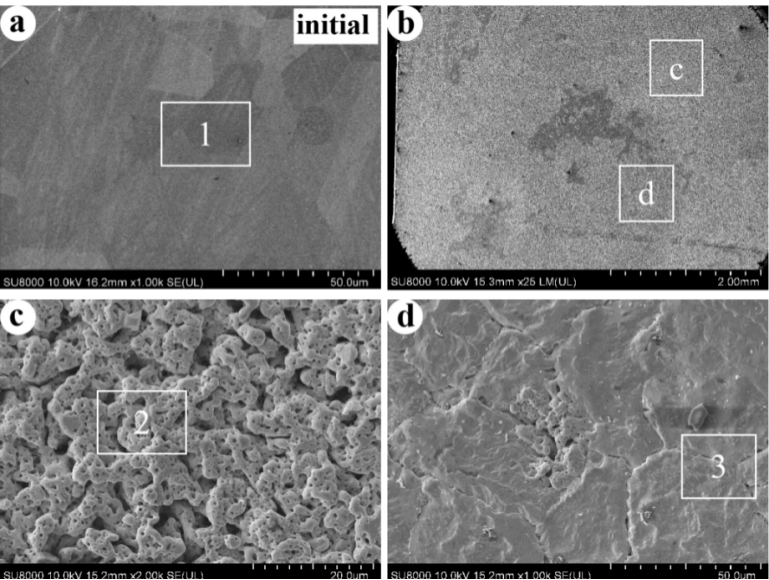
For candidate structural materials for high-temperature lead-lithium breeding claddings, the research team conducted accelerated static corrosion comparison experiments lasting up to 1000 hours on high-chromium-nickel austenitic stainless steel and iron-nickel alloys in a high-temperature static liquid lead-lithium environment at 700 degrees Celsius. The experiments systematically tracked the mass loss rate, microstructural evolution, and elemental diffusion depth of the specimens. The results showed that the overall lead-lithium corrosion resistance of high-chromium-nickel austenitic steel was superior to that of iron-nickel alloy, but both types of materials exhibited the common phenomenon of preferential dissolution and precipitation of chromium and nickel alloying components into the liquid lead-lithium during deep erosion, leaving porous honeycomb-like non-uniform corrosion layers in the grain boundary regions; meanwhile, the experiments found that a complete and dense metal oxide film pre-formed in situ on the metal surface could serve as a physical barrier in the early stage, effectively retarding the chemical erosion rate of high-temperature lead-lithium on the substrate material.
In the research on compatibility of candidate heat-resistant materials for liquid-solid composite first walls, the research team tested the damage morphology of tungsten fiber-reinforced tungsten matrix composites after 500 hours of scouring and infiltration in static liquid lithium at 350 degrees Celsius and 550 degrees Celsius. Microscopic characterization confirmed that the reinforced tungsten fiber regions mainly exhibited characteristic grain boundary corrosion and micro-pitting, while the matrix metal regions were dominated by preferential dissolution at phase boundaries and edges. After severe corrosion at 550 degrees Celsius, the microhardness of the composite matrix region showed a significant drop of over 54%, accompanied by a decrease in thermal diffusivity, revealing the significant weakening effect of high-temperature liquid lithium erosion on the high-temperature mechanical load-bearing and heat removal capabilities of tungsten materials. Analysis indicated that optimizing the powder metallurgy sintering process to substantially increase material density and eliminate microscopic voids can effectively reduce the working medium infiltration area, thereby significantly improving corrosion resistance.
Subsequently, the team will focus on the complex multi-field coupling environment of fusion reactors, accelerate the construction of a comprehensive experimental platform integrating high-temperature plasma irradiation and liquid metal flow channels, and further carry out dynamic corrosion assessment of flowing liquid metals, multi-scale compatibility simulation, and development of in-situ non-destructive testing equipment for service performance, providing underlying data support for engineering material selection of liquid metal claddings and first walls in future fusion reactors.
Disclaimer: Information republished from partner media, institutions or other websites is provided for reference and communication purposes only. It does not imply endorsement of its views or verification of its accuracy. Please contact us if any content infringes rights or requires correction.