
German team achieves first separation of tritium-containing hydrogen isotope mixtures using silver-exchanged zeolites
 Scan to share
A team at the Helmholtz-Zentrum Dresden-Rossendorf (HZDR) and partners recently demonstrated a new method for separating hydrogen isotopes using silver-containing zeolites, successfully separating hydrogen isotope mixtures containing radioactive tritium through a porous solid material for the first time. The research findings were published in Nature Communications.
Future fusion power plants will require not only high-temperature plasma and strong magnetic fields during operation, but also a stable fuel cycle system for recovering, separating, and reusing deuterium and tritium. Inside a fusion reactor, deuterium and tritium participate in reactions and release energy, but the fuel is not completely consumed, and the residual gas may also contain ordinary hydrogen (protium), forming a mixture of protium, deuterium, and tritium isotopes. Since the three have nearly identical chemical properties, the efficiency of conventional separation methods is limited.
The material used by the research team is silver-exchanged Y-type zeolite. Zeolites have a regular microporous structure, and the ions on the pore walls can be replaced to modify the material's properties. The researchers replaced sodium ions with silver ions, creating a specific interaction between hydrogen molecules and the electronic structure of silver ions, resulting in an adsorption potential. Due to the mass differences among protium, deuterium, and tritium, their zero-point energies differ; deuterium and tritium have lower zero-point energies than protium, making them more stable in the adsorption potential and thus binding more strongly to the material. Upon heating, the three isotopes are released at different temperatures: protium desorbs first, followed by deuterium, and finally tritium.
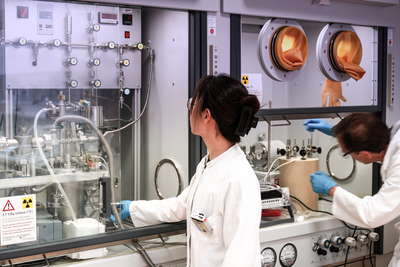
The tritium experiments were conducted at the radiochemistry laboratory at HZDR's Leipzig research site. The study showed that after an equal-volume mixture of protium, deuterium, and tritium gas came into contact with the silver-containing zeolite, the mixture ratio changed to H₂:D₂:T₂ = 1:41:175, indicating that tritium was retained to the highest degree in the material, with deuterium also significantly enriched. Experiments with two-isotope mixtures likewise demonstrated high selectivity, with the most pronounced difference observed between tritium and protium.
The researchers also examined the material's stability in a tritium environment. The β radiation produced by tritium decay could potentially damage the silver sites in the zeolite, but in exposure experiments lasting several hours, no measurable decline in separation performance was observed. The research team noted that this does not yet prove long-term engineering viability, but it indicates that such materials warrant further investigation.
At present, this work remains at the fundamental research stage, with relatively small amounts of material used in the experiments. If the method is to be scaled up for larger applications in the future, further validation of process design, long-term stability, and scalability will be required. The research team plans to extend this approach to other porous materials to explore more efficient separation of hydrogen isotopes that are nearly chemically indistinguishable.
Disclaimer: Information republished from partner media, institutions or other websites is provided for reference and communication purposes only. It does not imply endorsement of its views or verification of its accuracy. Please contact us if any content infringes rights or requires correction.