
India's Hylenr Technologies Claims Detection of Rare Earth Element Signatures in Lattice-Confined Fusion System
 Scan to share
Indian deep-tech company Hylenr Technologies announced on September 9 that it has observed evidence of element formation in an engineered lattice structure system, including rare earth element signatures. The company stated that this result could provide a technological pathway for nucleosynthesis and strategic materials production that differs from traditional mining.
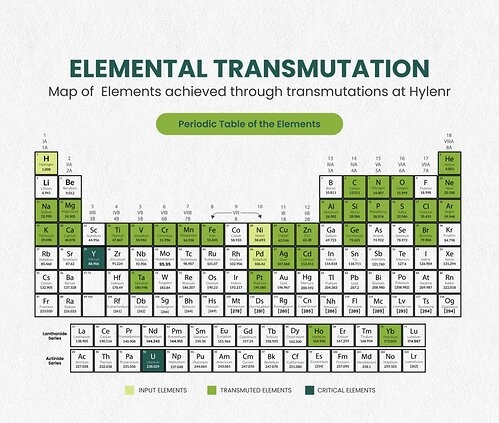
According to the company, the related results stem from Hylenr Technologies' more than 10 years of fusion technology research centered on lattice-confined fusion. Part of the research, titled "Nuclear Signatures in Hydrogen-Loaded Nickel-Palladium Lattice-Confined Systems," was presented earlier this month at the 27th International Conference on Condensed Matter Nuclear Science (ICCF-27) held in Niagara Falls, Canada. The company stated that the research also involved collaboration and validation with international research institutions.
Nucleosynthesis generally refers to the process by which atomic nuclei transform and form different elements. In nature, such processes mostly occur in extreme astrophysical environments such as stars and supernovae. Hylenr Technologies claims that its research shows that in hydrogen-rich metal lattices, interactions among hydrogen, lattice defects, vacancies, and the local electronic environment may create highly confined conditions within the material, thereby promoting processes similar to nuclear reactions.
The company stated that during approximately two years of materials analysis, the research team detected signature signals of 32 elements in post-operation samples, covering light elements, heavy elements, rare gases such as helium, neon, and argon, as well as rare earth elements such as yttrium and actinide elements such as uranium. The relevant signals were compared with baseline characterization results of the same catalyst material samples before operation and were verified through multiple independent analytical methods, including energy-dispersive X-ray spectroscopy (EDX), X-ray photoelectron spectroscopy (XPS), inductively coupled plasma optical emission spectrometry (ICP-OES), wavelength-dispersive X-ray spectroscopy (WDX), and residual gas analysis (RGA).
Ram Ramaseshan, co-founder and board member of Hylenr Technologies, stated that rare earth elements play an important role in fields such as permanent magnets, electric vehicles, robotics, wind turbines, electronics, aerospace systems, and advanced manufacturing, but the global supply chain remains relatively concentrated. The company believes that producing specific elements through engineered nucleosynthesis, rather than relying entirely on geological mining, could become a new model for materials acquisition.
Siddhartha Durairajan, co-founder and board member of Hylenr Technologies, stated that the significance of this discovery lies in its potential to place fusion energy and rare earth materials production within the same engineered nuclear platform. The company stated that future research directions will focus on how to design specific nuclear environments within materials to generate target elements.
Disclaimer: Information republished from partner media, institutions or other websites is provided for reference and communication purposes only. It does not imply endorsement of its views or verification of its accuracy. Please contact us if any content infringes rights or requires correction.