
Professor Yan Lixin's Research Group in the Department of Engineering Physics at Tsinghua University Collaborates to Achieve a Beyond-Megawatt Average Power Laser Optical Enhancement Cavity
 Scan to share
As another effective technical path parallel to multi-channel laser coherent combination, the optical enhancement cavity (OEC) can generate laser beams with extremely high average power. The OEC uses ultra-high reflectivity cavity mirrors to allow laser light to undergo repeated coherent superposition within the enhancement cavity, thereby increasing the average power by thousands or even tens of thousands of times, while maintaining a pure transverse mode. With its stably stored high average power, high repetition rate, high beam quality, and high phase stability laser field within the cavity, the OEC has become an ideal tool urgently needed for numerous advanced scientific applications, and higher and more stable intracavity average circulating power has become the goal pursued in this field. However, due to the nonlinear thermal loading of the optical system and intracavity thermal instability effects, the average laser power of optical cavities has been limited to the hundred-kW level and is difficult to further improve.
Aiming to achieve stable operation of a megawatt-level average power optical enhancement cavity, the research group of Professor Yan Lixin and the team of Professor Fabian Zomer from IJCLab at Université Paris-Saclay, France, have carried out long-term exploratory research. After more than a decade of sustained efforts, the research team finally broke through this long-standing bottleneck, achieving for the first time a four-mirror bow-tie optical cavity with an average laser power exceeding 1 MW, with a maximum intracavity average power of 1.15 MW, and for the first time measured and evaluated the phase noise level of high average power cavity laser light. More importantly, under the ultra-high average power of megawatt level, the intracavity laser still maintained an excellent Gaussian fundamental mode and outstanding phase stability. These results provide experimental basis for further optimizing cavity design, stability control, and thermal management, help to further improve system performance in the future, and lay a solid foundation for advanced applications of optical cavities in many frontier fields.
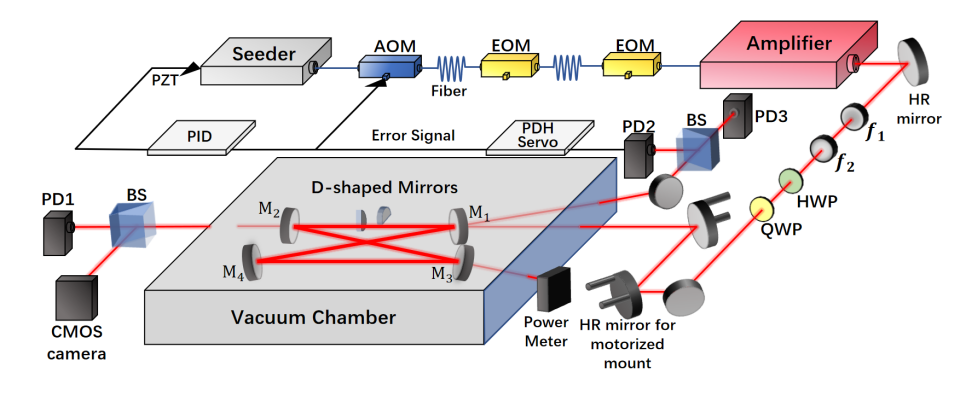
Figure 1 Schematic diagram of the high-power optical enhancement cavity system setup
The experimental setup layout of the high average power optical enhancement cavity system is shown in Figure 1, consisting of injection laser, optical matching, feedback control, and parameter diagnostics systems. The laser output from the low phase noise laser source undergoes transverse mode matching and optical axis alignment before being injected into the four-mirror bow-tie optical enhancement cavity. Under different injection powers, the variation of the stably stored intracavity laser power with time is shown in Figure 2, with a maximum intracavity average power of 1.15 MW and an effective gain factor exceeding 9000. When the intracavity average power is 1.05 MW, the RMS stability of the laser power is 0.3%. The stably stored intracavity laser mode is a pure Gaussian fundamental mode, as shown in Figure 3, with no phenomenon of higher-order mode degeneracy. The paper measured the phase noise levels of the laser inside and outside the cavity when the intracavity laser average power was 500 kW, with results shown in Figure 4. In addition, through modeling and quantitative analysis of the thermally induced deformation of the intracavity mirrors and the thermal lensing effect of the mirror substrates, the ultra-low absorption coefficient of the cavity mirrors was verified with sub-ppm level precision.
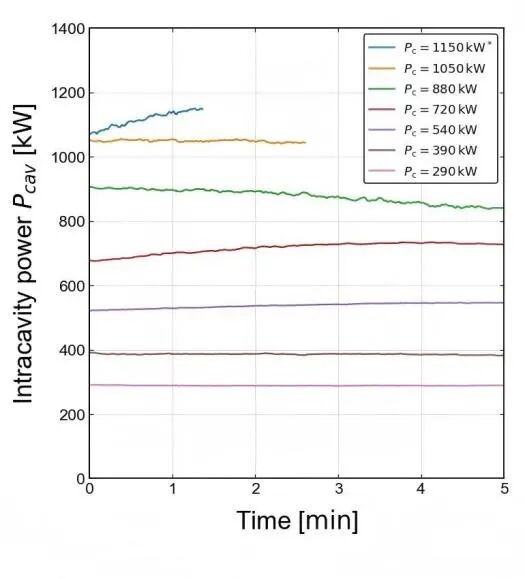
Figure 2 Variation of optical cavity laser power under different injection laser powers
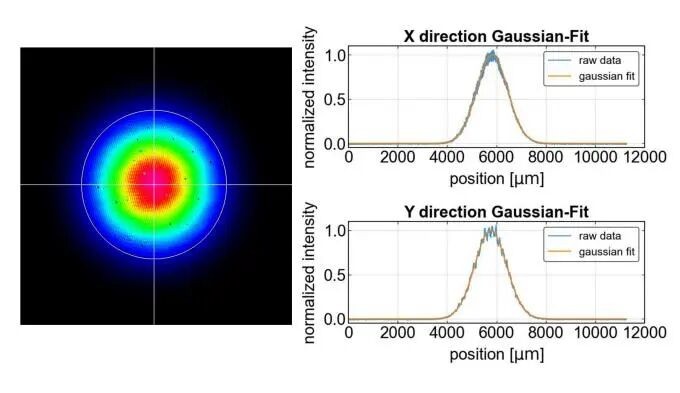
Figure 3 Beam mode measured on the transmission path when the intracavity average power is 1.15 MW
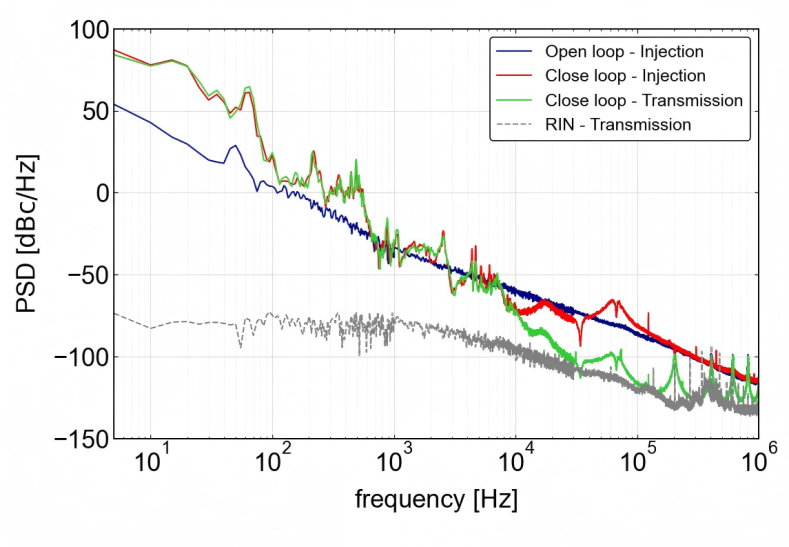
Figure 4 Measurement results of phase noise and relative intensity noise of the injection laser and intracavity laser when the intracavity average power is 500 kW
The research results were published under the title "Beyond a megawatt of average power in a high-finesse optical enhancement cavity" in Optica on September 12, Beijing time.
Zhao Yan and Yang Zhou, doctoral students from the Department of Engineering Physics at Tsinghua University, and Alice Renaux, a doctoral student from IJCLab at Université Paris-Saclay, France, are the co-first authors of the paper. Professor Yan Lixin and Dr. Liu Xing (currently at Xiong'an Guochuang Center Technology Co., Ltd.) from the Department of Engineering Physics at Tsinghua University are the co-corresponding authors. The paper authors also include Huang Yutong, Lu Xinyi, Tian Qili, Ronic Chiche, Kevin Dupraz, Aurelien Martens, Fabian Zomer, Professor Huang Wenhui, and Professor Tang Chuanxiang, among other researchers. The research was jointly funded by the Beijing Universities Outstanding Young Scientists Program, the National Key Research and Development Program, and the National Natural Science Foundation of China.
Disclaimer: Information republished from partner media, institutions or other websites is provided for reference and communication purposes only. It does not imply endorsement of its views or verification of its accuracy. Please contact us if any content infringes rights or requires correction.