

South Korea to Reconsider Accident Management Plans for Four Units at Gori and Hanbit
On September 11, 2026, the Nuclear Safety and Security Commission of South Korea held its 14th meeting of 2026 to review the accident management plans and operating change license applications submitted by Korea Hydro & Nuclear Power (KHNP) for Gori Nuclear Power Plant Units 3 and 4 and Hanbit Nuclear Power Plant Units 1 and 2. The meeting failed to reach a final conclusion and decided to refer the relevant agenda items to the next meeting for continued deliberation. The accident management plan mainly includes the scope of nuclear power plant accident management, management facilities, management strategies, and training programs. For nuclear power units with long operating lives, approval of this plan is generally regarded as an important prerequisite for subsequent discussions on continued operation licenses....
2026-09-12
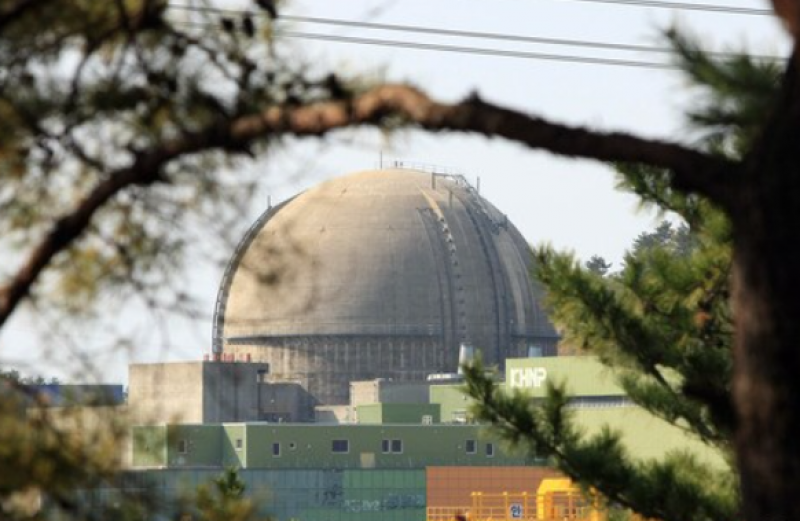
Hanbit Unit 2 in South Korea Shut Down as Operating License Expires, Four Nuclear Units Temporarily Off the Grid
On September 11, 2026, Hanbit Nuclear Power Plant Unit 2 in Yeonggwang County, South Jeolla Province, South Korea, stopped generating electricity as its 40-year operating license expired. Korea Hydro & Nuclear Power (KHNP) said the same day that the generator of Hanbit Unit 2 was disconnected from the grid at 10 a.m., after which it entered a phase of routine inspection and planned preventive maintenance. Hanbit Unit 2 began commercial operation on September 12, 1986. Previously, Hanbit Unit 1 had been shut down in December 2025 for the same reason. With this, about 1.9 gigawatts of installed capacity from Hanbit Units 1 and 2 has temporarily withdrawn from the grid. In addition to Kori Units 3 and 4, which have already been shut down due to license expiration and are awaiting subsequent review decisions...
2026-09-11
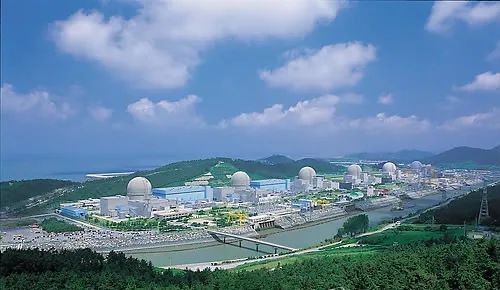
South Korea's Hanbit Nuclear Power Plant Unit 2 Shut Down Upon Expiration of Design Lifespan
South Korea's Hanbit Nuclear Power Plant Unit 2 will cease operation upon the expiration of its 40-year design lifespan. Following the shutdown of this unit, two of the six units at the Hanbit plant will have been taken offline due to reaching the end of their design lifespans. Unit 2 of the Hanbit plant received its operating license on September 12, 1986, and commenced commercial operation on June 10, 1987. Based on a 40-year design lifespan, the unit's operating license remains valid until September 11, 2026. The operator plans to conduct periodic inspections and planned preventive maintenance after the unit is shut down. In accordance with relevant regulations, once a unit reaches the end of its design lifespan, it may not resume operation until its application for continued operation is approved, and it must undergo legally required inspections and maintenance, and...
2026-09-09

South Korean civic groups oppose construction of spent fuel storage facility at Hanbit Nuclear Power Plant site
On September 4, the Joint Action Organization Against Hanbit Nuclear Power Plant in the Honam region of South Korea held a press conference in front of the high-level radioactive waste forum venue in Gochang County, North Jeolla Province, demanding the cancellation of plans to build a storage facility at the Hanbit Nuclear Power Plant site and proposing fundamental measures to address nuclear waste issues. The organization stated that Korea Hydro & Nuclear Power (KHNP) is pushing forward with the construction of temporary storage facilities at the plant site on the grounds that the spent fuel pools at Hanbit Nuclear Power Plant may reach saturation by 2030. The organization argued that this move fails to adequately respond to the opinions of residents near the plant and amounts to unilaterally shifting the burden of nuclear waste onto the local community. The organization stated that the current plan involves building storage facilities at the existing nuclear power plant site...
2026-09-06
Non-compliant Welding Procedures at Two Units of South Korea's Hanbit Nuclear Power Plant
The Hanbit Nuclear Power Plant headquarters of Korea Hydro & Nuclear Power Co., Ltd. (KHNP) recently confirmed that Units 1 and 2 of the plant had used welding procedure specifications (WPS) that had not undergone impact testing during maintenance of the component cooling water heat exchangers. A retrospective inspection found that among 14 repair activities conducted since the relevant heat exchangers were replaced in 2007, 6 cases involved similar non-compliance. The issue was identified during the 28th planned preventive maintenance outage of Hanbit Unit 1. Inspections revealed that some welding procedure specifications used for repairs to the water chambers of the component cooling water heat exchangers did not meet requirements, involving repair work on worn areas inside the heat exchanger water chambers in the cooling systems of Units 1 and 2. Hanbit Nuclear...
2026-09-04
Dry Spent Fuel Storage Facility Planned at Hanbit Nuclear Power Plant in South Korea
Korea Hydro & Nuclear Power (KHNP) held a resident briefing session on August 25 at the Hongnong-eup Community Center in Yeonggwang-gun, South Jeolla Province, to introduce its plan to build an on-site interim spent fuel storage facility at the Hanbit Nuclear Power Plant. Approximately 200 residents from villages near the plant, along with officials from Yeonggwang-gun and Korea Electric Power Corporation (KEPCO), attended the meeting, which proceeded in an orderly manner. KHNP stated that the existing wet spent fuel storage pools at Hanbit Nuclear Power Plant have reached 86% capacity and are expected to approach saturation by 2030, necessitating the construction of a new on-site storage facility. According to the plan, the proposed facility will be located within the Hanbit Nuclear Power Plant site, covering approximately 7,328 square meters, and will employ dry storage methods for interim spent fuel storage...
2026-08-26
Magnitude 3.1 Earthquake in South Korea Does Not Affect Safety of Nuclear Facilities
On August 23, the Nuclear Safety and Security Commission (NSSC) of South Korea reported that at 6:43 a.m. that day, a magnitude 3.1 earthquake occurred approximately 21 kilometers northwest of Haenam County, South Jeolla Province, South Korea. It was confirmed that all nuclear reactors and related nuclear facilities in South Korea were operating stably, with no abnormalities detected. The nuclear facility closest to the epicenter was the Hanbit Nuclear Power Plant, approximately 83.2 kilometers away. The peak ground acceleration recorded at this plant during the earthquake was 0.0032g, far below its seismic design basis of 0.2g, and it is expected that the safety of the facility will not be affected. The Hanbit Regional Office of the NSSC has conducted emergency safety inspections at the Hanbit Nuclear Power Plant site...
2026-08-24
Korea Advances Construction of Temporary Spent Fuel Dry Storage Facility at Hanbit Nuclear Power Plant
Korea Hydro & Nuclear Power (KHNP) is advancing the construction of a temporary spent fuel storage facility at the Hanbit nuclear power plant site. The company recently launched an information session process for local residents, planning to collect opinions through briefings and discussion meetings. According to the schedule, three briefing sessions will be held on the 25th and 26th of this month in Yeonggwang County, South Jeolla Province. The first session is set for 2:00 PM on the 25th at the Hongnong Community Center, with the other two held at 10:00 AM and 3:00 PM on the 26th at the Gunam-myeon Multipurpose Center and Starlight Hotel, respectively. Following the briefings, a discussion meeting will be held on the 1st of next month at 2:00 PM at the Starlight Hotel, with Korea Electric Power Corporation (...
2026-08-21
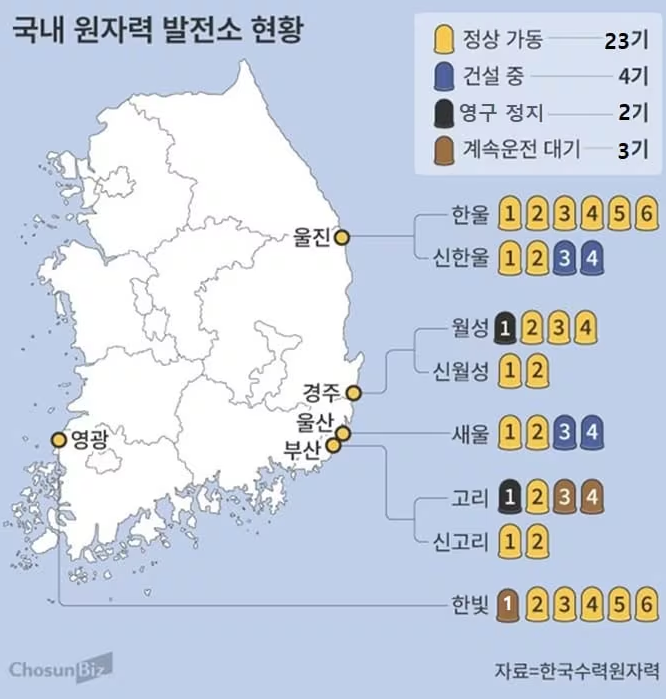
Sea Temperature Approaching Shutdown Threshold, Nuclear Power Belt on South Korea's East Coast Faces Load Reduction Pressure
Climate change is pushing nuclear power plants on South Korea's east coast toward new operational boundaries. South Korean nuclear plants generally rely on seawater as cooling water; after the heat generated by the reactor drives the turbine, seawater is needed to condense the steam back into water. Once the intake water temperature approaches or exceeds the design seawater temperature set by the equipment, heat exchange efficiency declines, affecting the heat dissipation capacity of key safety systems, and the plant must reduce load or even shut down in accordance with safety regulations. The area currently at greatest risk is around Uljin in North Gyeongsang Province. Data from the National Institute of Fisheries Science shows that nearshore surface seawater temperatures along parts of the east coast have approached 30°C, with multiple observation points near Uljin recording approximately 29.6°C to 30.2°C on the afternoon of August 7.
2026-08-10
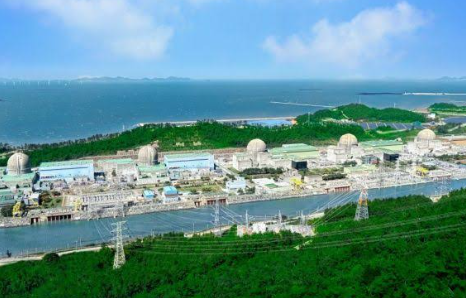
Hanbit Nuclear Power Plant launches 24-hour drone monitoring and strengthens no-fly zone publicity
The Hanbit Nuclear Power Headquarters of Korea Hydro & Nuclear Power (KHNP) recently conducted a special no-fly zone publicity campaign regarding illegal drone flights around the nuclear power plant. The campaign was held on July 27-28 at Gamame and Gusipo beaches near the Hanbit Nuclear Power Plant, focusing on educating summer tourists and drone users about flight control regulations around the plant. The publicity was jointly promoted by the Hanbit Nuclear Power Headquarters together with Yeonggwang Police Station, Gochang Police Station, Mokpo Maritime Police Station, Buan Coast Guard Station, volunteer fire brigades, and beach operators. Personnel at the site explained to visitors the drone flight restrictions around the nuclear power plant, consequences of violations, and precautions...
2026-08-08

Yeonggwang Fire Station in South Jeolla Province, South Korea, visited Hanbit Nuclear Power Plant to strengthen the disaster response coordination system.
On August 6, Lee Min-seok, Chief of Yeonggwang Fire Station in South Jeolla Province, led a team of 10 commanders and working-level personnel, including the head of the Prevention Safety Division and the captain of the Field Response Unit, to visit the Hanbit Nuclear Power Plant Headquarters of Korea Hydro & Nuclear Power, a Class A national critical facility, for an on-site inspection and special check aimed at establishing a rapid and effective initial response system in the event of a disaster. The visit placed particular emphasis on the unique characteristics of nuclear power facilities, with the goal of consolidating the coordination system with KHNP's self-defense fire brigade and enhancing the disaster response capabilities of field commanders. At the site, the fire station confirmed the status of major fire protection facilities and firefighting equipment at the nuclear power plant, inspected access routes and fire water supply facilities for fire and disaster situations, toured major power generation facilities, and reviewed disaster response routes. Discussions were also held on the linked response system and cooperation plans with KHNP's self-defense fire brigade.
2026-08-06

South Korea Accelerates Safety Reviews of Long-Term Operating Nuclear Reactors and Advances Licensing of First Spent Fuel Dry Storage Facility
The Nuclear Safety and Security Commission (NSSC) of South Korea stated at its second-half work report meeting on August 4 that it will accelerate safety reviews of long-term operating nuclear reactors while simultaneously advancing regulatory efforts such as licensing systems for spent fuel dry storage facilities and small modular reactors. Under the plan, the NSSC will conduct safety inspections on nine reactors applying for continued operation, with review standards referencing newly built nuclear power plants and confirming safety margins in consideration of the characteristics of long-term unit operation. Among these, whether Kori Nuclear Power Plant Units 3 and 4 will be approved for continued operation in the second half of this year, and whether Hanbit Nuclear Power Plant Units 1 and 2 will be approved for continued operation in the first half of next year, are the near-term review priorities...
2026-08-05
Reading Ranking
- 1 Hanbit Unit 2 in South Korea Shut Down as Operating License Expires, Four Nuclear Units Temporarily Off the Grid
- 2 South Korea to Reconsider Accident Management Plans for Four Units at Gori and Hanbit
- 3 Hanbit Nuclear Power Plant launches 24-hour drone monitoring and strengthens no-fly zone publicity
- 4 Yeonggwang Fire Station in South Jeolla Province, South Korea, visited Hanbit Nuclear Power Plant to strengthen the disaster response coordination system.
- 5 Non-compliant Welding Procedures at Two Units of South Korea's Hanbit Nuclear Power Plant
- 6 South Korean civic groups oppose construction of spent fuel storage facility at Hanbit Nuclear Power Plant site
- 7 Korea Advances Construction of Temporary Spent Fuel Dry Storage Facility at Hanbit Nuclear Power Plant
- 8 South Korea's Hanbit Nuclear Power Plant Unit 2 Shut Down Upon Expiration of Design Lifespan
- 9 South Korea Accelerates Safety Reviews of Long-Term Operating Nuclear Reactors and Advances Licensing of First Spent Fuel Dry Storage Facility
- 10 Sea Temperature Approaching Shutdown Threshold, Nuclear Power Belt on South Korea's East Coast Faces Load Reduction Pressure
- 11 Magnitude 3.1 Earthquake in South Korea Does Not Affect Safety of Nuclear Facilities
- 12 Dry Spent Fuel Storage Facility Planned at Hanbit Nuclear Power Plant in South Korea