
Sea Temperature Approaching Shutdown Threshold, Nuclear Power Belt on South Korea's East Coast Faces Load Reduction Pressure
 Scan to share
Climate change is pushing nuclear power plants on South Korea's east coast toward new operational boundaries. South Korean nuclear plants generally rely on seawater as cooling water; after the heat generated by the reactor drives the turbine, seawater is needed to condense the steam back into water. Once the intake water temperature approaches or exceeds the design seawater temperature set by the equipment, heat exchange efficiency declines, affecting the heat dissipation capacity of key safety systems, and the plant must reduce load or even shut down in accordance with safety regulations.
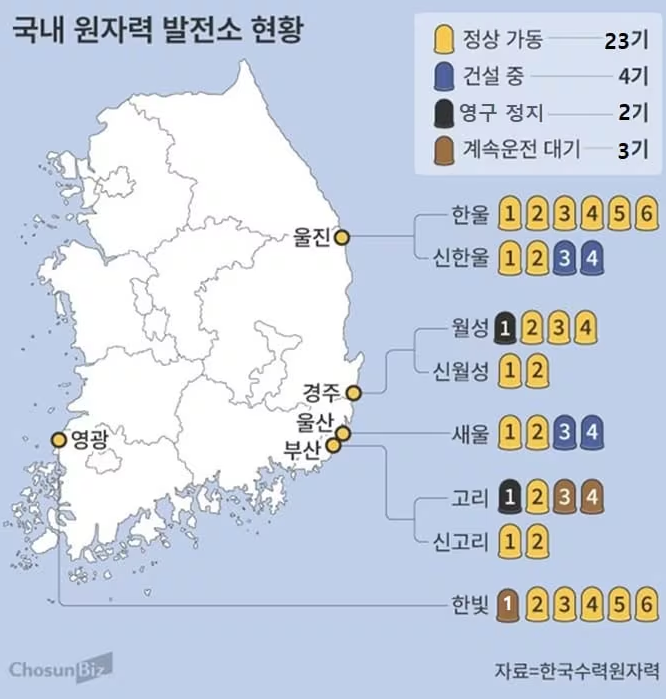
The area currently at greatest risk is around Uljin in North Gyeongsang Province. Data from the National Institute of Fisheries Science shows that nearshore surface seawater temperatures along parts of the east coast have approached 30°C, with multiple observation points near Uljin recording approximately 29.6°C to 30.2°C on the afternoon of August 7. Uljin is home to eight operating reactors—Hanul Units 1 through 6 and Shin-Hanul Units 1 and 2—and the design seawater temperatures for these units mostly range between 31°C and 32.5°C, leaving a narrow margin above current high seawater temperatures.
A greater concern is that some nuclear power plants were built during a period when the East Sea was colder, and the variable of long-term seawater temperature rise was not fully considered at the time, resulting in relatively low equipment limit settings. The design seawater temperature for Shin-Wolseong Units 1 and 2 is also only 31.5°C. Although surface seawater temperature is not identical to the cooling water temperature measured at a plant's intake pipe—deeper and offshore seawater is typically colder—the sustained rise in surface temperatures indicates that the overall marine thermal environment is changing, and the seasonal operational pressure on nuclear plants will increase accordingly.
The primary response currently adopted by Korea Hydro & Nuclear Power is to raise the design seawater temperature ceiling by enhancing cooling system performance. For example, Shin-Wolseong Units 1 and 2 have added heat exchanger plates to improve heat dissipation capacity and have pushed for regulatory re-evaluation of seawater temperature limits. Hanbit Units 1 through 6 also plan to improve heat exchanger facilities by 2029. Under current procedures, when cooling water temperature enters within 3°C below the design temperature, monitoring must be intensified; once the limit is exceeded, load reduction or shutdown procedures are initiated.
Experts believe that such measures are more of a phased remedy than a fundamental solution. As seawater temperatures continue to rise, the densely distributed nuclear units along the east coast may face consecutive load reduction risks during high-temperature seasons, affecting the stability of power supply. However, some argue that abnormal seawater temperatures are not year-round and can be flexibly managed through technological upgrades, operational scheduling, and output control. South Korea's nuclear safety regulatory authorities have begun inspecting relevant instrumentation, heat exchanger performance, and on-site emergency procedures, indicating that ocean warming is transforming from an environmental issue into a real test of nuclear power operational safety and energy supply resilience.
Disclaimer: Information republished from partner media, institutions or other websites is provided for reference and communication purposes only. It does not imply endorsement of its views or verification of its accuracy. Please contact us if any content infringes rights or requires correction.