
Behind India's Nuclear Power Expansion: Where Does Radioactive Waste Go? Government Details Management Process in Parliament for First Time
 Scan to share
India is rapidly advancing its nuclear power expansion, but the safe disposal of radioactive waste is the least-publicized challenge. The government has for the first time detailed in Parliament how it handles hazardous waste. In a written reply, the Department of Atomic Energy disclosed that all nuclear power plants in India generate an average of 0.15 cubic meters (approximately 150 liters) of solid radioactive waste per megawatt (MW) of capacity annually, including waste from operational and decommissioning phases, equivalent to about 1.5 household bathtubs in volume; radioactive waste quantities and disposal records are regularly reported to the Atomic Energy Regulatory Board (AERB).
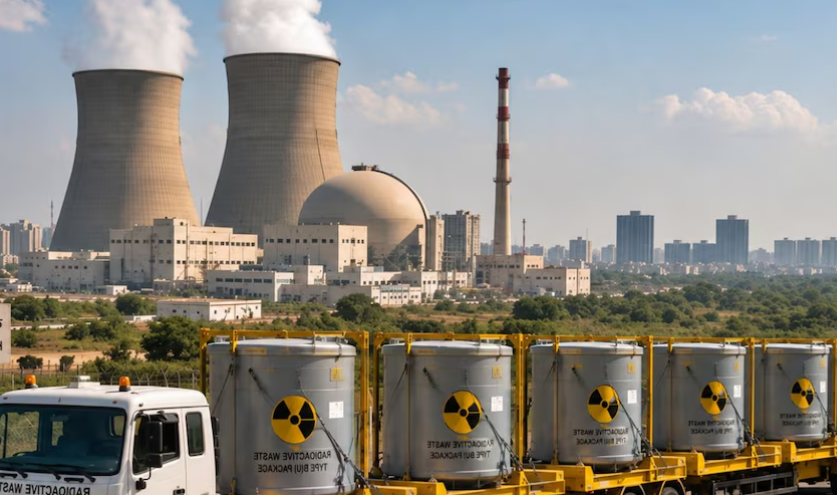
The operation and maintenance of nuclear power plants generate various types of radioactive waste, including spent filter cartridges, protective clothing, tools, equipment, and other items that come into contact with radioactive materials. Waste is categorized into three types—gaseous, liquid, and solid—each with distinct treatment and disposal methods: gaseous waste is purified and discharged only after meeting standards; liquid waste undergoes scientific purification processes; solid waste is volume-reduced by category and safely disposed of. No waste may be released into the environment without regulatory approval. Solid radioactive waste is stored in specially constructed stone-lined trenches, reinforced concrete channels, and tiled boreholes, employing multiple barrier systems to prevent the leakage of radioactive materials, with continuous site monitoring and regular testing of surrounding borewells to prevent contamination of drinking water.
The government explained that radioactive waste is treated as soon as it is generated and is never directly discharged into the environment. India adopts a closed nuclear fuel cycle, in which spent fuel undergoes reprocessing to extract useful materials such as uranium and plutonium, leaving only high-level radioactive waste for long-term safe storage. The United States employs a once-through fuel cycle, where spent fuel is first stored in pools and then transferred to special dry storage casks, with no permanent disposal facility built to date. Finland has gone further by building the world's first permanent nuclear waste repository, Onkalo, located approximately 430 meters underground, where spent fuel is stored in copper-lined specialized canisters with multi-layered bentonite clay protection, designed to remain safe for thousands of years. The government stated that although radioactive waste management remains out of public view, it will determine the success or failure of India's nuclear power program—not only in terms of clean electricity generation, but also in the safe disposal of hazardous waste and the maintenance of public trust.
Disclaimer: Information republished from partner media, institutions or other websites is provided for reference and communication purposes only. It does not imply endorsement of its views or verification of its accuracy. Please contact us if any content infringes rights or requires correction.