
228 Research Reactors Worldwide in Operation, Supporting Medical Isotope Production and Neutron Science Innovation
 Scan to share
According to the International Atomic Energy Agency on August 7, research reactors continue to drive innovation in science, medicine, and industry worldwide. Currently, 228 research reactors are in operation across 54 countries, with another 23 under construction or in the planning stage. Unlike nuclear reactors used for power generation, these reactors primarily produce neutrons to support medical, industrial, agricultural, geological, forensic, and nuclear science research.
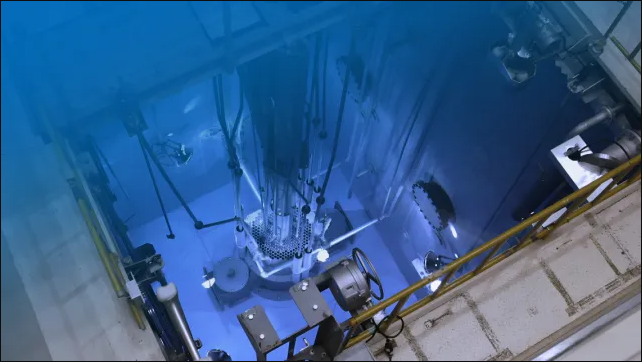
A research reactor pool photographed from above. (Photo: IAEA)
In the medical field, research reactors are a vital source of medical radioisotopes. Among them, technetium-99m is widely used for diagnosing cancer and diseases of the heart, brain, and bones; a large number of medical diagnostic and therapeutic procedures worldwide rely on this isotope. Other radioisotopes such as iodine-131 are also used in the treatment of cancer and thyroid diseases. The IAEA states that radioisotopes produced by research reactors serve millions of patients globally and are an essential component of modern nuclear medicine systems.
In scientific research and industrial applications, neutrons produced by research reactors can be used for elemental analysis, materials development, structural analysis, and imaging. When combined with computed tomography, neutron imaging can generate three-dimensional images for inspecting materials and components such as turbine blades, batteries, hydrogen storage devices, and electronic components, as well as for studies of cultural heritage and paleontological remains. Through neutron irradiation experiments, researchers can also evaluate changes in material performance after irradiation, providing data to support the development of advanced nuclear fuels, fast neutron reactors, fusion reactors, and microreactors for space applications.
Research reactors are also used for training nuclear professionals. Countries can leverage research reactors to conduct hands-on training in reactor operation, safety procedures, radiation protection, and nuclear physics, building a pipeline of professionals for the development of nuclear science and technology. Through training courses, fellowships, expert reviews, and technical cooperation projects, the IAEA supports member states in enhancing their capabilities in research reactor planning, operation, safety management, and utilization.
In terms of specific projects, the IAEA has provided technical guidance, expert reviews, and training for Jordan's first multipurpose research reactor, which is used for elemental analysis, radioisotope production, and educational training. The Agency has also carried out support related to research reactor safety, operation, decommissioning, and utilization assessments in countries such as Morocco, Ghana, and Uzbekistan, and has provided technical expertise to countries advancing research reactor projects, including Kenya, Rwanda, and Uganda.
The IAEA notes that many research reactors have been operating safely for decades and continue to undergo modernization to improve performance, safety, and availability. The role of research reactors in healthcare, industrial innovation, scientific research, and talent development is becoming an important foundation for countries to utilize nuclear technology safely and effectively.
Disclaimer: Information republished from partner media, institutions or other websites is provided for reference and communication purposes only. It does not imply endorsement of its views or verification of its accuracy. Please contact us if any content infringes rights or requires correction.