
The Mecca Mutual Defense Agreement Opens a "Finance-Industry-Nuclear" Triad, with Nuclear Energy as an Energy Security Sub-route among Six Economic Pathways
 Scan to share
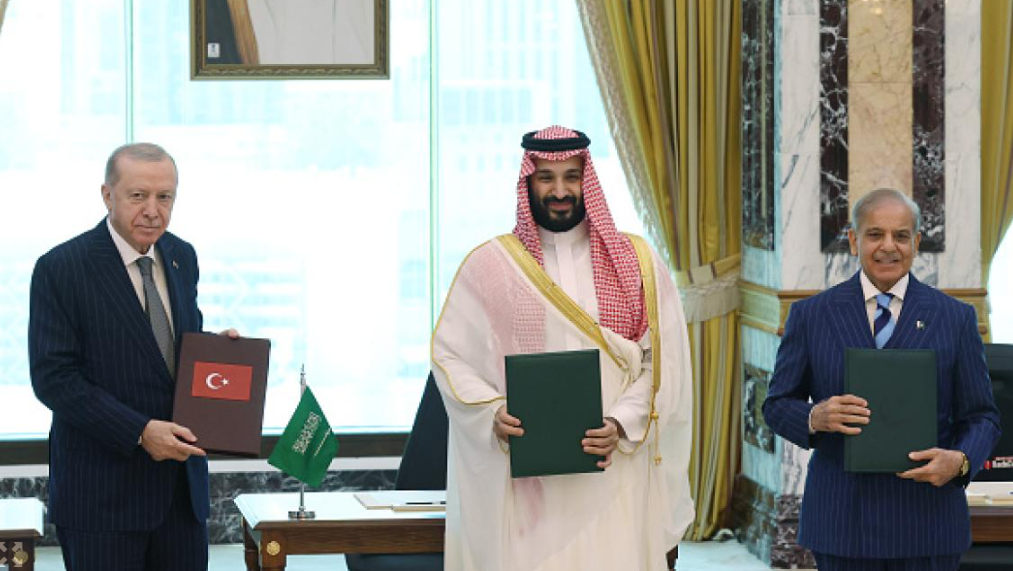 On August 7, Saudi Arabia, Turkey, and Pakistan signed the Mutual Defense Agreement in Mecca, attended by Saudi Crown Prince Mohammed bin Salman, Turkish President Erdogan, and Pakistani Prime Minister Shehbaz Sharif. The agreement binds Saudi financial weight + Turkish defense industry and manufacturing base + Pakistani nuclear and military experience into a single framework for the first time, stipulating that an armed attack on any one country is considered an attack on all, and covers joint defense industry, technology exchange, and training planning coordination. Saudi officials clarified that the agreement does not point to a military axis, religious bloc, or nuclear arms race, but rather to building self-sustaining capabilities.
The New Arab, citing analyses from IISS, Chatham House, and Reuters/AP, summarized six economic pathways the agreement could open: defense industry localization, expanded two-way investment, energy security, trade corridors and supply chains, advanced manufacturing and technology transfer, and trilateral economic integration. Among these, the "energy security" pathway directly touches nuclear energy—Saudi Arabia relies on stable oil exports, while Turkey and Pakistan depend on energy imports; after disruptions to shipping in the Strait of Hormuz and the Red Sea, protecting critical energy infrastructure becomes a core motive. An IISS study from February 2026 noted that the September 2025 Saudi-Pakistani strategic defense agreement already intended to revitalize bilateral trade and investment; Turkey's inclusion expands the scope to advanced technology, engineering, logistics, and R&D, with nuclear cooperation potentially incorporated as a "civilian energy security + technology transfer" sub-item. However, the Mecca text contains no specific provisions on reactors, SMRs, uranium supply, or Section 123 agreement terms.
AP quoted Pakistani defense analyst Abdullah Khan as saying the agreement upgrades traditional defense cooperation into an "institutional partnership," with the most realistic economic spillover being deepened weapons and technology R&D rather than large-scale troop deployment. Verisk Maplecroft's Kinnear assessed that Saudi capital will flow into new production lines, R&D, and technology transfer in Turkey and Pakistan, forming a trilateral value chain. In this chain, nuclear energy is not the protagonist but one thread in the "energy security" basket—alongside the previously cited "Colombia's $1 billion security package with a passing mention of civilian nuclear" and "Paraguay's ANDE openness to SMRs," it remains at the level of policy-listing mentions, with no sites, no licenses, and no financing mechanisms.
Disclaimer: Information republished from partner media, institutions or other websites is provided for reference and communication purposes only. It does not imply endorsement of its views or verification of its accuracy. Please contact us if any content infringes rights or requires correction.