
Sophelio Launches Fusion Equilibrium Challenge, Opening DIII-D and MAST Experimental Datasets
 Scan to share
On August 11, Sophelio launched the "Fusion Equilibrium Challenge." The competition has been accepted into the 2026 Conference on Neural Information Processing Systems (NeurIPS) competition track, making it the first fusion energy-related challenge to enter this track.
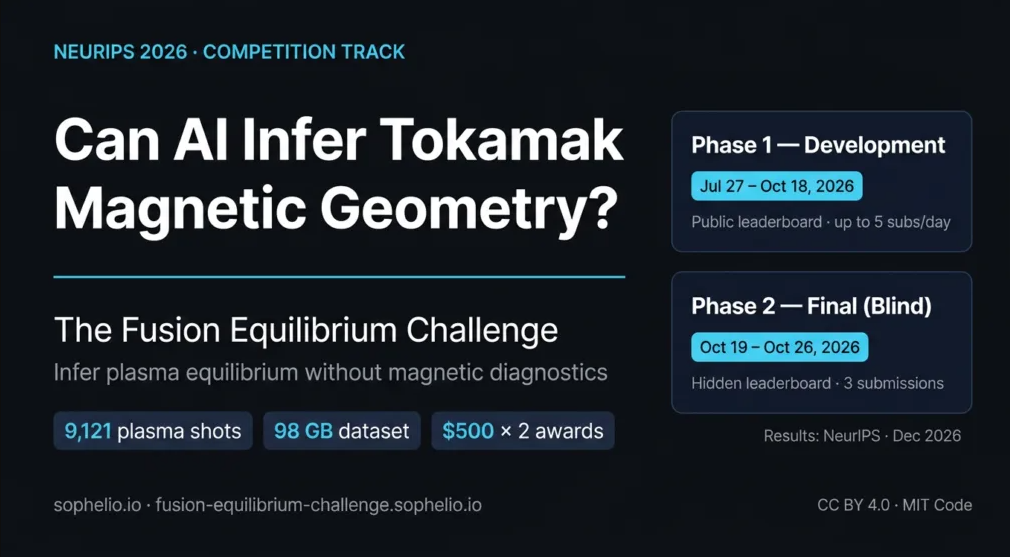
The challenge is co-organized by Sophelio together with the DIII-D National Fusion Facility, the UK Atomic Energy Authority (UKAEA) FAIR-MAST project, and the Institute for Fusion Studies (IFS) at the University of Texas at Austin, with data hosted on the Hugging Face platform. Open to the global machine learning community, the competition requires participants to reconstruct the magnetic structures that cannot be directly observed in confined fusion plasmas using only non-magnetic diagnostic measurements.
The organizers noted that future reactor-grade fusion devices, such as ITER, SPARC, ARC, and the China Fusion Engineering Test Reactor (CFETR), will operate in high neutron flux environments. Such environments may degrade the performance of traditional magnetic sensors, while field integrator drift during long-pulse operation can also compromise the reliability of magnetic measurements. Therefore, performing equilibrium inference when magnetic diagnostics are unavailable, degraded, or constrained is regarded as one of the key issues for future fusion power plant operation.
The challenge focuses on whether machine learning models can reconstruct the magnetic field geometry of confined plasmas—including the full two-dimensional poloidal flux map ψ(R,Z) and key equilibrium parameters—relying solely on non-magnetic features such as poloidal field coil currents and Thomson scattering electron profiles. Progress in such methods could help reduce the dependence of future reactor-grade fusion systems on complex magnetic diagnostics and support more simplified diagnostic operation schemes.
The open dataset released for this challenge is published under the CC BY 4.0 license and contains data from 9,121 plasma discharges across two experimental tokamak devices. Of these, 7,915 come from the DIII-D National Fusion Facility in San Diego, and 1,206 come from MAST device data released through the UKAEA FAIR-MAST project.
The competition will also examine a cross-device question: whether machine learning models can only learn device-specific correlations, or whether they can develop generalizable representations applicable across different geometries, diagnostic configurations, and operating conditions. This question has direct implications for the transferability of fusion equilibrium reconstruction models to future devices.
Craig Michoski, co-founder and CEO of Sophelio, stated that major advances in machine learning typically rely on open datasets and meaningful benchmarks, and the fusion field needs a similar transformation. By engaging AI researchers with real-world problems relevant to future reactors, the organizers hope to drive the co-evolution of machine learning and fusion energy research.
In addition to the released data, DIII-D, as an operational experimental facility, will continue its experimental campaigns. The project plans to schedule follow-up experiments targeting the weaknesses exposed by this challenge, with particular focus on diagnostic conditions where reconstruction models perform poorly.
Participants can use the free desktop platform data Fusion Labeler (dFL) developed by Sophelio to view each discharge in the dataset. The tool supports multimodal sensor data processing and can be used to inspect flux contours, Thomson scattering profiles, and diagnostic time series, helping participants understand data characteristics before modeling and evaluation.
Currently, Phase 1 of the competition is open, with a public Codabench leaderboard. Phase 2 is scheduled to launch in October 2026, with final results to be announced at NeurIPS 2026 in December 2026. Cash prizes will be awarded respectively to the best-performing in-device reconstruction model and the model with the strongest zero-shot cross-device generalization capability. Outstanding teams will also have the opportunity to be credited as co-authors on a competition summary paper and will be invited to present their research at the NeurIPS competition workshop.
Disclaimer: Information republished from partner media, institutions or other websites is provided for reference and communication purposes only. It does not imply endorsement of its views or verification of its accuracy. Please contact us if any content infringes rights or requires correction.