
US Oak Ridge National Laboratory Restarts Tungsten-188/Rhenium-188 Generator Production to Support Targeted Cancer Therapy Research
 Scan to share
The US Department of Energy's Oak Ridge National Laboratory (ORNL) recently restarted and upgraded its tungsten-188/rhenium-188 (W-188/Re-188) generator manufacturing operations to meet the demand for the rare medical isotope rhenium-188 in targeted cancer therapy research. The laboratory last manufactured such generators in 2011.
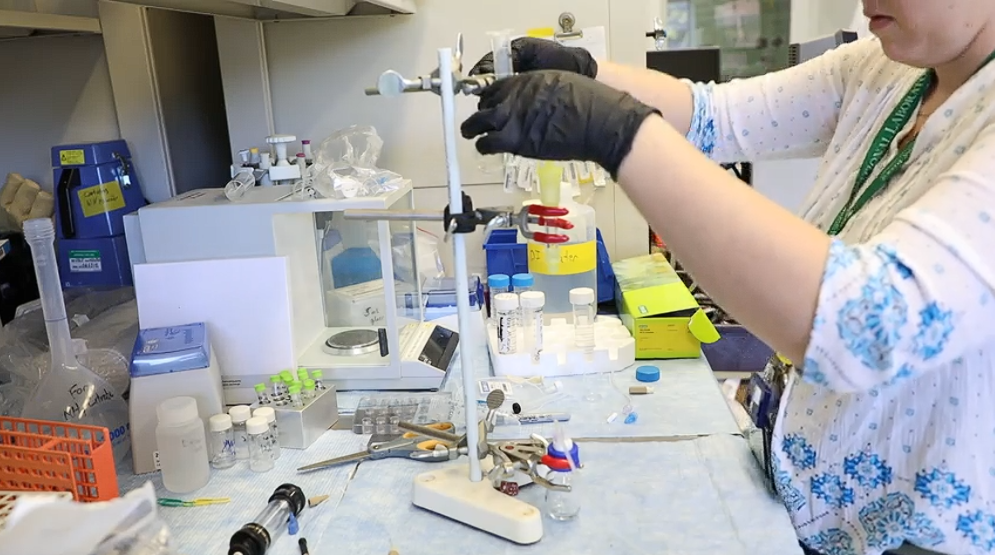
Radiochemist Becca Hores demonstrated the assembly process of the W-188/Re-188 generator. Depending on radioactivity levels, these generators must be assembled in gloveboxes or hot cells. Image credit: Maggie Gregg/Oak Ridge National Laboratory, US Department of Energy
Rhenium-188 is produced by the radioactive decay of tungsten-188. ORNL irradiates tungsten-186 in the High Flux Isotope Reactor (HFIR) to produce tungsten-188, which is then eluted from the generator to obtain rhenium-188. HFIR is a user facility of the US Department of Energy Office of Science and one of the key platforms for isotope production in the United States.
The research driving this demand comes from Vanderbilt University School of Medicine. Researchers are exploring a targeted therapy strategy for prostate cancer: using modified sodium/iodide symporter (NIS) to transport perrhenate containing rhenium-188, which is then directed to prostate tumors via polymer complexes. Data indicate that rhenium-188 is a beta-emitting isotope with strong tissue penetration capability and a relatively short half-life, which helps reduce potential impacts on surrounding healthy cells.
In mouse model experiments, the research team administered perrhenate containing rhenium-188 via intravenous injection. Preliminary results suggest that this approach appears capable of destroying tumors without observable significant adverse effects on other parts of the body following systemic administration. The researchers stated that the current results are encouraging, though further experiments are needed for validation.
ORNL Associate Radiochemist Becca Hores, who led the restoration of this generator technology, simplified and improved the original design. The new generator is a column-shaped device several inches tall, filled with filter material that captures tungsten-188 while allowing rhenium-188 to pass through, enabling users to elute rhenium-188 on demand. Depending on radioactivity levels, the generators must be assembled in gloveboxes or hot cells, but the finished products can be used in fume hoods, making them convenient for laboratory and clinical research institutions to operate.
Hores stated that tungsten-188 has a half-life of approximately 60 days, and a single generator is expected to be usable for one to one and a half years. Due to the relatively long half-life, this type of generator offers good transport adaptability and is expected to expand the supply of medical isotopes produced in the United States.
Currently, ORNL is providing related isotope products to customers through the National Isotope Development Center (NIDC). Previously, W-188 has been used in an approved epidermal radioisotope therapy for non-melanoma skin cancer overseas. As research on rhenium-188 in additional cancer treatment applications advances, ORNL expects to continue enhancing its generator manufacturing capabilities to support preclinical studies, clinical trials, and the development of new radiopharmaceuticals.
Disclaimer: Information republished from partner media, institutions or other websites is provided for reference and communication purposes only. It does not imply endorsement of its views or verification of its accuracy. Please contact us if any content infringes rights or requires correction.