
Japan's Nuclear Power Revival Enters Supply Chain Rebuilding Phase, with Spent Fuel and Engineering Capacity as Key Constraints
 Scan to share
As Japan advances energy security, reduces dependence on fossil fuel imports, and expands low-carbon electricity supply, the focus of the country's nuclear power market is shifting from mere reactor restarts to a comprehensive supply chain rebuild covering manufacturing, operations and maintenance, life extension, fuel cycle, and waste management.
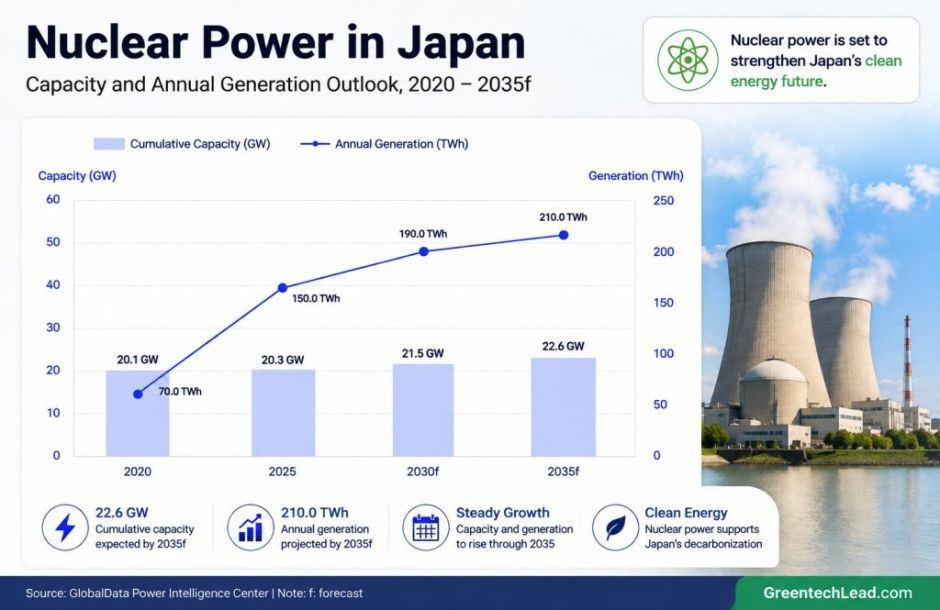
GlobalData estimates Japan's nuclear power generation at 101.0 TWh in 2025 and projects it to increase to 123.3 TWh by 2035. Japan's policy target is to maintain nuclear power at approximately 20% to 22% of the electricity generation mix. Based on total annual electricity demand of approximately 1,050 TWh, a 20% nuclear share corresponds to about 210 TWh, while a 22% share corresponds to about 231 TWh. Compared with the 2025 nuclear generation figure of 101.0 TWh, the estimated gap is approximately 109 TWh to 130 TWh.
Japan currently has 33 nuclear reactors with a total installed capacity of approximately 33.1 GW. By 2025, 15 reactors have been restarted, with a total installed capacity of approximately 14.6 GW; another 3 reactors have received regulatory approval and are advancing operational preparations; 6 reactors are still undergoing safety reviews; and some reactors remain offline due to regulatory, seismic, technical, and other uncertainties. In 2025, Japan's average nuclear capacity factor recovered to approximately 33.6%, the highest level since 2015, but there remains considerable room to fully unlock the generating capability of existing units.
The capacity factor will directly determine the actual effectiveness of Japan's nuclear power revival. Based on calculations, if 30 reactors operate at a 70% capacity factor, annual generation would be approximately 184 TWh; if increased to 80%, annual generation could reach approximately 211 TWh. If all 33 reactors operate, annual generation would be approximately 203 TWh at a 70% capacity factor and approximately 232 TWh at an 80% capacity factor. This means Japan not only needs more units to restart, but also needs simultaneous improvements in maintenance efficiency, outage management, fuel supply, and reliability of critical equipment.
The Kashiwazaki-Kariwa Nuclear Power Station, operated by TEPCO Holdings, is a key project in Japan's nuclear power recovery process. The plant has 7 units with a total installed capacity of approximately 8.2 GW, making it one of the largest nuclear power stations in the world by installed capacity. According to available data, Unit 6 of Kashiwazaki-Kariwa has a rated output of 1,356 MW, was restarted in January 2026, and entered commercial operation in April 2026. This is the first reactor to return to commercial operation at TEPCO since the Fukushima Daiichi accident. Unit 7 of Kashiwazaki-Kariwa also has a rated output of approximately 1,356 MW, and Units 6 and 7 together represent approximately 2.7 GW of potential nuclear capacity.
Beyond TEPCO, other utilities are also advancing reactor restarts. Hokkaido Electric Power's Tomari Unit 3 has an installed capacity of 912 MW, and Tohoku Electric Power's Onagawa Unit 2 has an installed capacity of 825 MW. Chugoku Electric Power's Shimane Unit 2, as well as units operated by Kansai Electric Power, Kyushu Electric Power, and Shikoku Electric Power, also constitute important components of Japan's nuclear power recovery. Meanwhile, Chubu Electric Power's Hamaoka Units 3 and 4 remain affected by regulatory and seismic safety concerns, demonstrating that nominal installed capacity does not equate to power supply capability that can be reliably committed to commercial operation.
Life extension of aging units is creating a long-term market. Kansai Electric Power operates multiple units at the Takahama, Ohi, and Mihama nuclear power stations, with Mihama Unit 3 and Takahama Units 1 and 2 having operated for more than 50 years. Such units require sustained investment for inspection of pumps, valves, electrical equipment, cooling systems, instrumentation and control systems, turbines, generators, and civil structures. Post-Fukushima safety requirements have also increased demand for emergency power supplies, seismic protection, containment improvements, hydrogen management, and severe accident mitigation equipment.
Manufacturing capacity is also emerging as a critical constraint. Japan Steel Works (JSW) plans to double its nuclear-related product capacity by fiscal year 2028 to meet demand for nuclear-grade components driven by existing reactor restarts and advanced nuclear projects. Due to the long manufacturing lead times and stringent certification requirements for nuclear equipment, supply chain expansion cannot be completed in the short term. The supply capacity of reactor components, turbines, generators, cooling technology, electrical systems, instrumentation, and other safety-critical equipment will influence the pace of Japan's nuclear power recovery.
Engineering talent availability could also become a bottleneck. Reactor restart and life extension projects require specialized capabilities in seismic analysis, safety assessment, regulatory documentation, equipment inspection, and modernization. If multiple utilities advance projects simultaneously, demand for nuclear engineers, inspectors, and safety experts could rise rapidly and outpace Japan's domestic talent development capacity.
In advanced nuclear energy, Japan's nuclear investment framework through 2040 is estimated at approximately 5 trillion yen, covering advanced reactors, small modular reactors, and nuclear supply chain rebuilding. Mitsubishi Heavy Industries is involved in nuclear equipment, engineering, maintenance, and advanced reactor development. Hitachi is also expanding its presence through Hitachi GE Vernova Nuclear Energy and the approximately 300 MW-class BWRX-300 small modular reactor project.
The back-end of the nuclear fuel cycle is another structural challenge facing Japan's nuclear power revival. Japan has accumulated approximately 1,450 tons of spent nuclear fuel, with relatively high spent fuel pool utilization rates at some major nuclear power stations. Spent fuel storage utilization rates at some Kansai Electric Power facilities are reportedly between 59% and 95%. Rising nuclear generation will add to spent fuel inventories, directly linking reactor utilization rates to storage, transport, reprocessing, and final disposal capabilities.
The Mutsu interim storage facility can provide approximately 3,000 tons of spent fuel storage capacity, offering utilities some relief from on-site storage pressure. However, interim storage is not a substitute for permanent disposal solutions; it only buys time for the development of reprocessing and geological disposal systems. The Rokkasho reprocessing plant, with a designed annual processing capacity of approximately 800 tons of uranium, is the core facility of Japan's closed nuclear fuel cycle strategy, but repeated project delays have increased uncertainty regarding the timing of reprocessing capacity deployment.
Japan has not yet built a permanent geological repository for high-level radioactive waste. Repository development involves geological surveys, environmental reviews, technical assessments, regulatory approvals, transport planning, and long-term community engagement, with timelines potentially spanning decades. In contrast, existing reactors can complete restart preparations in a relatively short period. The time gap between front-end generation capacity recovery and back-end waste disposal capacity development could affect the long-term sustainability of Japan's nuclear power operations.
GlobalData believes that opportunities in Japan's nuclear power market have expanded from reactor restarts to the entire value chain. Utilities need to increase generation output and capacity factors, manufacturers need to supply safety systems and replacement parts, engineering firms need to undertake seismic assessments, inspections, and compliance reviews, and fuel cycle companies need to advance storage, reprocessing, and waste management capacity development. Whether Japan can approach its 20% to 22% nuclear power target ultimately depends on whether its 33 reactors with a total installed capacity of 33.1 GW can generate sufficient electricity reliably, stably, and sustainably over the long term.
Disclaimer: Information republished from partner media, institutions or other websites is provided for reference and communication purposes only. It does not imply endorsement of its views or verification of its accuracy. Please contact us if any content infringes rights or requires correction.