
Thea Energy Completes Series B Extension to Advance Stellarator Fusion Plant Deployment
 Scan to share
Thea Energy, Inc. announced on August 18 that it has completed an extension of its Series B financing round, with new investors including Brevan Howard Macro Venture, Aloniq, ALJ Investments, Beyond Earth Ventures, and other global strategic investors. The company stated that the new funds will be used to advance the engineering and commercial deployment of its stellarator fusion technology.
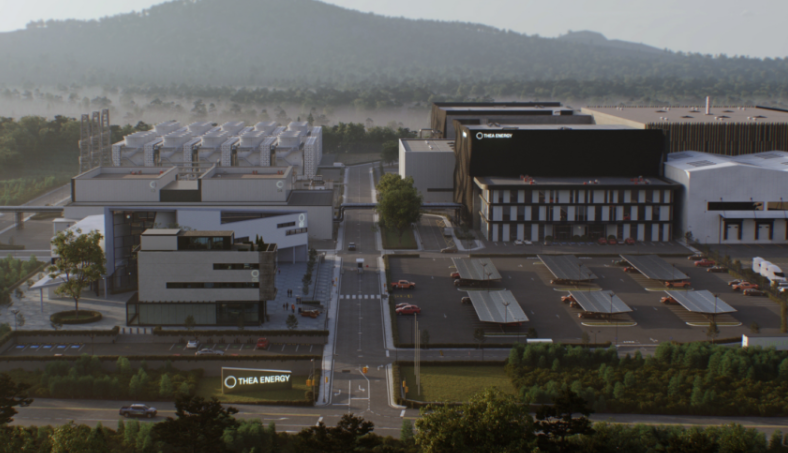
Thea Energy had previously announced the completion of a $100 million Series B round, led by the U.S. Innovative Technology Fund (USIT) under Thomas Tull. The funds are primarily intended to expand magnet manufacturing capacity, build a second facility in northern New Jersey, accelerate the construction of the integrated fusion system "Eos," and advance the commercial deployment of its first "Helios" fusion plant.
According to the company, the pre-conceptual design of the Helios fusion plant has been included in the U.S. Department of Energy (DOE) "Milestone-Based Fusion Development Program." Thea Energy stated that this design is one of its core architectures for commercial stellarator power plants.
Thea Energy co-founder and CEO Brian Berzin stated that the new investors bring commercialization expertise and will support the company in advancing its modular, AI-assisted technology roadmap. This roadmap is oriented toward large-scale manufacturing and continuous optimization, with a focus on the engineering scale-up of stellarator fusion systems.
The Brevan Howard Macro Venture team stated that Thea Energy's plant design, dynamically controlled magnets, and scaling roadmap were key reasons for its investment. The team believes that the practical value of fusion energy depends on whether power plants can maintain economic viability and reliability under real operating conditions, and that Thea Energy's software-defined fusion architecture, which it is exploring, aims to achieve scalable manufacturing and long-term operation.
Since announcing its Series B round, Thea Energy said it has made multiple advances. These include securing $20 million in support from the DOE's Advanced Research Projects Agency-Energy (ARPA-E), funded through the "SCALEUP" program, which will be used to expand the domestic U.S. production line for modular high-temperature superconducting magnets.
The company has also launched collaborations with NVIDIA, Synopsys, Argonne National Laboratory, and Princeton Plasma Physics Laboratory to develop a digital twin system for stellarators. Additionally, Thea Energy stated that magnets meeting Eos specifications have been verified to achieve the magnetic field strength and precision required for Eos, its large-scale integrated stellarator.
Thea Energy said it has evaluated multiple potential sites for the Eos project. Eos will employ a dynamic architecture with the goal of achieving steady-state fusion operation. The company also stated that it is in advanced discussions with power off-takers, hyperscale data center operators, and utility partners, who have expressed interest in obtaining scalable, high-availability fusion energy from Helios plants.
Founded in 2022 and incubated from technologies originating at Princeton University and Princeton Plasma Physics Laboratory, Thea Energy is focused on commercializing the planar coil stellarator architecture. The company states that its approach, built on mass-producible magnet arrays and dynamic software control systems, aims to reduce the engineering complexity of stellarator fusion systems and accelerate the commercial deployment of fusion energy.
Disclaimer: Information republished from partner media, institutions or other websites is provided for reference and communication purposes only. It does not imply endorsement of its views or verification of its accuracy. Please contact us if any content infringes rights or requires correction.