
Argonne National Laboratory Achieves Latest Research Progress in Advanced Reactor Passive Safety, Revealing Flow Characteristics of Reactor Cavity Cooling System Using NSTF Facility
 Scan to share
A research team at Argonne National Laboratory, under the U.S. Department of Energy (DOE), has achieved the latest research progress on passive shutdown decay heat removal mechanisms for next-generation advanced nuclear reactors. Under unplanned reactor shutdown or sudden emergency accident conditions, nuclear fuel continues to release decay heat. Ensuring continuous and reliable heat removal under complete power loss and without manual intervention is a core issue in the inherent safety design of Generation IV advanced reactors. The Argonne research team recently focused on the transient thermal-hydraulic response characteristics of key passive heat removal systems under realistic dynamic decay heat curves.
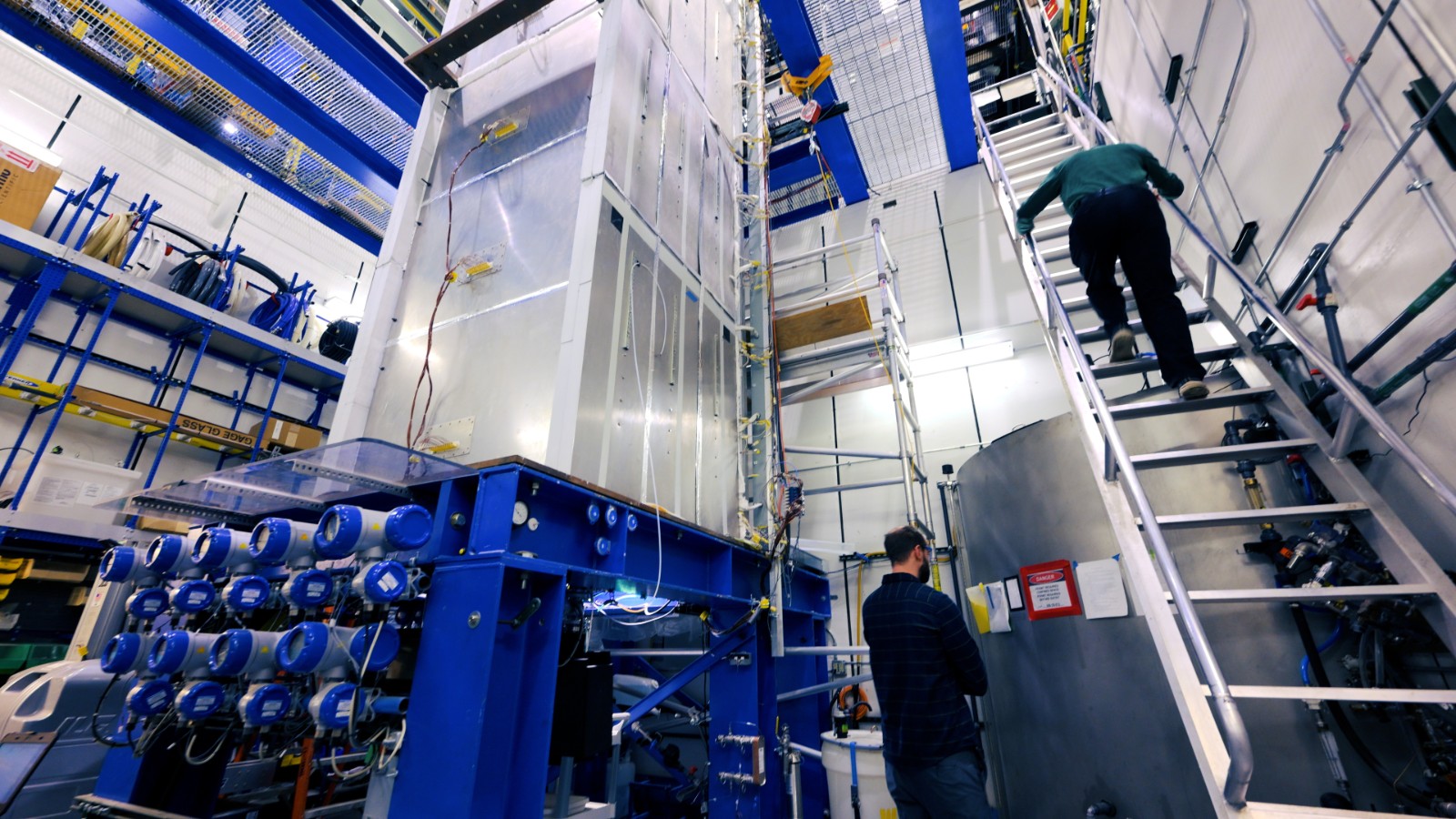
The subject of this investigation is the "Reactor Cavity Cooling System" (RCCS), which has been widely adopted by multiple advanced reactor development projects. The "Natural Convection Shutdown Heat Removal Test Facility" (NSTF) built by Argonne National Laboratory is currently the world's largest test platform for conducting full-scale and severe-condition mechanistic studies of this configuration. The RCCS system follows passive safety design principles, eliminating mechanical pumps and active control systems that are prone to failure under power loss conditions, and relies entirely on natural buoyancy-driven loop fluid circulation induced by gravity and density differences. Cooling water flows through metal piping networks arranged around the outside of the reactor pressure vessel, absorbs decay heat emitted from the reactor vessel wall, heats up and rises, then after cooling through elevated condensation or heat sinks, is driven by gravity to flow back, continuously transporting heat to a large elevated emergency water storage tank.
To address the boiling and two-phase co-existing flow challenges that may occur during long-term passive heat removal, researchers used the NSTF multi-level loop facility, which is 59 feet (approximately 18 meters) tall, to simulate gradient heat release scenarios across different decay power ranges of a full-scale reactor, and tested the effects of different main tank inlet elevations on circulation flux. The experiments clearly captured the key "Flashing" physical phase change mechanism: when heated water at the bottom of the loop flows upward through the riser section, as the hydrostatic pressure decreases, the fluid undergoes instantaneous local violent vaporization at the critical point of reaching saturation. This flashing phenomenon causes severe flow oscillations and surges in the steam-water two-phase flow within the loop, leading to localized transient cooling efficiency degradation and imposing additional hydraulic loads on pressure-bearing loop components.
Experimental data revealed that under lower power level decay heat conditions, the boiling and flashing phenomena propagating from the storage tank to the heat removal chimney in the NSTF test loop were significantly slowed. More critically, the relative installation height of the main tank inlet has a clear threshold boundary for flow stability. Tests showed that the "Mid-level inlet" design can effectively suppress large flow oscillations under multiple extreme conditions, providing a more stable passive natural circulation state. Qiuping Lu, a nuclear engineer at Argonne National Laboratory, stated that these quantitative mechanistic data provide highly valuable measured evidence for commercial advanced reactor development companies to optimize engineering design and prevent thermal two-phase hydrodynamic instabilities. This research is funded by the Advanced Reactor Technologies Program under the DOE Office of Nuclear Energy (DOE-NE).
Disclaimer: Information republished from partner media, institutions or other websites is provided for reference and communication purposes only. It does not imply endorsement of its views or verification of its accuracy. Please contact us if any content infringes rights or requires correction.