
China's Huanliu-4 High-Temperature Superconducting Magnet Development Roadmap Clarified
 Scan to share
On August 25, during the 2026 Fusion Energy Conference and Fusion Energy Activity Week, the Yangtze River Delta Innovation Consortium, led by China Fusion Energy Co., Ltd., has clarified its development targets for high-temperature superconducting high-field tokamak magnets: to build the first 25T high-temperature superconducting high-field magnet development and testing line by 2028, and to complete prototype magnet development by 2030.
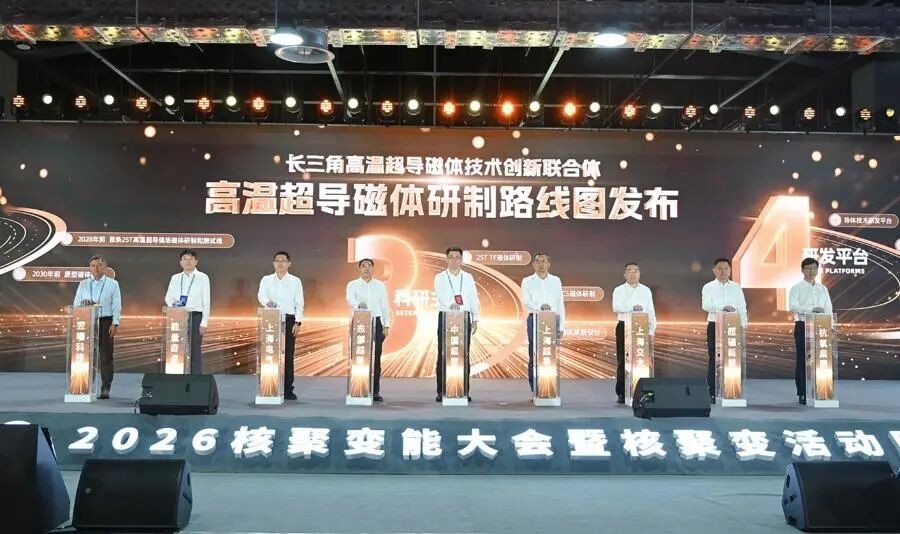
The consortium is led by China Fusion Energy Co., Ltd., with members including Shanghai Superconductor, Eastern Superconductor, Shanghai Jiao Tong University, Shanghai Electric Nuclear Power Group, Chaoci Xinneng, Energy Singularity, Hangyang Group, and Yixi Technology. The consortium will focus on building high-temperature superconducting high-field tokamak magnet development capabilities and engineering technology systems to provide key technical support for the subsequent construction of China's Huanliu-4.
China's Huanliu-4, being built by China Fusion Energy Co., Ltd., is the world's first high-temperature superconducting high-field steady-state burning plasma experimental platform. The device will systematically verify the reliability of 25T high-temperature superconducting high-field magnets under complex fusion environments. According to the plan, once the device is completed, the fusion gain Q value will exceed 5; when the Q value exceeds 1, it means that the fusion output energy exceeds the external input energy, achieving net energy gain.
High-temperature superconducting high-field magnets are one of the core components of magnetic confinement fusion devices, directly related to plasma confinement capability and the future engineering level of fusion reactors. A research report points out that in the key equipment cost structure of the International Thermonuclear Experimental Reactor (ITER), magnets account for 28%, making them the highest-cost single equipment category; the vacuum vessel, thermal shield, and cryostat together account for approximately 12%.
In recent years, global nuclear fusion investment has continued to grow, with China and the United States leading in investment scale in this field, and magnetic confinement technology routes have attracted widespread attention. In addition to China's Huanliu-4, the U.S. SPARC device and the UK's Spherical Tokamak for Energy Production (STEP) also adopt the high-temperature superconducting technology route. The development progress of high-temperature superconducting magnets will become an important indicator for assessing the engineering progress of fusion energy.
Disclaimer: Information republished from partner media, institutions or other websites is provided for reference and communication purposes only. It does not imply endorsement of its views or verification of its accuracy. Please contact us if any content infringes rights or requires correction.