
Japan's Helical Fusion Publishes Research Results on High-Temperature Superconducting Magnets
 Scan to share
Helical Fusion recently announced that its joint research on high-temperature superconducting magnets with the National Institute for Fusion Science (NIFS) has passed peer review and been published in the Journal of Physics: Conference Series. The results, previously disclosed in a preliminary report, primarily validate the performance of high-temperature superconducting conductors for fusion reactor applications under strong magnetic fields and high currents.
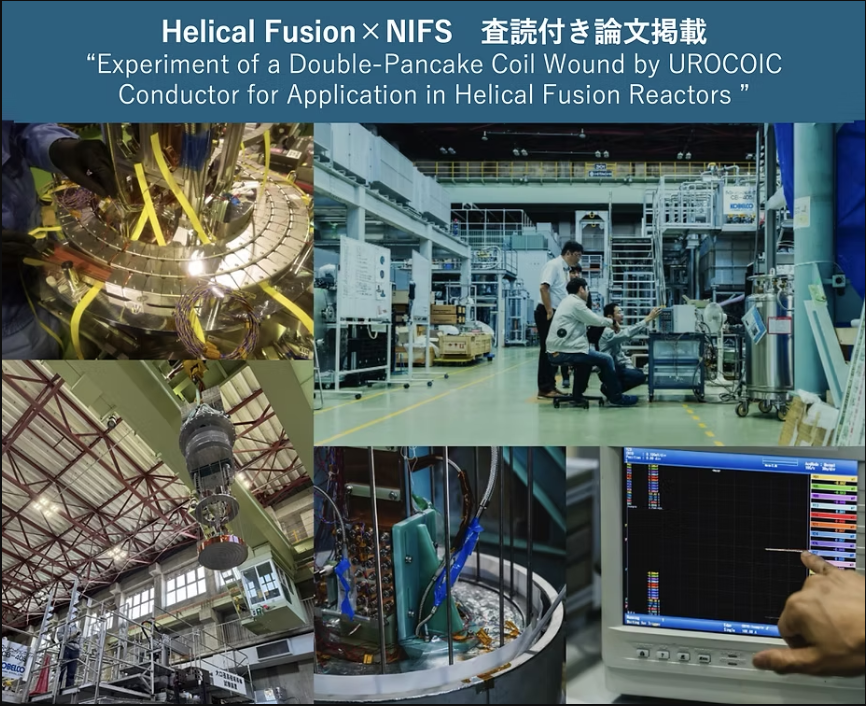
This study tested the UROCOIC high-temperature superconducting conductor independently developed by Helical Fusion. The research team fabricated the conductor into a "double-pancake coil" sample and used existing test equipment to simulate, as closely as possible, the magnetic field and current environment expected in future fusion reactors. The initial test temperature was 10 K, the external coil applied a magnetic field of 7 T, and the maximum local magnetic field experienced by the test coil reached 8.9 T.
The test results showed that the coil achieved a superconducting state with a current of 40 kA sustained for 280 seconds, while withstanding an 8.9 T local magnetic field and an electromagnetic force of 356 kN/m. The study also verified the self-protection characteristics of the no-insulation coil under rapid magnetic field changes and obtained relevant time constant data. Helical Fusion believes these results demonstrate that the UROCOIC conductor meets the conditions for subsequent validation on the Helix HARUKA integrated demonstration device.
The Helix project aims to develop a helical nuclear fusion power generation device. According to the company's roadmap, the project will complete individual validation of key technologies, including high-temperature superconducting magnets, blankets, and divertors, in the 2020s, and will conduct integrated demonstration using Helix HARUKA in the 2030s, while advancing the construction of the first power generation device, Helix KANATA.
High-temperature superconducting magnets are one of the core components of magnetic confinement fusion devices, serving to generate and maintain the strong magnetic fields required to confine ultra-high-temperature plasma. Compared with conventional superconducting technology, high-temperature superconducting magnets are expected to achieve higher magnetic field strengths in more compact devices, which is of significant importance for improving the efficiency and engineering feasibility of fusion power plants. Helical fusion devices have the potential for steady-state operation, but the three-dimensional helical structure makes magnet manufacturing more challenging; therefore, flexible high-temperature superconducting conductors and manufacturable coil technology are key to advancing engineering development.
This research was supported by the Small and Medium Enterprise Innovation Creation Promotion Program of Japan's Ministry of Education, Culture, Sports, Science and Technology (MEXT), and combined corporate R&D, research institution test platforms, and the manufacturing capabilities of Japanese fabrication companies. Helical Fusion stated that the next phase will advance the assembly of the developed coils and conduct integrated validation for the Helix HARUKA device.
Disclaimer: Information republished from partner media, institutions or other websites is provided for reference and communication purposes only. It does not imply endorsement of its views or verification of its accuracy. Please contact us if any content infringes rights or requires correction.