
Japan's JT-60SA Experimental Team Advances Preparations for Next Operation Phase
 Scan to share
Preparations for the next phase of JT-60SA experimental activities are underway. The technical team is carrying out integrated commissioning as planned, while the experimental team is simultaneously refining related tools and software to enhance scientific output capabilities for the next operation phase.
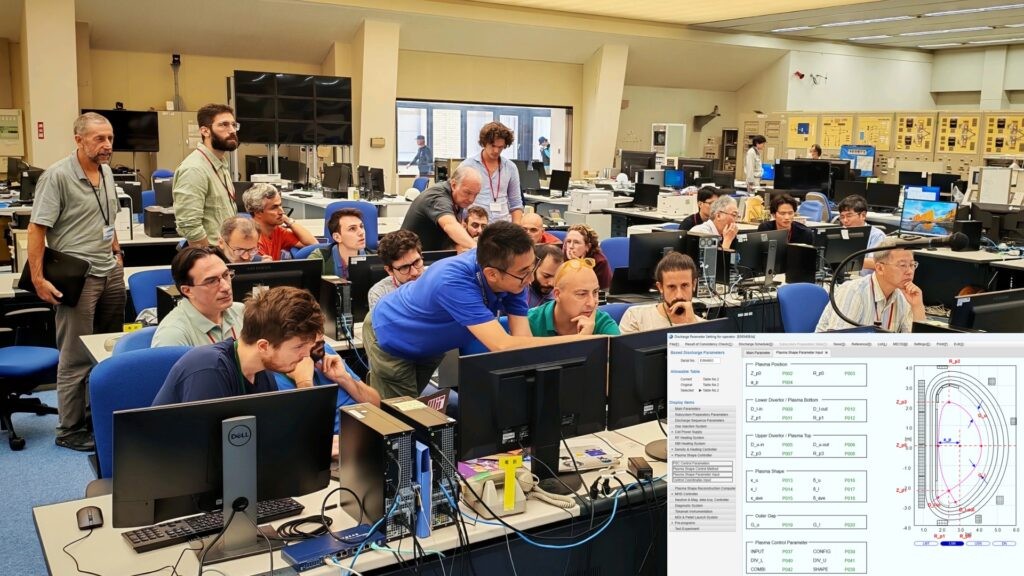
During a training course organized by QST, EUROfusion participants are learning how to configure discharge settings using the Human-Machine Interface (HMI) in preparation for the next JT-60SA campaign. Image credit: QST.
The Third JT-60SA Experimental Team Workshop was held from July 27 to 31, 2026, at the Naka Institute of the National Institutes for Quantum Science and Technology (QST) in Japan. Approximately 50 experts attended, including 20 representatives from Europe, coming from laboratories and universities associated with the European Consortium for the Development of Fusion Energy (EUROfusion) as well as the European Joint Undertaking for Fusion Energy (Fusion for Energy, F4E). The meeting focused on collaboration between European and Japanese research teams, experiment preparation, and technical exchange.
During the workshop, QST organized a training course for participants, focusing on the Human-Machine Interface (HMI) dedicated to JT-60SA experiment configuration. After QST experts completed their presentations, trainees entered the control room for hands-on practice, learning how to configure discharge parameters and use the HMI to prepare for subsequent experimental research. European participants completed the training under the guidance of the QST team, while providing feedback on HMI functionality and usability.
The European team also continues to contribute to the development of advanced numerical tools, providing support for the design of high-quality JT-60SA experiments. At the meeting, Domenico Frattolillo from the Swiss Federal Institute of Technology Lausanne (EPFL) and Carlo Sozzi from the Institute for Plasma Science and Technology (ISTP) of the Italian National Research Council (CNR) presented the features of the pulse design simulator. This platform can be used for the development, testing, and optimization of experimental and operational scenarios, which can be validated through simulation before implementation.
In addition to training, the workshop also discussed plasma control strategies, data analysis, and the work of JT-60SA topical groups. At the conclusion of the meeting, new trainees from EUROfusion and several Japanese universities presented reports, sharing their HMI training experiences and introducing the progress achieved during the workshop.
Maiko Yoshida of QST, one of the JT-60SA experiment leaders, stated that with the technical and scientific teams continuing to advance preparations, this workshop marks an important step for JT-60SA experimental activities toward the next phase. Yevgen Kazakov, the European experiment leader, noted that during the workshop, the European and Japanese teams conducted a two-way exchange centered on QST's HMI and analysis tools, as well as EUROfusion's analysis software and pulse design simulator, and that this kind of knowledge sharing is of great significance for the next phase of JT-60SA experiments.
Disclaimer: Information republished from partner media, institutions or other websites is provided for reference and communication purposes only. It does not imply endorsement of its views or verification of its accuracy. Please contact us if any content infringes rights or requires correction.