
U.S. HFIR Research Reactor Boosts Validation of New Nuclear Fuels
 Scan to share
The High Flux Isotope Reactor (HFIR) at the U.S. Department of Energy's (DOE) Oak Ridge National Laboratory (ORNL) is becoming a key facility in the U.S. research, development, and qualification system for new nuclear fuels. A research paper published on August 25 noted that amid growing demand for new commercial nuclear power and advanced reactor construction in the United States, research reactor resources available for new fuel testing are becoming strained, and HFIR is expected to help alleviate the shortage of related testing capabilities.
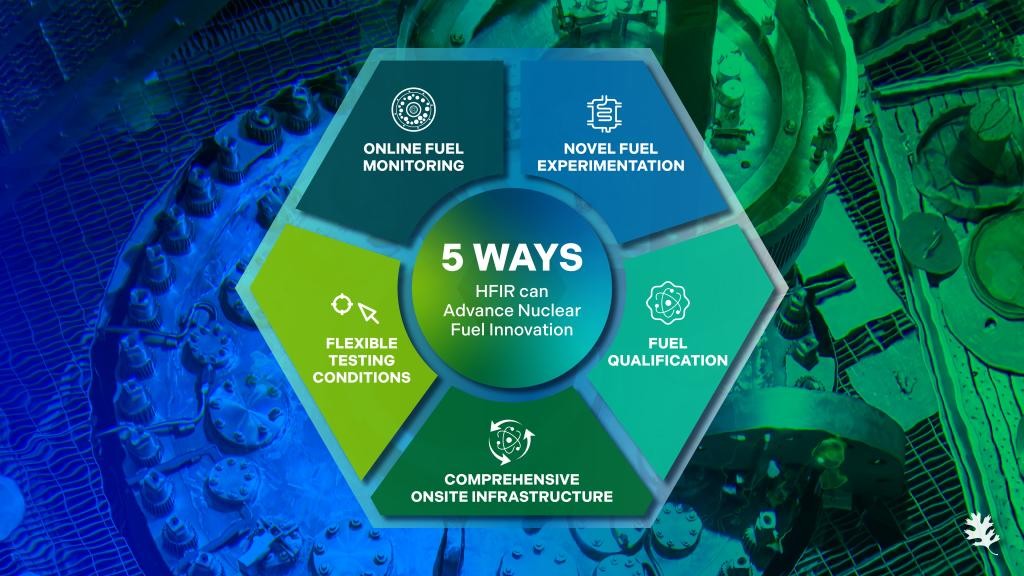
Image credit: Gunes Ozcan/Oak Ridge National Laboratory, U.S. Department of Energy
HFIR is one of the world's highest-flux steady-state research reactors and has long been used for nuclear fuel and materials irradiation testing. The paper argues that this reactor can provide important data needed to validate new fuels, supporting extended reactor lifetimes, improved operational efficiency, and the deployment of advanced reactor technologies.
In terms of testing adaptability, HFIR can accommodate a wide range of test conditions and experimental platforms. The reactor features three primary irradiation regions and can accommodate small "rabbit" irradiation capsules. These capsules have relatively short design, fabrication, and deployment cycles and can be placed in the reactor's central flux trap, exposing samples to the highest neutron flux levels. HFIR's removable beryllium reflector region and permanent beryllium reflector region can also support larger, more complex irradiation experiments, including tests equipped with instrumentation, sensors, or thermal neutron shields to tailor the neutron flux spectrum.
In fuel development, Oak Ridge National Laboratory has long utilized HFIR for separate-effects tests and integral fuel tests. The reactor has played a significant role in the development of high-temperature gas-cooled reactor fuel architectures, particularly research on tristructural isotropic (TRISO) fuel particles. Recently, researchers have also conducted experiments based on the MiniFuel concept, irradiating accident-tolerant fuels (ATF), coated fuel particles, and metallic fuels, among others. These efforts complement the extensive fuel cladding irradiation experiments conducted in HFIR's flux trap.
HFIR's modernization efforts have further enhanced its instrumented experiment capabilities. Through the Materials Irradiation Facility (MIF), ORNL can regulate temperature using controlled sweep gas mixtures and independently control multiple temperature zones within a single experiment. Automated monitoring systems continuously track temperature, pressure, and gas composition, and support remote real-time monitoring and adjustment of experimental parameters by researchers. These capabilities have been applied to fission gas release testing of TRISO fuel during irradiation, demonstrating that HFIR can simultaneously support multiple complex high-flux experiments.
The paper also notes that fuel performance data obtained from HFIR can provide a technical basis for the U.S. Nuclear Regulatory Commission (NRC) in nuclear fuel qualification. These data cover key performance indicators such as fission gas release, microstructural evolution, and fuel-cladding interaction, and can be used to validate fuel performance, support safety analyses, and provide a foundation for technical reports related to regulatory reviews of new fuels.
The ORNL campus where HFIR is located also hosts a relatively complete suite of nuclear fuel examination and analysis facilities, including the Coated Particle Fuel Development Laboratory, the Low Activation Materials Development and Analysis Laboratory, the Irradiated Fuel Examination Laboratory, and the Irradiated Materials Examination and Testing facility. Leveraging these facilities and ORNL's long-accumulated fuel development expertise, HFIR has formed a comprehensive testing platform covering fuel fabrication, irradiation, examination, and analysis.
The research concludes that as utilities push to extend the lifetimes of existing reactors and advanced reactor developers accelerate commercialization, HFIR will continue to play an important role in rapidly acquiring high-quality fuel data and advancing fuels from the conceptual stage to regulatory certification. The research was supported by the Advanced Fuels Campaign of the U.S. Department of Energy's Office of Nuclear Energy.
Disclaimer: Information republished from partner media, institutions or other websites is provided for reference and communication purposes only. It does not imply endorsement of its views or verification of its accuracy. Please contact us if any content infringes rights or requires correction.