
Czech nuclear power plants largely unaffected by summer heat and drought
 Scan to share
The Czech State Office for Nuclear Safety (SÚJB) stated on August 26 that this summer's heat waves and drought only caused a slight decline in electricity generation at the Temelín and Dukovany nuclear power plants, without leading to reactor power reduction or raising nuclear safety concerns. Currently, both plants meet the conditions for safe operation, including adequate cooling and water supply guarantees.
SÚJB noted that some European nuclear power plants reduced output or temporarily shut down during high-temperature periods, mainly due to their cooling methods. Some plants use once-through cooling, making their operation directly affected by river water temperature and flow rate. When water temperatures rise and river flows are low, plants may reduce electricity generation due to environmental discharge limits, and in special cases may also shut down.
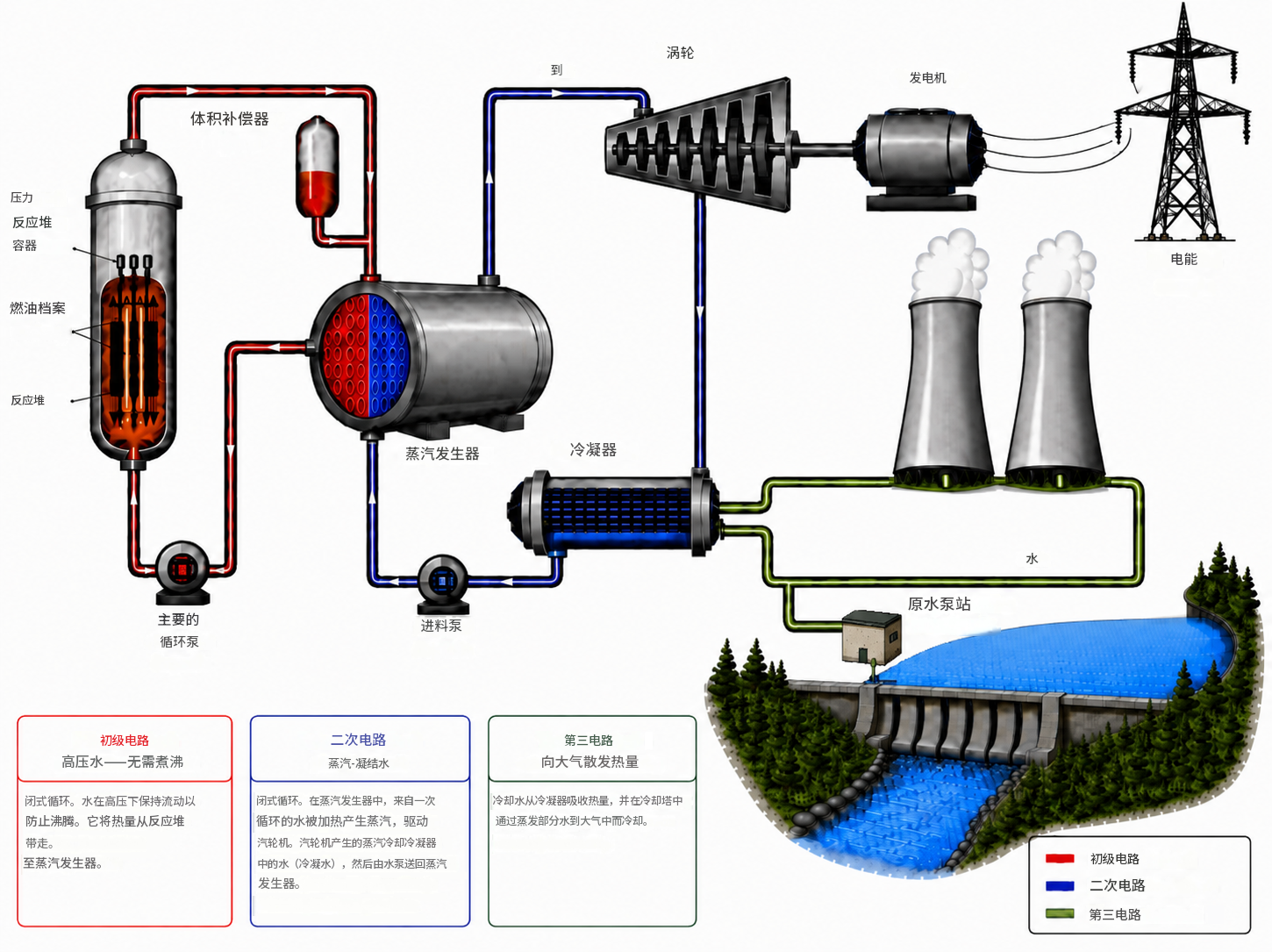
Both Czech nuclear power plants use cooling tower systems. Cooling towers do not directly cool the reactor; instead, they dissipate heat from the condensers in the non-nuclear island portion of the plant. The white clouds commonly seen above cooling towers are not smoke but water vapor and fine water droplets. Since cooling water is recirculated in the system and excess heat is released into the atmosphere through evaporation in the cooling towers, plant operation is relatively less affected by external water body temperature and instantaneous flow variations.
High temperatures still have a certain impact on power generation efficiency. When cooling water temperature rises, the condensation effect of turbine exhaust steam decreases slightly, thereby reducing the power generation efficiency of the non-nuclear portion of the plant. However, this change does not limit reactor thermal power and does not constitute a nuclear safety issue.
Regarding water supply, the Dukovany nuclear power plant relies on the Dalešice Reservoir on the Jihlava River, while the Temelín nuclear power plant uses the Hněvkovice Reservoir on the Vltava River. The Vltava River basin also includes the Lipno No. 1 Reservoir as a long-term water regulation source. SÚJB pointed out that the Vltava River flow in the Temelín plant area is significantly higher than the Jihlava River flow near the Dukovany plant; therefore, the water supply guarantee capacity of the two plants cannot be simply compared based on individual reservoir capacity alone.
According to SÚJB, during this year's heat waves and drought, both plants maintained adequate water supply without any output reduction due to water shortage. Since the Dukovany and Temelín nuclear power plants began operation, there has never been a case of unit power reduction or shutdown caused by insufficient water supply.
SÚJB emphasized that nuclear power plant operation must be premised on safety. If cooling conditions could affect the safe operation of the reactor, the operator must take conservative measures, such as reducing reactor power or shutting down the reactor in advance. The plant's automatic protection systems are also designed according to this principle. SÚJB maintains resident inspectors at both plants to continuously supervise nuclear facility operations, with special attention paid during high-temperature weather to parameters that may be affected, such as cooling water temperature.
Disclaimer: Information republished from partner media, institutions or other websites is provided for reference and communication purposes only. It does not imply endorsement of its views or verification of its accuracy. Please contact us if any content infringes rights or requires correction.