
Rock Fusion AI Platform Streamlines the Entire Stellarator Design Workflow
 Scan to share
Recently, the AI agent collaboration platform for stellarator design independently developed by Rock Fusion has achieved full coverage of the entire design workflow, encompassing key stages such as zero-dimensional parameter design, plasma configuration optimization and performance analysis, as well as coil engineering feasibility assessment. The company stated that the platform can search over a thousand initial configurations and hundreds of thousands of coil schemes, reducing the typical design iteration cycle from several weeks to several days.
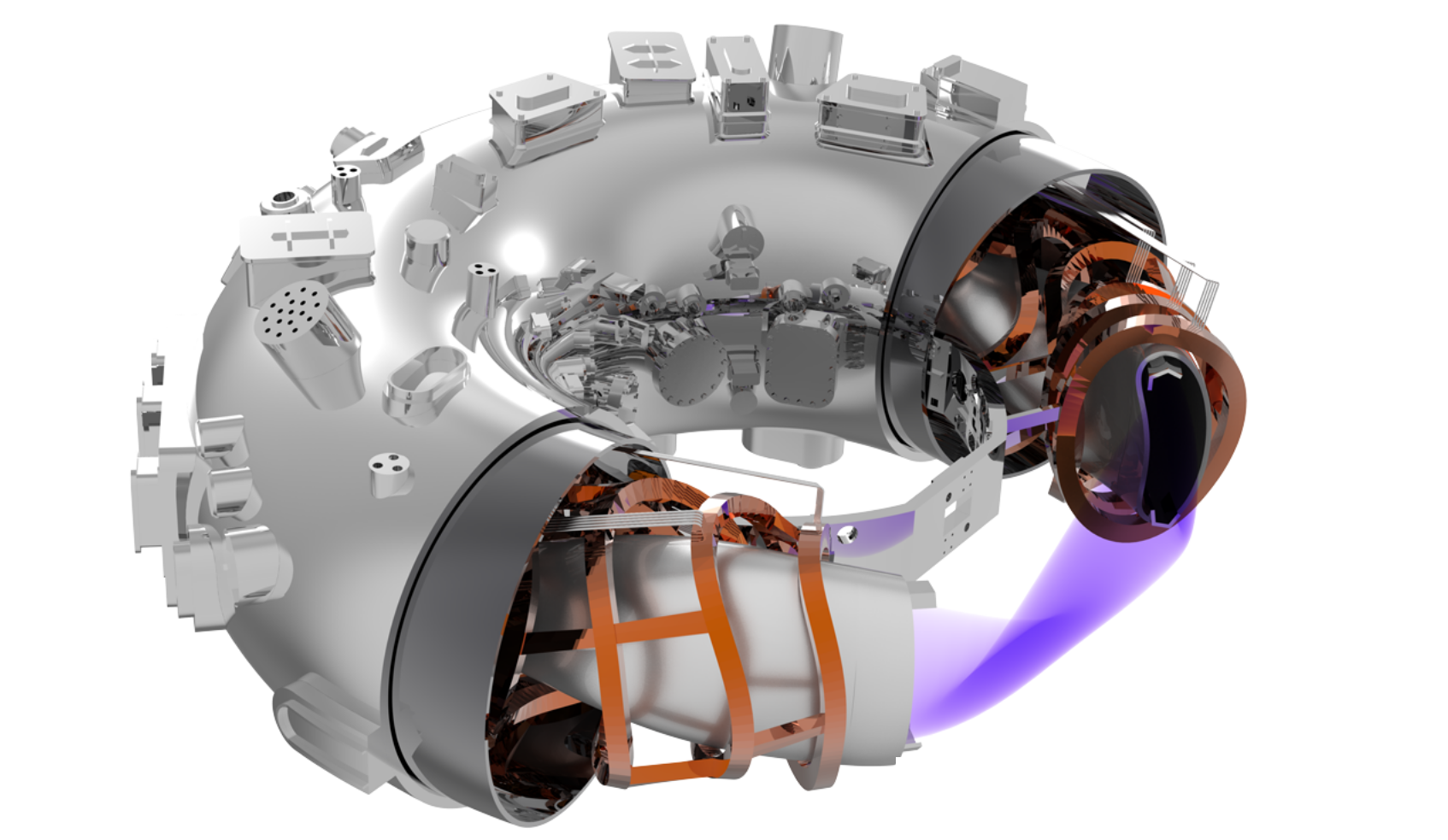
Rock Fusion stellarator concept image
Leveraging this platform, Rock Fusion has completed the full-machine physics design of a medium-sized superconducting stellarator with a major radius of 2 meters and a central magnetic field of 3 tesla. Design work for the company's other devices under development is also being advanced on the same platform.
Stellarators rely on external three-dimensional coils to directly generate helical magnetic fields, eliminating the need to sustain magnetic confinement through plasma current. This mechanism inherently reduces the risk of major disruptions faced by tokamaks and offers the potential for long-pulse steady-state operation. In 2025, Germany's Wendelstein 7-X (W7-X) stellarator achieved significant progress in the "triple product" metric during long-duration discharges, drawing greater attention to the stellarator route.
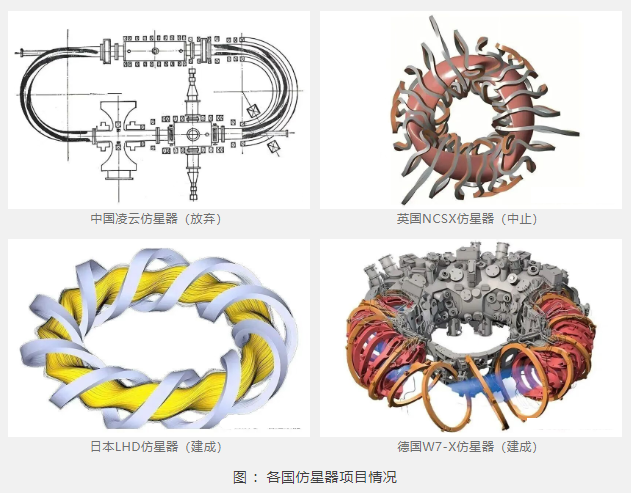
However, stellarators have long faced challenges in both physics design and engineering manufacturing. On one hand, three-dimensional plasma equilibrium calculations are complex and computationally intensive, leading to lengthy configuration optimization and validation cycles. Taking W7-X as an example, its scientific preparation began in the 1980s, and first plasma was achieved at the end of 2015—a process spanning more than three decades. On the other hand, the manufacturing of three-dimensional shaped magnets is highly demanding. According to available data, China's "Lingyun" stellarator was abandoned due to failure to meet magnetic field precision requirements, while the U.S. National Compact Stellarator Experiment (NCSX) was terminated in 2008 due to excessive magnet costs. Currently, Japan's Large Helical Device (LHD) and Germany's W7-X are the representative superconducting stellarator devices that have been successfully constructed.
The approach adopted by Rock Fusion involves deploying specialized AI agents at each stage of the design chain, coordinated through a unified platform. The platform integrates candidate scheme generation, optimization search, solver invocation, result verification, and physics assessment into a parallelizable computational workflow, reducing the repeated back-and-forth between physics design and engineering evaluation typical of traditional approaches.
In the zero-dimensional design stage, the platform starts from device objectives and performs optimization calculations on overall parameters such as size, magnetic field, energy gain, and confinement time, providing baseline parameters for subsequent configuration and coil design. In the configuration optimization stage, the team employs the SQuID quasi-isodynamic (QI) configuration design method and conducts cross-validation based on internationally mainstream stellarator computation and optimization tools including DESC, VMEC, and SIMSOPT. The company reports that under multi-dimensional objective functions, the magnetic field distributions obtained from different solvers show a high degree of consistency.
In the coil optimization stage, the platform directly incorporates coil manufacturability as a constraint, jointly optimizing coil geometric complexity, curvature, and spatial relationships while controlling magnetic field errors. Rock Fusion states that the platform has so far searched and screened hundreds of thousands of coil schemes, and can reconstruct the plasma configuration from the actual magnetic fields produced by candidate coils, then automatically conduct physics re-verification. Only schemes that pass configuration, coil, and physics performance checks simultaneously proceed to the next stage.
According to the company's introduction, the entire AI design workflow remains led by the stellarator physics team. How optimization objectives are defined, how physics constraints are set, whether computational results are credible, and whether candidate schemes can be advanced—all are reviewed and decided by researchers. AI agents primarily handle large-scale search and process execution tasks. Under this model, overall iteration efficiency has improved by more than 10 times, and the scale of candidate schemes and computational tasks that can be processed concurrently within the same R&D cycle has increased by 1 to 2 orders of magnitude.
Currently, Rock Fusion's engineering team is fabricating prototype three-dimensional superconducting coils. Subsequently, the physics team will determine the final configuration and coil scheme from multiple candidate options based on the actual manufacturing difficulty and cost of the prototype coils. As the physics design cycle shortens, the competitive focus of stellarator device development will further shift toward engineering capabilities such as high-precision three-dimensional superconducting magnet manufacturing.
Disclaimer: Information republished from partner media, institutions or other websites is provided for reference and communication purposes only. It does not imply endorsement of its views or verification of its accuracy. Please contact us if any content infringes rights or requires correction.