
Gyeongsangbuk-do lawmakers demand stronger nuclear power plant accident notification and oversight
 Scan to share
On September 3, Gyeongsangbuk-do lawmaker Kim Jae-jun spoke at the 365th provisional session of the Gyeongsangbuk-do Council, criticizing the delayed notification and inadequate response to the recent boric acid solution leak at Unit 6 of the Hanul Nuclear Power Plant, and calling for stronger resident safety protection mechanisms in areas with concentrated nuclear power plants.
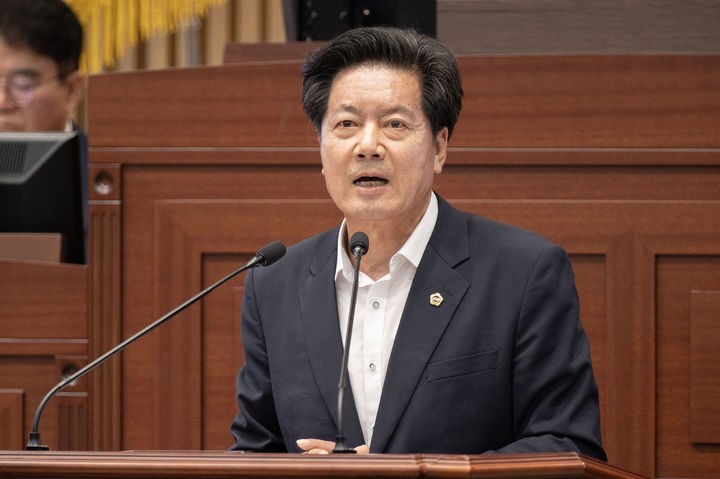
Kim stated that on August 3, a boric acid solution containing radioactive materials leaked from Unit 6 of the Hanul Nuclear Power Plant during spent fuel transfer, but local residents were not informed of the incident until approximately three weeks after it occurred. He argued that Korea Hydro & Nuclear Power (KHNP) failed to disclose information about the incident promptly and transparently, undermining residents' trust in nuclear safety management.
He also noted that last year, Unit 2 of the Shin-Hanul Nuclear Power Plant sparked controversy over delayed notification of a high radiation alarm and radioactive gas release event. Although relevant authorities pledged at the time to prevent similar problems from recurring, similar controversy emerged again just over a year later, indicating that gaps remain in accident notification and on-site response mechanisms.
Kim emphasized that whether radioactive impacts occur and whether residents should be promptly informed of accident information are two separate issues. He argued that the foundation of nuclear safety management lies in the rapid and transparent disclosure of abnormal situations, and that even for minor incidents, surrounding residents should be kept informed of the facts in a timely manner.
According to data from the Nuclear Safety and Security Commission (NSSC), over the past 10 years, the number of failures and incidents at nuclear power plants in Gyeongsangbuk-do has ranked among the highest of all nuclear power plant host regions in South Korea. Among them, the Hanul Nuclear Power Plant recorded 26 cases and the Wolsong Nuclear Power Plant recorded 23 cases. Kim pointed out that 13 of South Korea's 26 operating nuclear reactor units are located in Gyeongsangbuk-do, and the region bears a relatively high level of nuclear safety risk, which should be matched with corresponding safety monitoring and accident response systems.
Kim recommended that South Korea revise relevant regulations to require that abnormal conditions and minor incidents at nuclear power plants be disclosed to the public without exception, while also granting Gyeongsangbuk-do the authority to independently conduct nuclear power plant monitoring and on-site investigations. He also called for measures to prevent the recurrence of human error and for the relocation of nuclear safety-related agencies to Gyeongsangbuk-do, where nuclear power plants are most concentrated.
Disclaimer: Information republished from partner media, institutions or other websites is provided for reference and communication purposes only. It does not imply endorsement of its views or verification of its accuracy. Please contact us if any content infringes rights or requires correction.