
India's Private Fusion Tokamak PRAGYA Achieves Plasma Operation
 Scan to share
Bengaluru-based deep-tech energy startup Pranos Fusion has produced plasma in its experimental device PRAGYA. The company states that PRAGYA is India's first compact tokamak developed by a private enterprise, marking a transition in India's private fusion research and development from the design and manufacturing phase to experimental operation.
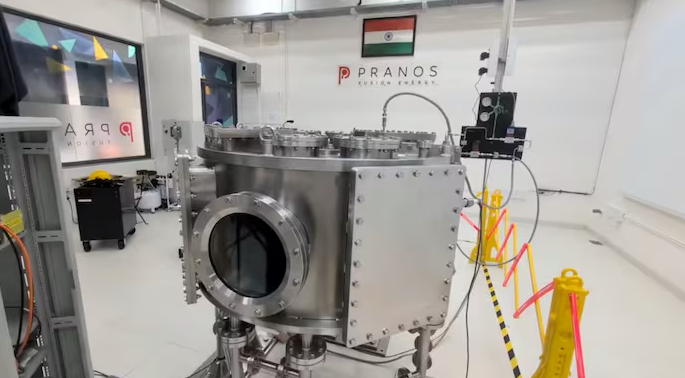
PRAGYA adopts a compact, low-aspect-ratio tokamak design, primarily used to generate, confine, and control plasma. Tokamaks use strong magnetic fields to confine high-temperature plasma within a toroidal vacuum vessel, creating conditions for future fusion of light atomic nuclei. The fundamental process of fusion reactions is the same mechanism by which the Sun releases energy, but engineering implementation still faces multiple challenges in plasma confinement, magnets, materials, and control systems.
Pranos Fusion stated that PRAGYA is currently not intended for commercial fusion power generation, nor does it equate to achieving net energy gain. The device is positioned as a test platform to validate the hardware, control systems, and operational experience required for larger fusion devices. The company plans to operate PRAGYA for nearly two decades, with a target of conducting 10 to 12 experimental discharges per day and approximately 3,000 discharges per year, thereby accumulating data on plasma behavior, tokamak design, and control systems.
The construction period of PRAGYA was approximately eight months. Pranos Fusion has previously developed the JENGA computing platform for tokamak design and control, and is advancing the MAGGA project for fusion-grade high-temperature superconducting magnets. According to the company's technology roadmap, PRAGYA will serve as a physics test platform for testing plasma control technologies, high-temperature superconducting magnets, diagnostic equipment, and other key systems. The company aims to bring high-temperature superconducting magnet technology into operation by 2027 and plans to build a net-gain fusion device named PraniQ by 2030.
Pranos Fusion was founded in 2024 by Shaurya Kaushal and Roshan George, and its current team includes computational scientists, engineers, and physicists. The company has been incubated jointly at the Jawaharlal Nehru Centre for Advanced Scientific Research (JNCASR) and the Institute for Plasma Research (IPR), leveraging relevant scientific research infrastructure and plasma research expertise to advance its development.
The company previously completed a $6.8 million funding round, co-led by pi Ventures and Ankur Capital, with participation from existing investor Industrial47 and angel investors. Pranos Fusion has stated that the funding will be used to accelerate the development of its fusion technology stack and support the construction of experimental platforms such as PRAGYA.
India's fusion research has long relied primarily on government research institutions and international collaborative projects such as the International Thermonuclear Experimental Reactor (ITER). The operation of PRAGYA adds a new pathway of private sector participation to India's fusion research and development. For Pranos Fusion, this device is not an endpoint, but a platform for data, engineering, and talent development oriented toward future fusion reactors.
Disclaimer: Information republished from partner media, institutions or other websites is provided for reference and communication purposes only. It does not imply endorsement of its views or verification of its accuracy. Please contact us if any content infringes rights or requires correction.