
First concrete poured for turbine building foundation of Unit 3 VVER-1200 at Leningrad NPP Phase II
 Scan to share
On September 9, 2026, concrete pouring began for the foundation of the turbine building of Unit 3 VVER-1200 at Leningrad NPP Phase II in Russia. Construction workers have completed the pouring of the central section of the future foundation, with concrete consumption approaching 5,000 cubic meters.
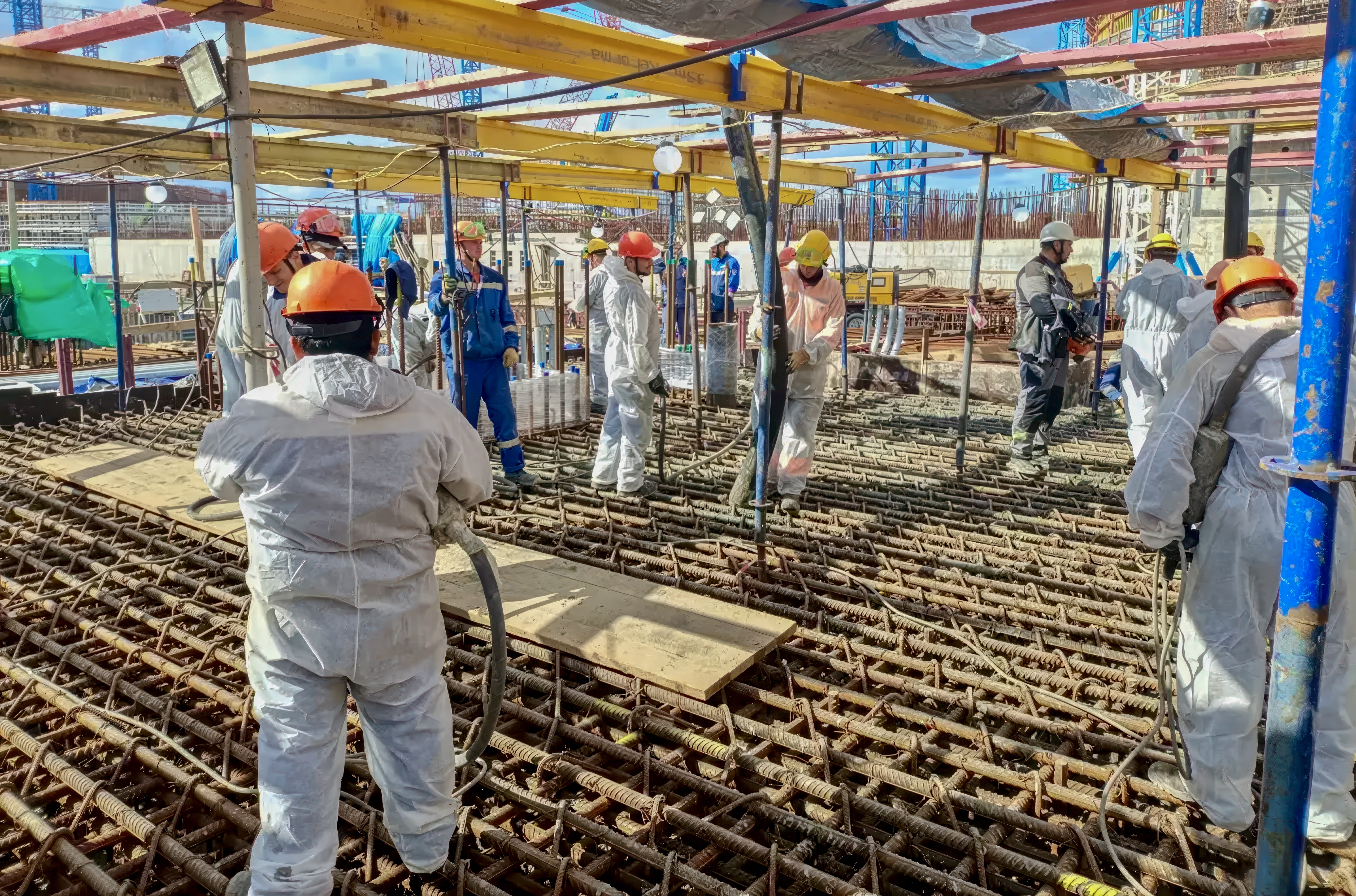
This pour is the first stage of construction of the foundation structure for this building. According to the plan, the contractor will use nearly 5,000 tonnes of rebar and more than 20,000 cubic meters of high-strength concrete to build a monolithic foundation slab 2.5 meters high and more than 8,000 square meters in area. The related operations are currently being carried out simultaneously in 7 construction zones.
Konstantin Khudyakov, head of the Leningrad NPP project at TITAN-2 Holding (TITAN-2), said that the foundation construction of the turbine building places high demands on concrete quality, pouring technology and curing conditions, especially in the first few days after pouring, when it is necessary to focus on controlling on-site temperature and humidity and preventing mechanical damage. After the concrete reaches design strength, the contractor will, together with the owner, use non-destructive testing methods to inspect the structure, including ultrasonic testing; at the same time, specimens made from the same batch of concrete will also be subjected to compressive tests on a hydraulic press to confirm that the foundation is capable of bearing the loads of walls, floors, piping and large operating equipment.
According to the plan, the foundation slab of the turbine building of Unit 3 VVER-1200 at Leningrad NPP Phase II will be completed before the end of November this year. After that, construction workers will carry out wall and floor construction and build the condenser foundation. A condenser is a heat exchange device used to convert turbine exhaust steam into condensate. The foundation of the turbine generator set, including the steam turbine and turbogenerator, is planned to start construction next year, and installation of the turbine equipment is planned for 2029.
Yevgeny Milushkin, deputy director of Leningrad NPP and head of Phase II construction management, said that the turbine building is the core facility of the conventional island of a nuclear power unit, where steam energy will be converted into mechanical energy and then into electrical energy for delivery to users. This building will also perform a key function in the heat supply chain: turbine extraction steam will be used to heat water for the heating network, after which hot water and thermal energy will be supplied to the satellite town of Leningrad NPP, Sosnovy Bor, and its industrial area.
According to the construction schedule, Unit 3 of Leningrad NPP Phase II is planned to deliver its first electricity to the Russian Unified Power System in 2030. Facilities related to heat carrier supply also need to be completed in the same period. To meet pre-commissioning requirements, civil construction and installation work for the new unit will be completed ahead of schedule so that equipment, process systems, auxiliary systems and other systems can successively complete verification at each pre-commissioning stage.
Leningrad NPP is located in Sosnovy Bor, Leningrad Oblast, Russia. It is a branch of Rosenergoatom and has an installed capacity of 4,400 MW. The plant currently operates two RBMK-1000 units and two Generation III+ VVER-1200 units. Units 1 and 2 RBMK-1000 have been shut down after 45 years of service and have entered the decommissioning stage, and the two VVER-1200 units replacing their capacity were commissioned in 2018 and 2021, respectively.
Units 3 and 4 VVER-1200 of Leningrad NPP Phase II began construction in 2022 and will in the future replace Units 3 and 4 RBMK-1000 of Leningrad NPP. After the project is commissioned, each unit is expected to generate more than 8.5 billion kWh per year. TITAN-2 Holding is part of the Rosatom system and serves as general contractor for the construction of new units at Leningrad, Kola and Smolensk nuclear power plants, and also participates in international nuclear power projects such as Akkuyu in Turkey, Paks II in Hungary and El Dabaa in Egypt.
Disclaimer: Information republished from partner media, institutions or other websites is provided for reference and communication purposes only. It does not imply endorsement of its views or verification of its accuracy. Please contact us if any content infringes rights or requires correction.