
Visiting Taipingling Nuclear Power Plant and the Nuclear Heavy Equipment Manufacturing Base: Hualong One Iteration, Forging the Pinnacle of Heavy Equipment, China's Nuclear Power Advances Toward a New Stage
 Scan to share
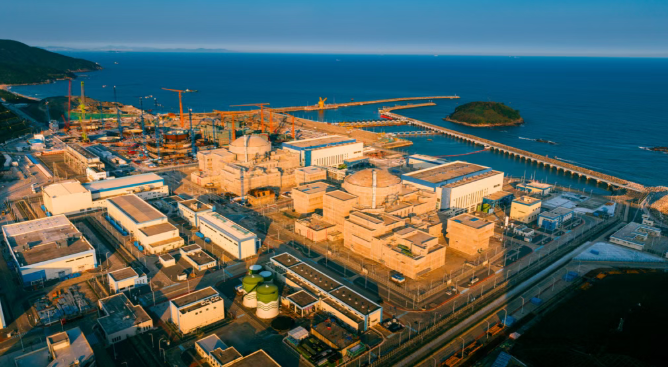
Standing on the viewing platform of Taipingling Nuclear Power Plant by the Red Bay, leaning on the railing and gazing into the distance, a picture of modern industry blending with mountains and sea unfolds before your eyes. Multiple Hualong One nuclear power units are lined up in formation; Phase I has entered stable commercial operation, Phase II is at the peak of civil construction, and with the official approval of Phase III, the Hualong One Version 2.0 demonstration project is poised for launch. From Daya Bay, where the early domestic content rate was less than 1%, to today's achievement of organized and batch deployment of independently developed third-generation nuclear power, China's nuclear power industry is entering deep waters on the dual tracks of technological innovation and industrial manufacturing.
In this process, Taipingling Nuclear Power Plant and Dongfang Heavy Machinery in Nansha, Guangzhou, together constitute a vivid microcosm of China's nuclear power industry transitioning from "following and importing" to "full-chain autonomy and industrial upgrading."
The Iteration Logic of Hualong One: From Engineering Validation to Full-Chain Autonomous Optimization
The evolution of Hualong One from Version 1.0 to Version 2.0 is not a disruptive reconstruction from scratch, but a systematic quality and efficiency enhancement built upon large-scale batch construction and operational experience. This evolution is concentrated in the addition of safety design, the subtraction of engineering quantities, and a fundamental leap in the standards system.
In terms of safety, Version 2.0 strengthens the safety mechanism combining active and passive features. By fully utilizing physical phenomena such as gravity, natural circulation, and heat conduction that do not rely on external power sources or human intervention, the units can achieve post-accident operator non-intervention for seventy-two hours and seven-day accident autonomy under extreme conditions, pushing the overall safety margin to a new height. At the same time, the engineering team boldly applies "subtraction" in system design. Through the development and application of new nuclear-grade instrumentation, complex piping layouts have been effectively streamlined, auxiliary system configurations significantly optimized, and the number of core process pipelines and valves reduced by more than one-quarter compared to Version 1.0, with the nuclear island installation volume reduced by one-third. This system-level streamlining directly compresses the main construction schedule from sixty months to approximately fifty-four months, significantly enhancing the electricity price competitiveness of nuclear power in regional power markets.
Most critically, Version 2.0 has completely broken free from path dependence on the traditional nuclear power standards of the United States, France, and other countries, and fully adopts China's independently developed nuclear power standards system, achieving complete closed-loop and domestic production from underlying software and system design to key equipment.
Intelligent Control and Modular Construction: Reshaping the Underlying Paradigm of Project Delivery
The leap in technical standards ultimately needs to be translated into efficient engineering execution. In the practice of Hualong One Version 2.0, intelligent control and modular construction are deeply integrated into the entire project lifecycle, accelerating the transformation of nuclear power construction from traditional "on-site assembly of scattered blocks" to "high-end manufacturing and precision prefabrication."
In the intelligent dimension, the project relies on a fully independent digital instrumentation and control system (DCS), achieving comprehensive domestic production of plant-wide control logic and safety protection system software. Combined with artificial intelligence and high-precision self-guided nuclear-grade sensors, the units possess powerful online self-diagnosis and automated adjustment capabilities, significantly reducing the intensity of manual intervention in daily operations and maintenance. Meanwhile, a plant-wide three-dimensional digital model and supply chain online collaboration platform were simultaneously constructed at the project's inception, enabling real-time online traceability of all data from equipment manufacturing, transportation, installation, and commissioning, with a complete digital dossier handed over upon unit commissioning, laying a solid foundation for full-lifecycle asset management.
In terms of construction mode, super-large structural modularization and integrated equipment-piping have become mainstream. The engineering team carries out high-precision prefabrication of the nuclear island steel containment vessel, internal structural walls, and complex valve and pump modules at factories or rear processing plants, which are then transported to the site and directly lifted into place as integrated thousand-tonne-class equipment. This Design for Manufacturing and Assembly (DfMA) concept transforms the originally sequential civil construction and installation processes into parallel prefabrication production and lifting, fundamentally reducing the on-site welding and non-destructive testing workload of dense piping, and significantly lowering construction risks associated with work at height and in confined spaces.
The Leap of the Heavy Equipment Industry Chain: Resonance of Ultimate Craftsmanship and Digital Foundation
The grand narrative of nuclear power technology must ultimately be materialized in every weld seam and every piece of main equipment through precision manufacturing. As the nuclear power equipment manufacturing base with the most comprehensive reactor type coverage, the capability evolution of Dongfang Heavy Machinery reflects the underlying resilience of China's heavy equipment industry chain.
Nuclear island main equipment must operate continuously, safely, and stably for sixty years in the harsh environment of high temperature, high pressure, and intense radiation, which imposes extreme requirements on special welding, heavy forging, and high-end non-destructive testing. Through the comprehensive implementation of an online collaborative manufacturing platform and full-process digital archives, Dongfang Heavy Machinery has achieved full-chain quality traceability from steel plate entry to finished product shipment. Currently, China has built the world's most complete nuclear power equipment industry chain and supply chain system, with an annual manufacturing capacity of ten sets of nuclear power main equipment, and a domestic production rate of key equipment and core materials exceeding ninety percent. Relying on a strong manufacturing and logistics system, the domestic nuclear power industry has not only firmly grasped the development initiative but also possesses the formidable engineering strength to simultaneously construct dozens of units.
Strategic Perspective: Regional Energy Support and the Global "Triple Nuclear Power" Wave
From a macro-strategic perspective, the intensive construction of major projects such as Taipingling Nuclear Power Plant is building solid clean baseload support for the high-quality development of the Guangdong-Hong Kong-Macao Greater Bay Area. After all planned units are put into operation, annual electricity generation will exceed fifty billion kilowatt-hours, playing a ballast role against the backdrop of continuously rising regional electricity load and computing center demand. At the same time, the project's practices of proactively setting back the site during construction, preserving the original beach, adopting deep-sea far-field discharge, and protecting historical relics vividly exemplify the deep integration of modern industry and natural ecology.
Looking globally, driven by both climate change response and the explosive growth of carbon-free electricity triggered by artificial intelligence, the international nuclear renaissance has become inevitable. With a complete industry chain, outstanding batch construction capability, and leading comprehensive cost-effectiveness, China's nuclear power industry is deeply participating in global energy governance as a full-industry-chain solution provider, demonstrating to the world the hardcore responsibility of China's major national equipment.
Disclaimer: Information republished from partner media, institutions or other websites is provided for reference and communication purposes only. It does not imply endorsement of its views or verification of its accuracy. Please contact us if any content infringes rights or requires correction.