
Controversy Over U.S. Nuclear Waste Repository Siting Draws Renewed Attention: Historical Decision Alleged to Have Relied Excessively on Cost Estimates
 Scan to share
The issue of siting a U.S. nuclear waste repository has once again drawn attention. A reanalysis of the U.S. Department of Energy's (DOE) 1986 candidate site evaluation report points out that the key factor determining the priority siting of a nuclear waste repository at that time was not fully verified differences in long-term safety performance among the sites, but mainly estimates of repository construction and operating costs and spent fuel transportation costs. This analysis argues that the relevant cost data had considerable uncertainty, yet played a decisive role in the final ranking, causing the technical evaluation to present a clearer ordering of advantages and disadvantages than the actual evidence supported.
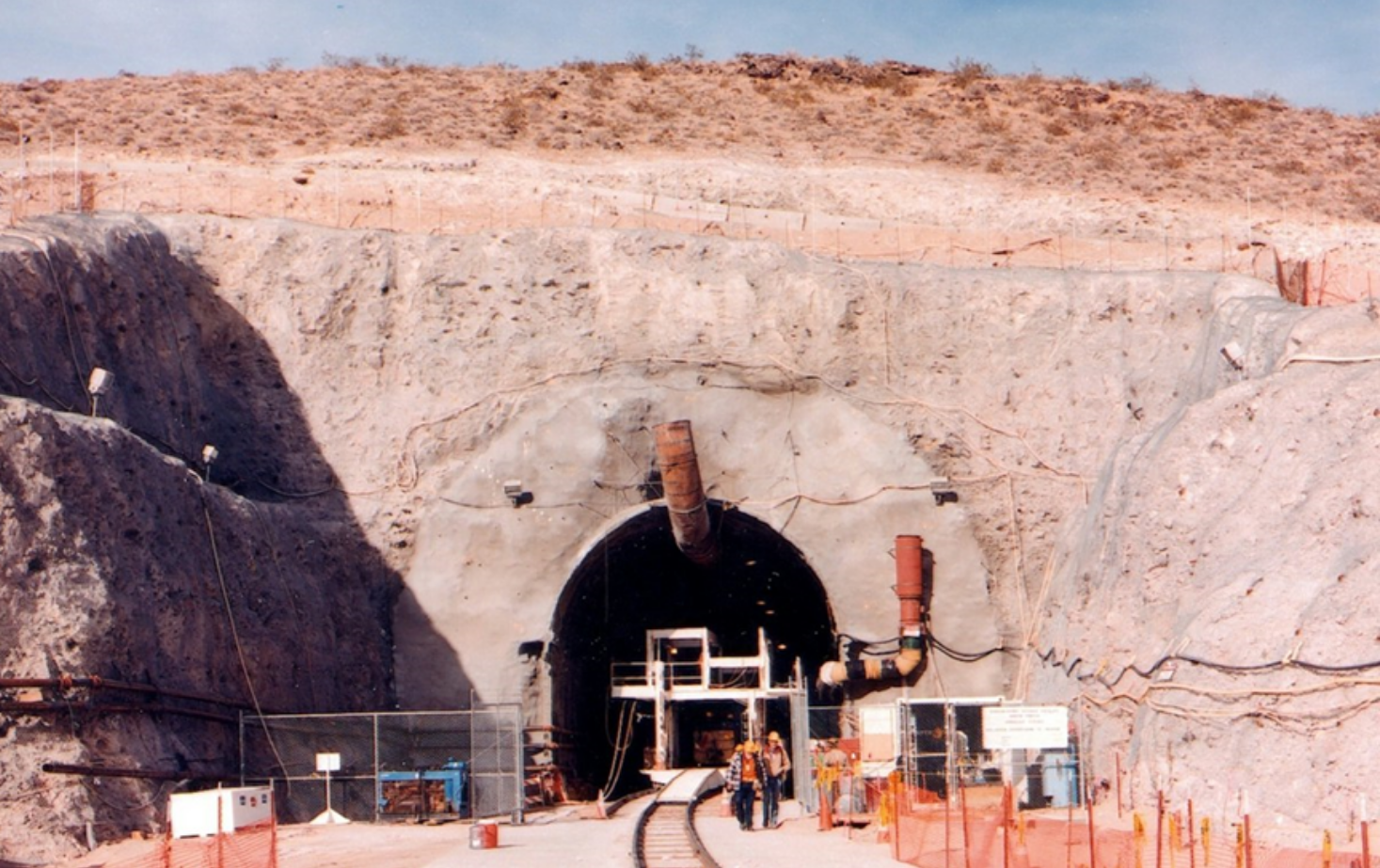
The debate over U.S. nuclear waste repository siting has lasted for decades. The 1982 Nuclear Waste Policy Act required the DOE to recommend three sites from among the candidate sites to enter the costly underground characterization phase. In 1984, the DOE ranked five candidate sites in a draft environmental impact assessment, and later, because the assessment methodology drew substantial criticism, switched in 1986 to a multi-attribute utility analysis model to evaluate the sites' pre-closure performance, post-closure long-term isolation capability, and overall performance.
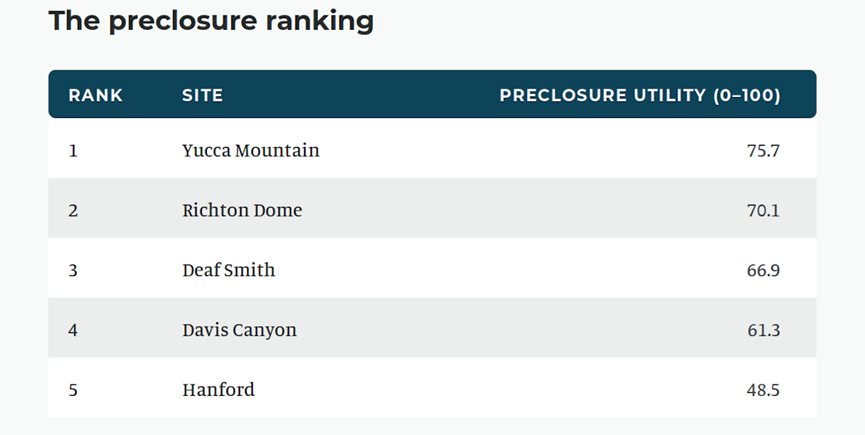
Total pre-closure utility
The reanalysis found that the five candidate sites scored very similarly on post-closure long-term radioactive isolation performance, with a total score gap of only 0.23 points (out of 100), and a gap of only 0.01 points among four of the sites. Under the original model, all sites met the evaluation requirements for long-term isolation with a large safety margin, and the relevant indicators could hardly effectively distinguish between sites. Because safety performance scores were similar, the factor that truly separated the overall rankings shifted to the economic costs of the pre-closure phase.
Specifically, repository construction and operating costs contributed 87.9% of the difference in pre-closure scores among the five sites, transportation costs contributed 7.8%, and the remaining twelve indicators together accounted for only 4.3%. This means that although the evaluation system covered environmental impacts, socioeconomic impacts, and other technical factors, the final ranking in fact depended heavily on two cost estimates. The analysis argues that even if some indicators differed among sites, their low weights prevented them from changing the final ranking; and the cost indicators with the greatest influence lacked sufficiently reliable data support.
The uncertainty of cost estimates is one of the core issues of this analysis. When the evaluation report was issued in May 1986, none of the five sites had completed comprehensive underground characterization, and construction costs were estimated mainly on the basis of engineering assumptions. The cost ranges published by the DOE show that the repository cost ranges of the five sites overlapped substantially, and the uncertainty range for transportation costs was also quite wide. Re-examination found that all ten pairwise site comparisons could experience ranking reversals within the original estimate ranges. Even a directional deviation of only a few percentage points in cost could change the relative positions of some sites.
Later cost changes in the Yucca Mountain project further highlighted the limitations of the early estimates. In 1986, the DOE's baseline estimate for construction and operation of the Yucca Mountain repository was about $7.5 billion, with a published cost ceiling of about $10.1 billion. By 2001, the estimate for the project's full life-cycle cost had risen to $57.5 billion; in 2008, expressed in 2007 dollars, the estimate further reached $96.2 billion, of which about $54.8 billion was for the repository itself. Because the estimates from different periods did not cover exactly the same scope, waste inventory, and operating period, these figures cannot be directly equated, but they still reflect the risk of significant deviation in early first-of-a-kind engineering cost forecasts.
The DOE at the time recommended Yucca Mountain, Deaf Smith, and Hanford for subsequent evaluation, corresponding respectively to the sites ranked first, third, and fifth by the model. The DOE also cited geological media diversity as a reason for the recommendation: Yucca Mountain was the only tuff site among the five candidates, and Hanford was the only basalt site. However, the reanalysis points out that if repository construction and operating costs and spent fuel transportation costs are excluded, Hanford actually ranked first on the remaining indicators. The researchers argue that this does not prove Hanford was necessarily more suitable, because after removing the two cost factors, the model also lost most of its discriminating power, and the remaining rankings mainly reflected limited differences and could not be used to determine a true winner.
In 1987, the U.S. Congress passed the Omnibus Budget Reconciliation Act, amending the Nuclear Waste Policy Act to limit subsequent site characterization evaluation to Yucca Mountain and require the gradual termination of site-specific work at other candidate sites. The relevant statutory provisions have since continued to restrict study of candidate sites for a second repository unless Congress specifically authorizes and appropriates funds. The reanalysis argues that this policy decision transformed a site comparison that still awaited verification through underground field investigation into a long-term fixed siting arrangement, and also made it difficult for the United States thereafter to reassess other candidate locations through the same procedure.
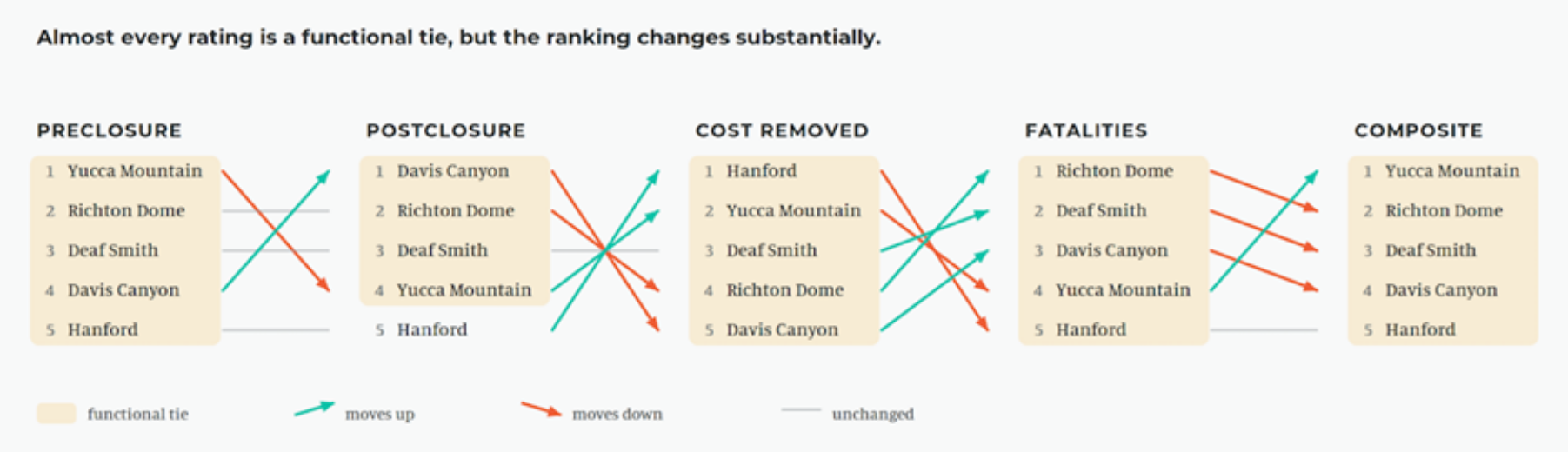
The same five sites, ranked five different ways using DOE's 1986 numbers; the last column is the ranking actually pursued at the time. Rank 1 is the most favorable site, and shaded blocks indicate functional ties.
For future nuclear waste repository siting, the analysis proposes that before publishing an overall ranking, the discriminating power of each indicator should be clarified, it should be tested whether conclusions change when key input data vary in different directions within the published uncertainty ranges, and the margin of error required for a ranking reversal should be reported for every pair of candidate sites. The researchers also suggest first defining the thresholds that must be met, such as safety and environmental impact, and then openly comparing cost and social acceptance among sites that meet the conditions. This approach does not reject decision-analysis models, but emphasizes that site rankings must truthfully reflect what the data can support, and must not package highly uncertain estimates as definite technical advantages.
Disclaimer: Information republished from partner media, institutions or other websites is provided for reference and communication purposes only. It does not imply endorsement of its views or verification of its accuracy. Please contact us if any content infringes rights or requires correction.