
Construction Management Practice of Unbonded Prestressed Tendons in the Containment of the Reactor Building
 Scan to share
As a landmark project of China-Russia nuclear energy cooperation, Units 7 and 8 of Tianwan Nuclear Power Plant were the first in China to apply unbonded prestressing technology to the inner containment of the reactor building. There was no domestic construction experience with unbonded prestressing in containments to draw upon, and the installation of large-diameter prestressing ducts, as well as the strand threading, grouting, and tensioning of greased and sheathed strands, presented considerable difficulty, exposing construction to significant risks and challenges. As a “first-of-a-kind new process,” to complete this pioneering project to high quality and high standards, China Nuclear Power Engineering Co., Ltd., as the general contractor, worked in close coordination and collaboration with all participating units to carry out innovative work, guided by strategy, driven by technology, rooted in quality, and powered by innovation, advancing the engineering practice of this technology and filling the domestic gap in unbonded prestressing construction technology for the inner containment of nuclear power plant reactor buildings.
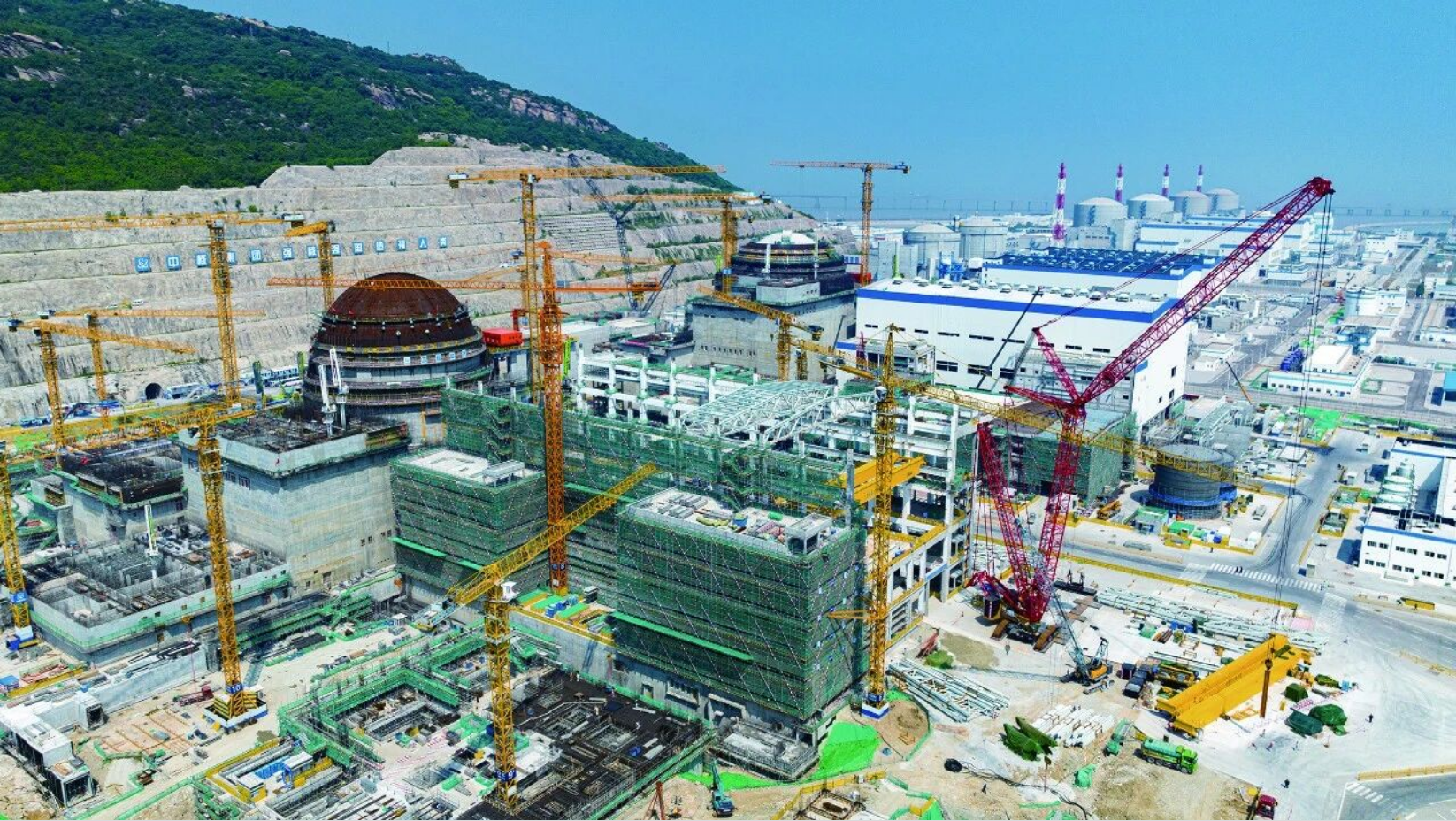
Main Practices
Facing the challenges, the project management team first anchored its development direction and established a clear construction vision and strategic objectives. Guided by CNNC’s corporate vision of “becoming a leader in the global nuclear field,” and integrating the core connotation of “striving to be a world-class ace team in nuclear power general contracting management” from the benchmark culture system of the CNPE Tianwan Project Department, the team formulated the strategic objective of “technology leadership, first-time excellence, international first-class” for the unbonded prestressing construction of the reactor building containment, and defined the strategic measures of “driving management upgrading through technological innovation and safeguarding nuclear safety through refined management.” In the process of research and application of unbonded prestressing construction technology for the reactor building containment, the implementation path of “technology research → technology application → technology summarization” was established.
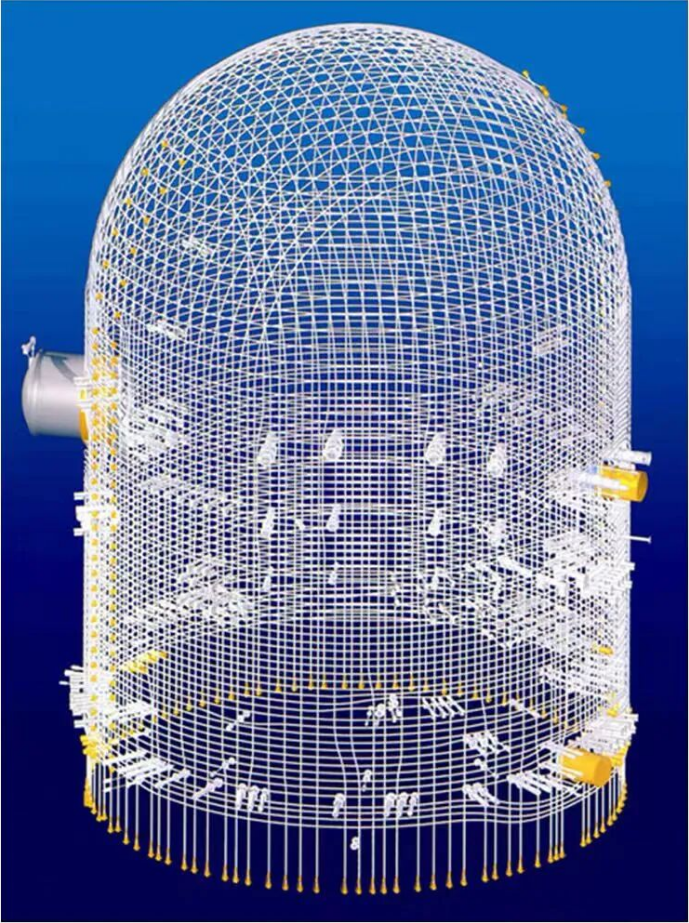
Rendering of Prestressing Tendon Layout
1. Early Intervention and Systematic Planning
In response to the first domestic application of an unbonded prestressing system for the VVER-1200 reactor type, the CNPE Tianwan Project Department took the lead in establishing a joint research group from the very beginning of the project, organizing all participating parties to jointly carry out technical research and construction technology tackling. The project team planned and formulated a detailed special construction schedule and a compilation checklist of construction technical documents, and established a technical tackling mechanism led by the general contractor with multi-party collaboration. In the research of unbonded prestressing construction technology, implementation was advanced step by step in the order of “analysis → testing → verification → application,” conducting penetrating technical management.
Comparative analysis of construction processes. First, through differential comparative analysis with bonded prestressing, key technical and quality risks were identified, and unbonded prestressing construction technical documents were formulated. A series of tests were carried out on prestressing corrugated duct types, compatibility, grout, full-scale grouting, and tensionability under strand sheath damage conditions, laying the foundation for process verification. The project team conducted systematic process verification around core technologies such as threading technology for greased and sheathed unbonded prestressing strands, single-strand tensioning, and wax injection processes, laying the foundation for the formal construction of unbonded prestressing in the containment.
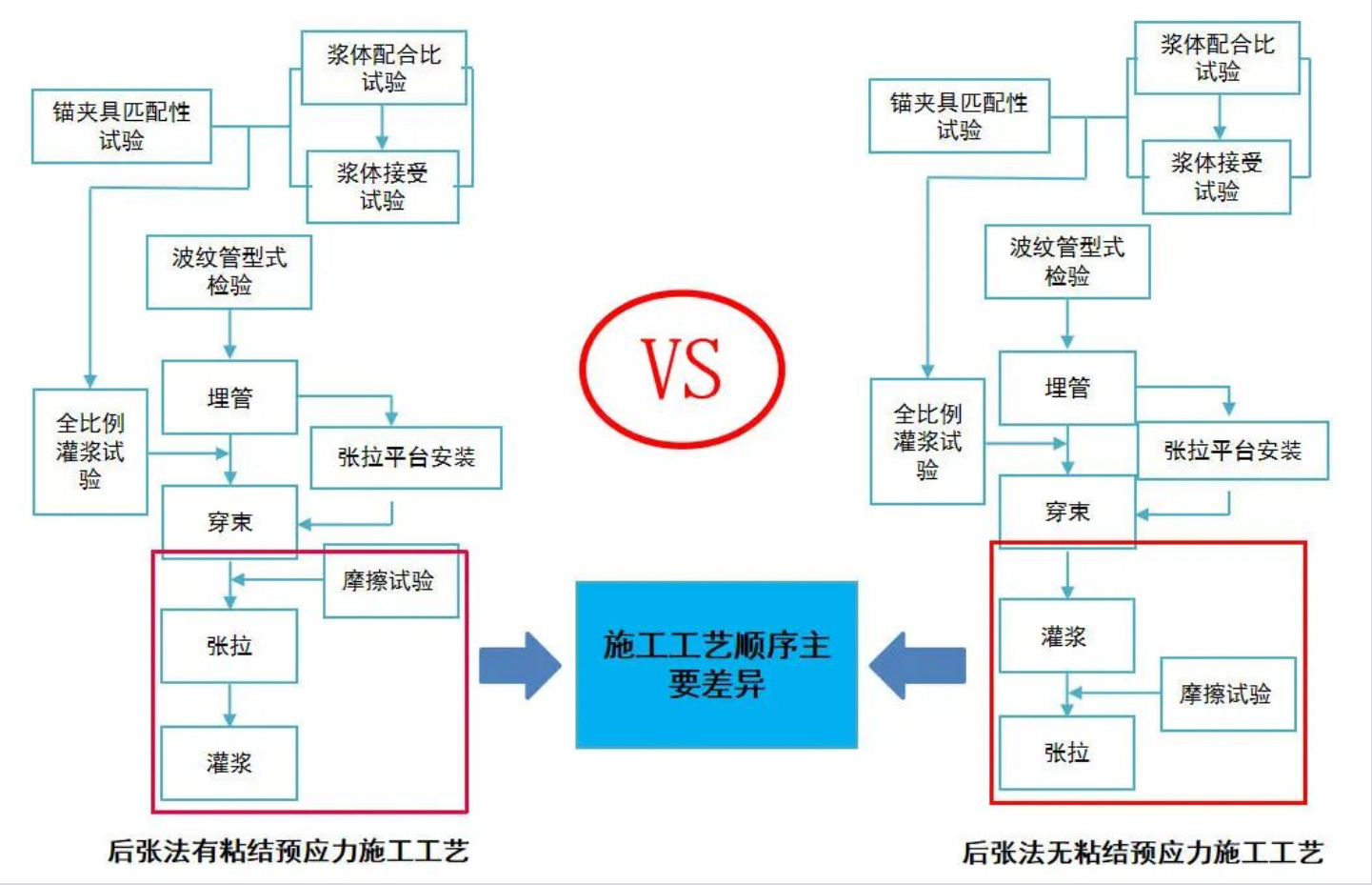
Comparison of Construction Processes
Technical scheme management planning. In accordance with the sequence of “overall construction scheme → individual construction scheme → work procedures,” construction work guidance documents were progressively refined. Industry experts were invited to conduct expert demonstration of construction schemes, thereby ensuring that the construction schemes were scientific, safe, and controllable. Ultimately, a systematic unbonded prestressing construction technical scheme and work instructions for the reactor building containment were formed, and construction technology was continuously summarized and optimized during execution.
For the unbonded prestressing construction planning of the reactor building containment of Units 7 and 8 of Tianwan Nuclear Power Plant, 1 overall construction scheme, 10 individual construction schemes, and 11 work procedures were compiled, ensuring that all unbonded prestressing construction operations had guiding documents and rules to follow.
2. Problem Solving and Technical Tackling
During construction, technical management was driven by goal orientation, problem orientation, and result orientation. The team used the FMEA tool to conduct failure mode analysis on unbonded prestressing construction processes, determined the risk priority number of each process, performed quantitative ranking, identified the key risk points of strand threading and grout preparation technology, focused on key problems, and organized technical tackling one by one, upgrading from “passive response” to “scientific prevention and control” of construction problems.
Problem solving. Aiming at the identified difficulty of threading sheathed strands for unbonded prestressing, through fishbone diagram analysis, three main causes were locked in: “insufficient equipment power, large wear of rubber pressure wheels, and high friction of the sheath.” Relying on the project department’s innovation studio, special technical tackling breakthroughs were made on the difficult and blocking issues in the construction process.
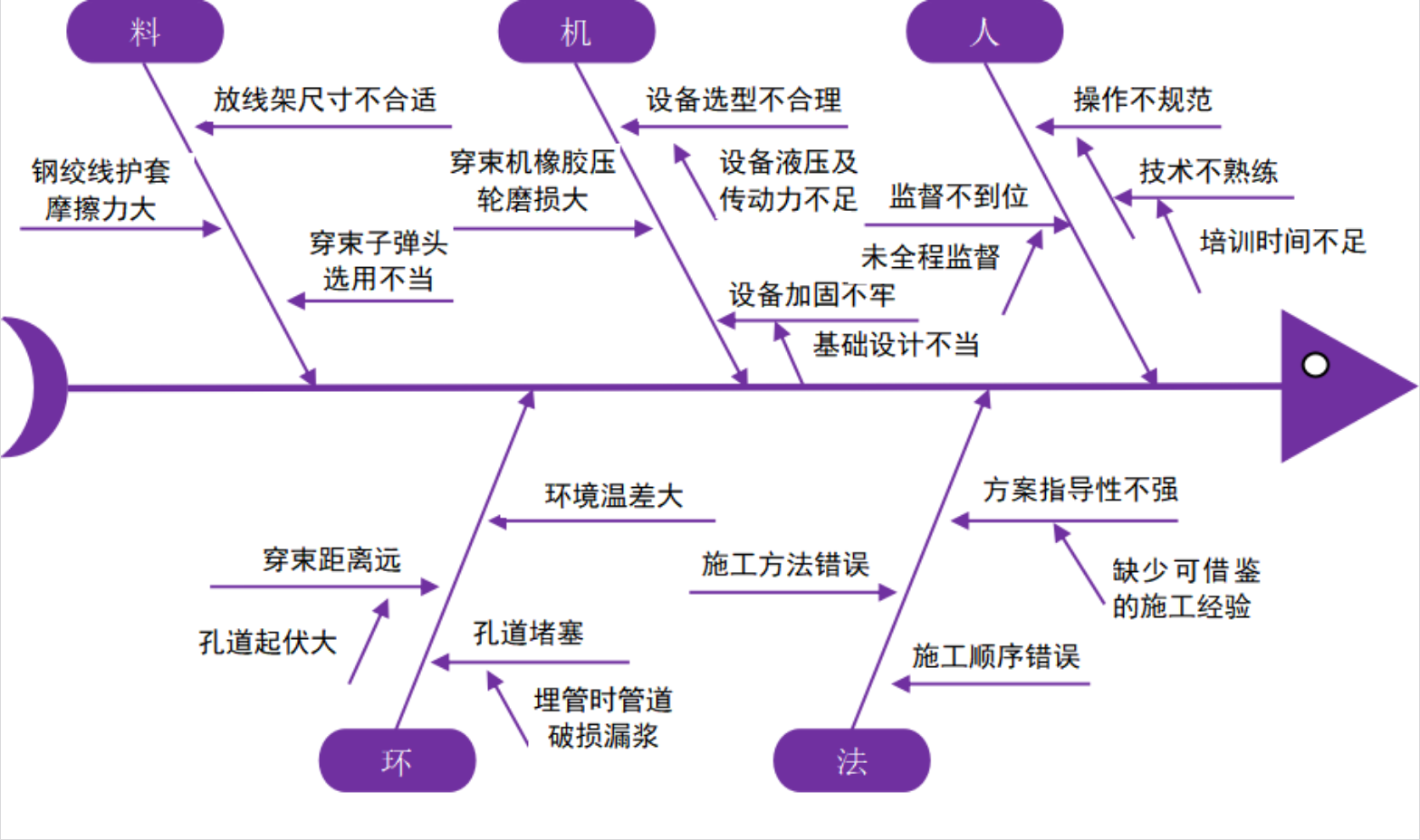
Fishbone Diagram of Strand Threading Problems
The 5W1H method was used to formulate countermeasures for the main problems. A dedicated unbonded strand threading device was developed, wear-resistant rubber pressure wheels were used to replace steel pressure wheels, and an oil spray lubrication device was added at the front end of the threading machine, successfully overcoming the problems of low threading efficiency and easy sheath damage for sheathed strands.
Process innovation. In the past, prestressing grout adopted on-site proportioning of various raw materials and two-stage mixing for grout preparation, which had the problems of large grout performance fluctuation, many grout preparation steps, and low grout preparation efficiency. Units 7 and 8 of Tianwan Nuclear Power Plant were the first in China’s nuclear power field to develop and apply pre-mixed finished grouting material for grout and a one-time grout preparation (grouting) process, solving the problem that on-site proportioning to produce cement grout could easily lead to grout performance fluctuation due to unstable compatibility between cement and admixtures; at the same time, the use of pre-mixed finished grouting material reduced the grout preparation steps. This process shortened grout preparation time from 50 minutes to 10 minutes, increased efficiency by 80%, and fundamentally ensured the stability of grout quality and the continuity of grouting.
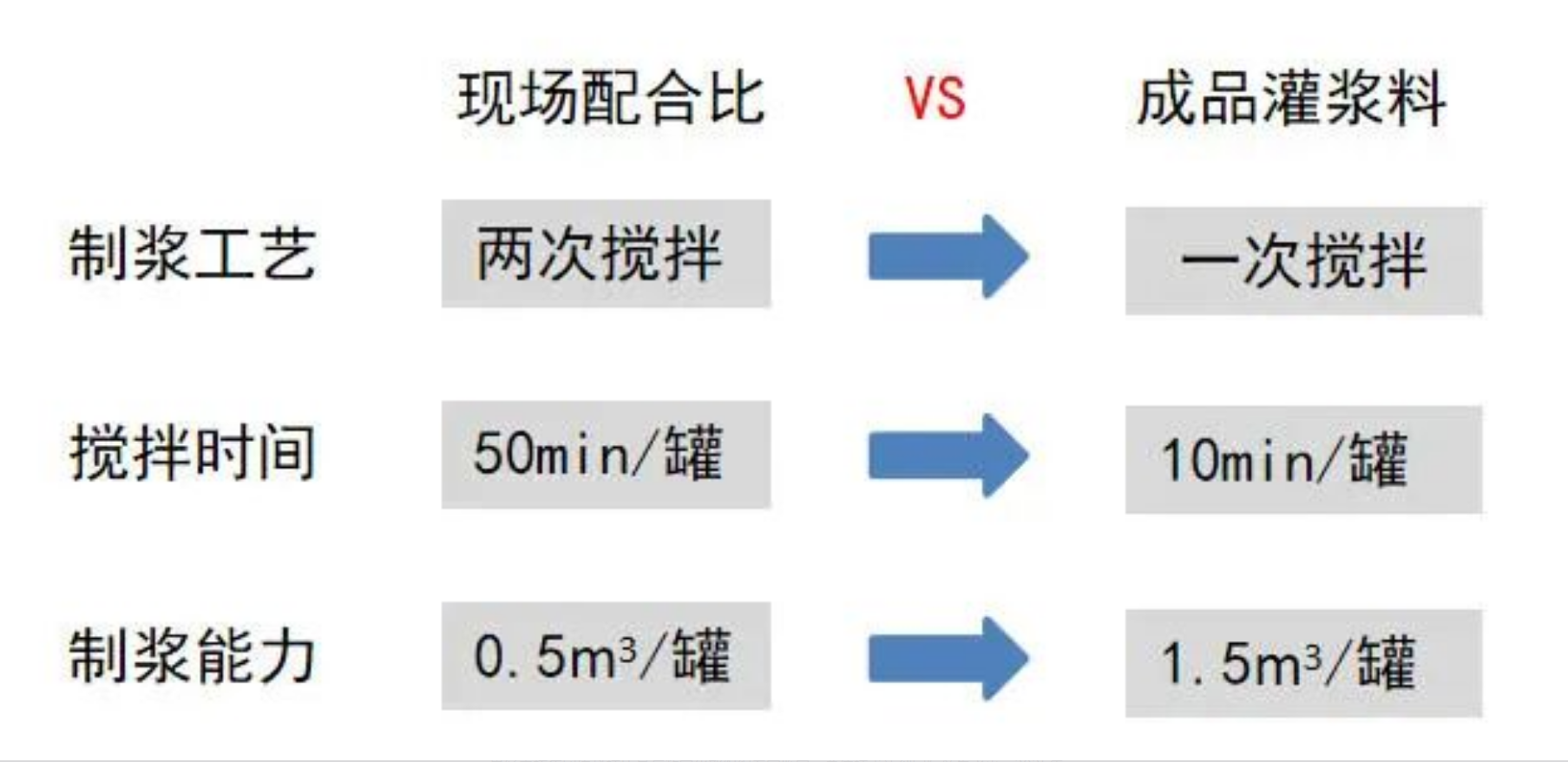
Comparison of Grout Preparation Processes
Technical innovation. Due to the addition of an external water tank in the VVER-1200 reactor type, the penetrations extending from the inner dome prevented the pre-tensioning platform from operating onto the dome, affecting the movement of the large-tonnage jacks lifted with the tensioning platform. To solve this problem, the project team innovatively proposed the “single-strand tensioning” process. This process not only solved the lifting problem of large-tonnage jacks, but also decoupled prestressing construction from outer dome construction, enabling the outer dome to be constructed during prestressing tensioning, solving the problem of limited tensioning space after outer dome construction, and realizing single-strand tensioning of strands in a narrow space, creating a valuable window period for outer dome construction 4 months ahead of schedule.
Implementation Effects and Achievement Consolidation
The project team systematically reviewed and consolidated the key technologies of unbonded prestressing construction, forming a series of scientific and technological achievements. In November 2024, the scientific and technological achievement “Research on Key Technologies for Unbonded Prestressing Construction of Nuclear Power Plant Containments” formed based on this project was appraised by experts organized by the former Science, Technology, Quality and Digitalization Department of CNNC, and the overall technology reached the international leading level. In November 2025, the research and application of unbonded prestressing construction technology for the reactor building containment won the Third Prize of the 2025 China Association for Quality Quality Technology Award (Project Award).
After the completion of prestressing tensioning construction for Unit 8, the unbonded prestressing construction of the reactor building containment has become a mature application that can be promoted, accumulating valuable experience for similar units. The achievements formed by this technology, such as the “grouting before tensioning” construction method, the application of finished grouting material, and the synchronous construction method of prestressing and outer shell dome, have broad value for industry promotion and application. The project has obtained 7 utility model and invention patents.
Innovation Point 1: The project team successfully mastered the core process of “grouting before tensioning” unbonded prestressing. By adjusting the logical sequence of prestressing construction, it was the first in China’s nuclear power field to apply the synchronous construction method of prestressing and outer shell dome, adopting the single-strand tensioning process for tensioning horizontal tendons in the dome, realizing decoupling of the outer shell dome and prestressing construction, providing a window period for outer shell dome structure construction 4 months ahead of schedule, and laying the foundation for the on-schedule completion of the passive water tank above the dome. At the same time, this technology has the functions of strand stress monitoring, supplementary tensioning, detensioning and cable adjustment, and replacement during nuclear power plant operation, providing technical support for extending the structural life of nuclear power plants.
Innovation Point 2: For the first time in China’s nuclear power reactor building containment, a new type of composite pre-mixed finished grouting material for grout and a one-time grout preparation (grouting) process were successfully developed, achieving one-time grouting forming and increasing grout preparation efficiency by 80%. Through grout testing verification, the duct grout has good compactness and high early strength, and all technical indicators meet design requirements.
Innovation Point 3: A method for accurately measuring the friction coefficient of prestressing ducts was developed, simplifying the friction test process. The test results are more accurate and closer to actual working conditions, ensuring that the test passes on the first attempt and avoiding safety risks and cost losses caused by detensioning and secondary testing due to inaccurate test data.
Innovation Point 4: Equipment, devices, and methods supporting unbonded prestressing construction were developed, solving the problem of dependence on imported equipment for unbonded prestressing construction of reactor building containments, and fully verified in construction, fully capable of replacing imported equipment.
Summary and Outlook
The construction management practice of unbonded prestressing in the reactor building containment of Units 7 and 8 of Tianwan Nuclear Power Plant was a successful exploration using the performance excellence model as the framework, technological innovation as the core, and refined management as the means. By anchoring strategic objectives, building an integrated penetrating organization, establishing a quantitative evaluation system, and continuously optimizing key processes, it not only overcame the many difficulties brought by the “first-of-a-kind new process” and completed the engineering construction task with high quality, but also formed a set of replicable and promotable construction management experience for complex special structures.
Looking ahead, this management practice provides three important insights for subsequent nuclear power plant construction and major projects: first, adhere to the deep integration of strategic leadership and technological innovation, using top-level design to drive bottom-level breakthroughs; second, build an integrated collaborative platform, break down organizational barriers, and achieve optimal resource allocation; third, integrate the concept of performance excellence into daily management, use data to drive decision-making, use indicators to lead improvement, and continuously pursue excellence. This practical achievement will contribute important strength to promoting the standardization, leanness, and internationalization of China’s nuclear power construction technology.
Disclaimer: Information republished from partner media, institutions or other websites is provided for reference and communication purposes only. It does not imply endorsement of its views or verification of its accuracy. Please contact us if any content infringes rights or requires correction.