
Multiple Units at Tianwan Nuclear Power Plant Go Live with Self-Developed EPM System
 Scan to share
On August 31, the EPM system, a production management platform independently developed by China National Nuclear Power (CNNP), was officially launched at Units 3, 4, 7, and 8 of Tianwan Nuclear Power Plant. This launch marks a new stage of standardized management and control for Jiangsu Nuclear Power's production management, and also provides a practical example from Tianwan Nuclear Power Plant for CNNP's digital transformation.
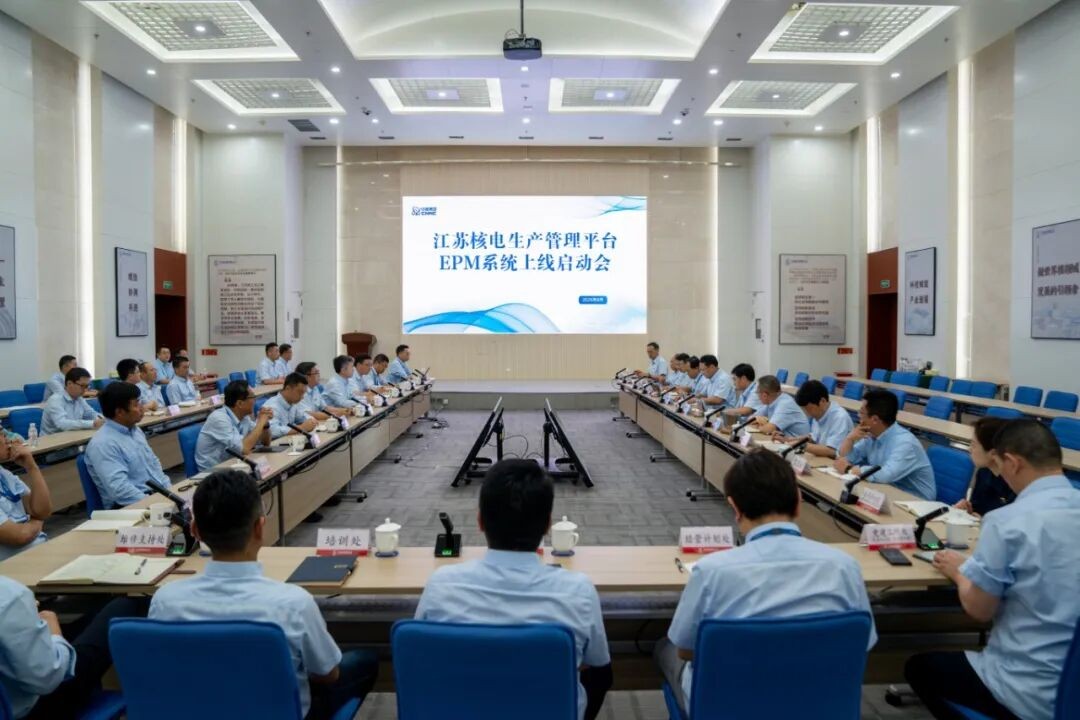
The EPM system is a new-generation nuclear power plant production management system independently developed by CNNP with fully independent intellectual property rights. Designed to meet the operational needs of nuclear power plant field operations, the system integrates business processes such as planning, operations, maintenance, equipment, and safety permits, unifies plant-wide work execution standards, and achieves closed-loop control across the entire production management chain. The system covers core business modules including commissioning management, operations management, and work order management, serving as an important tool supporting nuclear power plant operation, power generation, production organization, and safety management.
To ensure the smooth implementation of the system, Jiangsu Nuclear Power established an EPM promotion project leadership group headed by the company's general manager to coordinate top-level decision-making and cross-departmental resource allocation. The Production Planning Department, as the lead department, joined forces with 17 core business departments including operations, maintenance, safety supervision, and technical departments to form a dedicated promotion project team, which prepared milestone plans, cutover plans, and other documents, and systematically reviewed the process differences between the old and new production management systems.
The project team covered 11 business areas in total, identified over 70 business difference points, and focused on key tasks such as data migration, process changes, and cutover, forming an integrated working mechanism coordinated by the Production Planning Department, with collaboration across all business departments and participation from all staff, laying the foundation for project initiation and implementation.
It is understood that the launch of the EPM system is not merely an information system upgrade, but a business adjustment covering the entire production process. The project lasted 8 months since its initiation in early 2026, with all business departments working collaboratively to complete multiple construction tasks and achieve a smooth transition from the SAP system to the EPM system.
During project implementation, the Production Planning Department led the preparation of more than 10 documents including milestone plans, cutover plans, and go-live support plans, promoted the consolidation of 31 production processes, reviewed 60 management procedures affected by the system launch, and organized multiple rounds of cross-departmental full-process joint drills covering core business scenarios such as the full work order process and comprehensive permit processing. Functional optimization suggestions identified during the drills were promptly fed back to the development department, providing support for system deployment and unit cutover.
The operations department dispatched frontline business experts to participate in production process testing. The EPM system adopted a phased launch strategy, prioritizing the deployment and commissioning of three core modules: operation logs, operation inspections, and operation limit management. Operations personnel, drawing on their hands-on experience at the units, put forward optimization suggestions to align the initially launched modules with on-site production needs, ensuring stable unit operation.
The maintenance department focused on addressing challenges such as the large volume of historical work orders, complex data relationships, and high verification difficulty. While ensuring the safe operation of the units, key users conducted item-by-item comparison and verification, corrected data errors and omissions, filled in missing fields, and completed the cleaning and verification of one million work orders, achieving complete and accurate integration of old and new work order data.
To help employees adapt to the business process changes after the system launch, the promotion project team carried out phased hands-on training following the approach of "key users leading the learning, all users learning broadly, and key modules receiving reinforced training." In January 2026, the project team completed plant-wide awareness and promotion; in April, key users from departments including operations, maintenance, technical, safety and quality, and security organized special business training for plant users; and in August, just before the launch, reinforced training on key modules was conducted. Employees from all business departments familiarized themselves with system functions through hands-on drills, building the personnel foundation for system deployment.
On the day of the official system cutover, the Production Planning Department led all business departments and coordinated with the Operations Research Institute to initiate a round-the-clock joint duty mechanism, with over 30 personnel working together on-site to provide support in areas such as data migration finalization, on-site system function verification, hands-on Q&A, and issue resolution, ensuring a smooth transition of production operations.
The successful cutover of the EPM system at Units 3, 4, 7, and 8 of Tianwan Nuclear Power Plant further advances Jiangsu Nuclear Power's production management transformation toward standardization and digitalization. In the next phase, the promotion project team will continue to optimize system functions, steadily advance the launch at the remaining units, and gradually achieve full EPM system coverage across all 8 units at Tianwan Nuclear Power Plant.
Disclaimer: Information republished from partner media, institutions or other websites is provided for reference and communication purposes only. It does not imply endorsement of its views or verification of its accuracy. Please contact us if any content infringes rights or requires correction.