
Central Commission for Discipline Inspection and National Supervisory Commission: Toward Innovation and Green Development, Empowering All Industries with Nuclear Energy
 Scan to share
Important Discourse
The nuclear industry is a high-tech strategic industry and a crucial cornerstone of national security. We must adhere to safe development and innovative development, persist in the peaceful use of nuclear energy, comprehensively enhance the core competitiveness of the nuclear industry, and write a new glorious chapter for China's nuclear industry.
Empowering All Industries with Nuclear Energy
A Visit to the World's Largest Large-Scale Coupling Demonstration Base of Nuclear Energy and Petrochemical Industry
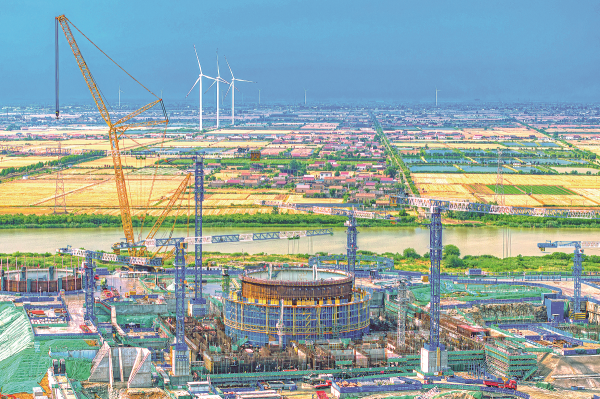
CNNC Suneng Jiangsu Xuwei Nuclear Heating and Power Plant
Panoramic view of the nuclear island of Unit 1

CNNC Suneng Jiangsu Xuwei Nuclear Heating and Power Plant
Interior view of the nuclear island of Unit 1
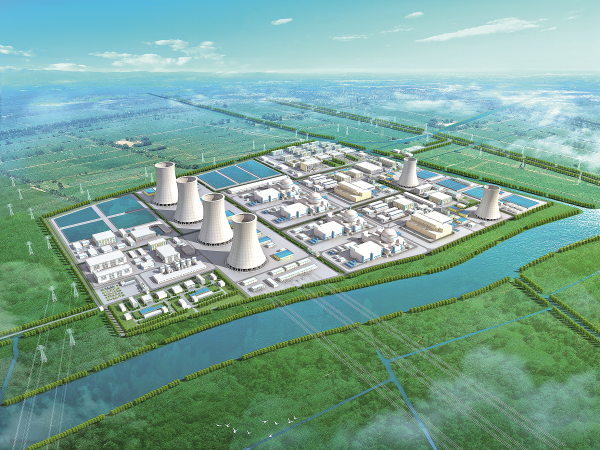
Rendering of CNNC Suneng Jiangsu Xuwei Nuclear Heating and Power Plant

Night view of Lianyungang Petrochemical Industry Base
(All photos provided by CNNC)
On the coast of the Yellow Sea, Lianyungang, Jiangsu Province. Here stands Huaguo Mountain, home to the myths and legends of *Journey to the West*.
Here also lies the world's largest large-scale coupling demonstration base of nuclear energy and petrochemical industry (hereinafter referred to as the Demonstration Base), currently under accelerated construction. It will write a new myth with cutting-edge nuclear energy technology and unlock more possibilities for the large-scale industrial application of nuclear energy.
Upon completion of the first phase of the Demonstration Base, it will supply over 35 million tonnes of industrial steam annually, providing large-scale, high-quality, low-carbon industrial steam to the Lianyungang Petrochemical Industry Base, one of the seven national petrochemical industry bases. The construction of the Demonstration Base marks China's nuclear energy comprehensive utilization entering a new stage of standardization and scale-up, transitioning from technical demonstration. Its construction achievements and experience will be promoted to industrial clusters in the Yangtze River Delta, the Guangdong-Hong Kong-Macao Greater Bay Area, and other regions, driving the large-scale development of China's "nuclear energy + petrochemical" model, and providing a replicable "China Solution" for the low-carbon transformation of global high-energy-consuming industries.
Nuclear Energy Steam Supply to Drive Green and Low-Carbon Transformation
The exploration of large-scale coupling between nuclear energy and the petrochemical industry is driven by multiple factors, including the "dual carbon" goals, the advantages of nuclear energy, and the need for green and low-carbon transformation.
Advancing carbon peak and carbon neutrality is a major strategic decision made after careful consideration by the Party Central Committee with Comrade Xi Jinping at its core. It is China's solemn commitment to the international community and an inherent requirement for promoting high-quality development. The green and low-carbon transformation of the energy structure is key to achieving carbon peak and carbon neutrality, and nuclear energy is a clean, efficient, and safe energy source with multiple advantages.
The petrochemical and chemical industry is an important foundational and pillar industry of the national economy, playing a significant role in stabilizing economic growth and ensuring energy, industrial chain, and supply chain security. After years of development, China has become the world's largest producer and consumer of petrochemical and chemical products.
The operation of the petrochemical and chemical industry is inseparable from steam. High-temperature, high-pressure steam plays a huge role in various processes such as raw material pretreatment, reaction processes, product separation, and equipment maintenance. However, traditional steam supply methods rely mainly on coal combustion, resulting in high carbon emissions and significant environmental pressure. Against the backdrop of the "dual carbon" goals, the green and low-carbon transformation of the petrochemical and chemical industry is imperative.
So, how can carbon emissions be effectively reduced while ensuring large-scale, high-quality, and continuous steam supply?
"Nuclear energy + petrochemical" precisely targets the green and low-carbon transformation needs of the petrochemical and chemical industry. "Nuclear energy steam supply" refers to using heat from nuclear power plants to supply industrial steam. This is a new approach to meeting the steam demand of the petrochemical and chemical industry while reducing comprehensive energy consumption and environmental pollution.
The Demonstration Base consists of the CNNC Suneng Jiangsu Xuwei Nuclear Heating and Power Plant (hereinafter referred to as the Xuwei Project) and a "Heqi No.1" steam supply system, with the large-scale, high-quality industrial steam produced primarily delivered to the Lianyungang Petrochemical Industry Base.
As one of the seven national petrochemical industry bases, the Lianyungang Petrochemical Industry Base has a large demand for industrial steam with diverse steam parameter requirements. How will the Demonstration Base meet its steam demand?
Li Bo, Chief Engineer of the Comprehensive Subsystem of the Xuwei Project at CNNC Engineering, introduced that the Demonstration Base utilizes a "Dream Boiler" combining China's third-generation nuclear power technology "Hualong One" with full proprietary intellectual property rights and the fourth-generation high-temperature gas-cooled reactor technology.
"'Hualong One' is mature, stable, and has high power output, responsible for heating desalinated water into saturated steam containing immense thermal energy; the high-temperature gas-cooled reactor is responsible for 'reheating' the industrial steam produced by 'Hualong One', generating three types of high-quality industrial steam with different parameters to meet the steam demand of the petrochemical park," Li Bo further explained.
By closely connecting the large nuclear power base with the Lianyungang Petrochemical Industry Base, deeply integrating the clean advantages of nuclear energy with the energy needs of the petrochemical industry, clean nuclear energy is further integrated into industrial production processes from the power grid. This coupling development model explored by CNNC provides a new solution for the petrochemical and chemical industry to overcome high energy consumption and high emissions challenges, and also offers a new pathway for the green and low-carbon transformation of China's industrial parks and high-energy-consuming industrial clusters.
Courageous Innovation, Breaking Through a Series of Core Technologies
At the construction site of the Xuwei Project, tower cranes stand in rows and various construction equipment operates in an orderly manner, presenting a bustling scene.
The first phase of the Xuwei Project plans to construct 2 "Hualong One" units and 1 high-temperature gas-cooled reactor unit. Since the official commencement of construction in January this year, the plant area has been changing with each passing day.
Unlike traditional nuclear power projects that focus primarily on power generation with limited heat supply, this is a nuclear power plant "focused on industrial heat supply with electricity generation as a secondary function." Zhang Zhen, Deputy Section Chief of the Conventional Island Process Section of CNNC Suneng Design Management Department, introduced that the design principle of the Xuwei Project is "determining electricity generation based on heat demand, with combined heat and power" — prioritizing the supply of industrial steam to the Lianyungang Petrochemical Industry Base, with surplus thermal energy used for power generation, achieving efficient cascaded utilization of energy.
The Xuwei Project boasts multiple "world firsts": the world's first large-scale coupling project between nuclear energy and the petrochemical industry, the world's first coupling project between pressurized water reactors and high-temperature gas-cooled reactors, the world's first application project of the "reactor-machine-heat" coordinated control model, and the world's first commercial application project of high-temperature gas-cooled reactors.
With multiple "world firsts," construction has not been easy. Around the construction of the Xuwei Project, the project team has conducted over 70 research topics, demonstrating a pioneering spirit, courageous innovation, and continuous breakthroughs.
Currently, in the construction of the Xuwei Project, more than 40 scientific and technological innovation achievements have been applied, including the first dual-main-pipe continuous steam supply, large-scale heat exchange with small temperature differences, and integrated intelligent control of reactor-machine-heat systems. Construction challenges such as subsea shield tunneling and modular construction have been overcome, with multiple innovations filling gaps in global nuclear industry heat supply technology.
Upon completion, the Xuwei Project will possess both high-quality industrial steam supply and power generation capabilities under design conditions, better meeting the demand of the Lianyungang Petrochemical Industry Base for high-quality industrial steam at higher temperatures and pressures.
The Demonstration Base will also draw on China's first industrial nuclear energy steam supply demonstration project — the Tianwan Nuclear Power "Heqi No.1" — to build a new steam supply system.
The Tianwan Nuclear Power "Heqi No.1" has been in stable operation since its commissioning in June 2024, verifying that "operating nuclear power units can stably supply industrial steam to large industrial parks while safely generating electricity." To date, it has supplied over 4.8 million tonnes of green steam to the Lianyungang Petrochemical Industry Base.
"This is the first international exploration and practice of large-scale production and supply of industrial steam by pressurized water reactor nuclear power units, with neither standards nor engineering references to follow," said Zhou Ping, Head of the Expert Advisory Group of Jiangsu Nuclear Power, recalling the construction process of the Tianwan Nuclear Power "Heqi No.1." She noted that its key innovation lies in achieving real-time precise matching of reactor core power, steam supply thermal power, and grid power. Through tackling key challenges, the research team developed reactor-machine-heat matching technology for large steam supply units, successfully solving the problem of slow automatic response of reactor power when industrial steam flow drops sharply due to steam supply equipment failures.
The Tianwan Nuclear Power "Heqi No.1" also innovatively adopted the largest single-set dual-side phase-change steam conversion technology in China. Through this technology, the thermal efficiency of the nuclear power plant can be increased to 42%, making nuclear energy steam and heat supply more efficient and stable. "'Heqi No.1' not only fills a domestic gap but also provides a replicable and scalable 'China Solution' for global nuclear energy comprehensive utilization," Zhou Ping said.
Diversified Expansion, Opening a New Chapter of Comprehensive Utilization
Nuclear energy steam supply has injected strong green momentum into the development of the petrochemical industry.
It is understood that after the first phase of the Demonstration Base is completed and put into operation, it will supply over 35 million tonnes of industrial steam annually, with a maximum power generation capacity exceeding 11.5 billion kWh, equivalent to reducing standard coal consumption by 7.26 million tonnes and carbon dioxide emissions by 19.6 million tonnes per year.
The "green content" of nuclear energy steam supply can also be seen from its carbon footprint.
Data analysis shows that the carbon footprint of nuclear energy steam supply is only 1/600 of that of coal-fired combined heat and power steam and 1/100 of that of natural gas combined heat and power steam. This fully demonstrates the significant advantages of nuclear energy steam supply in reducing carbon emissions.
It is understood that CNNC Jiangsu Nuclear Power Co., Ltd. launched a nuclear energy steam supply carbon footprint factor calculation project in March 2025. Based on the research results, CNNC established China's first carbon footprint factor calculation system for nuclear energy industrial steam supply. Under this calculation system, each kilogram of nuclear energy steam is equivalent to having a "green ID card," allowing precise calculation of carbon emissions throughout the entire life cycle and production process, from seawater to industrial steam. This system fills a gap in domestic and international industry practice and helps enhance the green competitiveness of Chinese chemical products.
The white paper "China's Actions on Carbon Peak and Carbon Neutrality" released in 2025 states that "China always adheres to the orderly development of nuclear power under the premise of ensuring safety, and promotes the utilization of nuclear energy in clean heating, industrial heat supply, seawater desalination, and other fields."
The construction of the Xuwei Project is precisely a concrete practice of promoting the diversified application of nuclear energy.
Zhang Zhen said: "The Xuwei Project combines China's third-generation and fourth-generation nuclear power technologies. Under the premise of ensuring reactor safety, it can achieve precise matching of nuclear energy, thermal energy, and electrical energy, promoting nuclear energy applications beyond single-function power generation and providing a replicable technical paradigm for nuclear energy participation in clean heating, industrial heat supply, seawater desalination, and other diversified application scenarios."
Upon completion, the Xuwei Project will achieve intelligent operation and maintenance with AI empowerment. The cooling towers will have a "smartest brain" — the nation's first full-factor intelligent energy-saving circulation water system for nuclear power plants, featuring smarter anti-freezing, more significant energy savings, and more agile response. The application of diversified intelligent inspection terminals and intelligent equipment condition diagnosis and fault warning will gradually upgrade the operation and maintenance model.
With the safe and innovative development of the nuclear industry, nuclear energy will empower more industries in the future, beyond driving the green and low-carbon transformation of the petrochemical and chemical industry.
CNNC's nuclear power units have a total installed capacity of 46.859 million kW, with cumulative clean energy grid-connected electricity of 230.747 billion kWh in 2025. In recent years, CNNC has been continuously expanding "nuclear energy +" diversified application scenarios, accelerating layout in fields such as "nuclear energy + heating," "nuclear energy + medical," and "nuclear energy + computing power."
Li Han, Deputy General Manager of the CNNC Energy Jiangsu Xuwei Project Department, stated that the implementation of "nuclear energy + petrochemical" has further expanded the industrial boundaries of nuclear energy applications, demonstrating the broad space for nuclear energy to empower all industries and cultivate new quality productive forces. Against the backdrop of promoting high-quality development, accelerating the construction of a new energy system, and implementing the national "dual carbon" strategy, the clean and low-carbon nuclear energy industry has great potential.
Supervision in Action | Precise Supervision Safeguarding a Mega Project
As the construction of the world's largest large-scale coupling demonstration base of nuclear energy and petrochemical industry is in full swing, the supervision of discipline inspection and supervision cadres follows closely.
The Discipline Inspection and Supervision Group stationed at CNNC by the Central Commission for Discipline Inspection and the National Supervisory Commission, focusing on implementing General Secretary Xi Jinping's important instructions on the nuclear industry, centering on practicing the green development concept and leveraging the role of clean energy as a mainstay, has made the construction of the Demonstration Base a key focus of political supervision. Through concrete, precise, and regular supervision, it safeguards the effective implementation of this mega project.
As China's first industrial nuclear energy steam supply demonstration project, the Tianwan Nuclear Power "Heqi No.1" has been selected into the first batch of national "Green and Low-Carbon Advanced Technology Demonstration Projects." The Discipline Inspection and Supervision Group stationed at CNNC closely monitors major energy engineering construction and has established a political supervision working mechanism that connects the upper and lower levels and forms a coordinated force. The Discipline Inspection and Supervision Group stationed at CNNC, the Discipline Inspection Commission of CNNC Nuclear Power, and the Discipline Inspection Commission of Jiangsu Nuclear Power operate at three levels in coordination, promoting the smooth progress, commissioning, and operation of the project through precise supervision.
"The Tianwan Nuclear Power 'Heqi No.1' covers multiple key tasks including investment cost control, ultra-long pipeline laying, and local land use coordination, with numerous technical difficulties and potential safety and integrity risks," introduced Xu Yuejin, Secretary of the Discipline Inspection Commission of Jiangsu Nuclear Power. At the beginning of the project's construction, the Discipline Inspection and Supervision Group stationed at CNNC and discipline inspection commissions at all levels of the group incorporated the project into the key project list for political supervision. Based on extensive research, they explored the construction of a special supervision and evaluation model for the project, conducted frontline supervision, established ledgers for problems, responsibilities, and rectification, and cleared risk hazards in areas such as management boundaries, contract control, and cost payment, upholding the bottom line of integrity. They will apply the relevant supervision experience to further strengthen supervision in the construction of the Demonstration Base.
To supervise and ensure the high-quality advancement of the first phase of the Xuwei Project, the Discipline Inspection and Supervision Group stationed at CNNC formulated a special supervision plan, organizing relevant units to implement 9 key measures in 7 aspects. In early this year, the nuclear island of Unit 1 of the first phase of the Xuwei Project — the first nuclear power unit to commence construction in China in the opening year of the "15th Five-Year Plan" — officially started construction. Chen Jianhong, Secretary of the Discipline Inspection Commission of CNNC Suneng, introduced that in accordance with the political supervision deployment arrangements of the Discipline Inspection and Supervision Group stationed at CNNC and the Discipline Inspection Commission of CNNC Nuclear Power, the Discipline Inspection Commission of CNNC Suneng has carried out list-based supervision of the Xuwei Project around key construction milestones; focusing on nuclear safety, engineering quality, and other aspects, it has sorted out problem ledgers, identified integrity risks, and supervised the resolution of identified issues with listing and follow-up, promoting the implementation of key tasks such as nuclear safety responsibility lists and on-site integrity risk prevention and control, safeguarding the project construction.
A relevant person in charge of the Discipline Inspection and Supervision Group stationed at CNNC stated that building the world's largest large-scale coupling demonstration base of nuclear energy and petrochemical industry is a vivid practice of CNNC actively promoting the comprehensive utilization of nuclear energy and developing new quality productive forces. In the next step, the Discipline Inspection and Supervision Group stationed at CNNC will continue to strengthen political supervision, ensuring the implementation of key innovation projects and the implementation of the national "dual carbon" strategy.
Disclaimer: Information republished from partner media, institutions or other websites is provided for reference and communication purposes only. It does not imply endorsement of its views or verification of its accuracy. Please contact us if any content infringes rights or requires correction.