
From "Three Nuclear Projects Advancing in Parallel" to a Closed Green Power Loop: Yantai's "Smelting Furnace" of New Quality Productive Forces
 Scan to share
In October 2026, tides surge along the coast of the Yellow Sea and Bohai Sea. While many cities across the country are still struggling fiercely in the “red ocean” of new energy investment promotion, competing over production capacity, Yantai—a major northern city with a GDP in the trillions—has quietly unveiled an energy report card that has stunned the nation: as of the first half of 2026, the city's clean energy installed capacity exceeded 20.5 million kilowatts, accounting for more than 60% of the city's total installed capacity, ranking first in Shandong Province for five consecutive years.
Even more remarkable is its deep-rooted industrial foundation——home to Shandong's first nuclear power plant and first offshore wind farm, and the site of China's first commercial nuclear heating demonstration project.
Entering the window period of the “15th Five-Year Plan,” the development logic of Yantai's clean energy industry is undergoing profound iteration: the development focus is shifting from scale expansion to efficiency and quality improvement, and clean energy has been officially incorporated into the city's five major emerging industrial clusters. Its value positioning has also been elevated from a mere energy supply and green substitution tool to a core support for forging new urban growth poles and cultivating new quality productive forces.
Cities everywhere are rushing to stake their claims in the new energy track—why is it that Yantai has been able to achieve sustained breakthroughs and form systemic advantages? Along the coastline of this major northern industrial and commercial city, an industrial revolution featuring deep integration of nuclear, wind, solar, hydrogen, storage and modern manufacturing is unfolding with unprecedented density and speed.
National Heavy Equipment: The Profound Foundation of “Three Nuclear Projects Launching Together” and the Nation's Heavy Equipment
Nuclear power is the deepest and most enduring foundation of Yantai's clean energy landscape.
In China's current prefecture-level city landscape, Yantai has set a record that is absolutely unmatched: three large nuclear power plants—Haiyang Phase II, Zhaoyuan, and Laiyang—are being advanced simultaneously. This base-oriented, large-scale nuclear power construction rhythm has built Yantai's unique hardcore energy barrier.
Three major nuclear power central enterprises—State Power Investment Corporation (SPIC), China General Nuclear Power Group (CGN), and China National Nuclear Corporation (CNNC)—have made heavy investments in Yantai, laying out four major nuclear power bases here, with a planned total installed capacity of 30.06 million kilowatts and total investment of up to 508 billion yuan, a scale that tops the entire province.
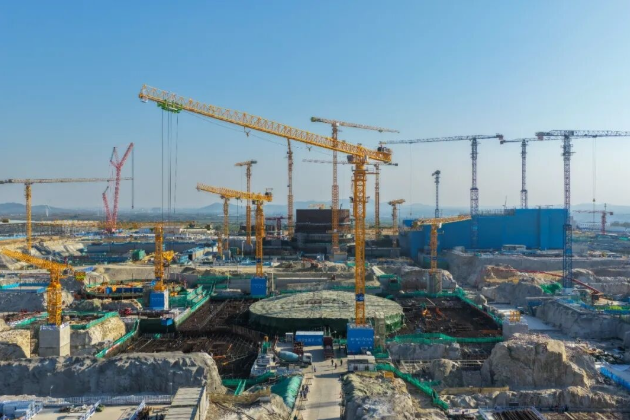
At the CGN Shandong Zhaoyuan Nuclear Power Project site, dozens of yellow tower cranes stand towering, their long steel arms crisscrossing and dancing in the air, and the nuclear island reactor building has already risen from the ground. Nearby, the 48 pairs of herringbone columns of the cooling tower have been poured and closed, with the grand arc beginning to take shape. The project plans to build six million-kilowatt-class pressurized water reactor nuclear power units, adopting China's “Hualong One (China's independently developed third-generation pressurized water reactor nuclear power technology with extremely high safety and economy)” third-generation nuclear power technology, with a single unit capacity of 1.2 million kilowatts. Currently, Phase I of the project has fully entered the construction stage. After all six units are completed and put into operation, they will output up to 50 billion kilowatt-hours of clean electricity annually, sufficient to meet the production and living electricity demand of over 5 million people.
At the Haiyang Nuclear Power Phase II base, construction of Units 3 and 4 is progressing steadily as planned, with full operation scheduled for 2027. By then, the four units at the Haiyang base will generate up to 40 billion kilowatt-hours annually, sufficient to meet half of Shandong Province residents' living electricity demand.
Meanwhile, the Laiyang Nuclear Power Project is also accelerating. On September 1, 2026, the pre-construction meeting for site leveling and the construction mobilization meeting for the Laiyang Nuclear Power main plant area were officially held, and site leveling construction is in full swing. Phase I Units 1 and 2 are planned to adopt the “Guohe One (CAP1400, China's independently developed large advanced pressurized water reactor nuclear power technology with enormous single-unit power)” third-generation pressurized water reactor nuclear power technology, with a rated power of approximately 1.54 million kilowatts per unit, and dual-unit commercial operation is expected to be achieved by the end of 2032.
The simultaneous advancement of the three major nuclear power projects has not only laid a steel foundation of baseload energy for Yantai but also driven an overall leap in the regional industrial chain. The Zhaoyuan nuclear power project alone has already established cooperative relationships with more than 300 Shandong local enterprises, creating an industrial magnet effect of “central enterprises building major projects, local supply chains following suit.”
Chain Leaders and Industrial Chains: Building a Full Closed Loop of Green Power through “Production-Storage-Use-Recycling”
The explosive growth of clean energy installed capacity has brought about a problem commonly faced by the industry: how to ensure the safety, stability and efficient utilization of the energy system, and avoid “curtailment of wind and solar power” and energy waste?
Yantai's answer is not a point-like breakthrough in a single field, but a complete green power industrial closed loop from “production” to “storage” to “use” and finally to “recycling.”
In this closed-loop system, the deep participation of chain leader enterprises is crucial. As a global chemical industry leader, Wanhua Chemical is accelerating its transformation toward the new energy materials track, laying out lithium iron phosphate battery material production capacity at multiple locations within Shandong Province. In March 2026, Phase I of the Wanhua Haiyang Green Power Industrial Park was officially put into production, achieving an annual output of 100,000 tons of lithium iron phosphate, fully adaptable to the diversified needs of the power battery and energy storage markets. Meanwhile, the Wanhua Green Power Industrial Park in Laizhou is also accelerating, with a planned annual production of 650,000 tons of lithium iron phosphate. The cross-sector landing of chemical giants has achieved seamless integration of local green power consumption and high-value-added new material manufacturing.
At the end of the battery industry chain, retired batteries also have a green destination with a “Yantai solution.” Jereh Group has independently developed key technology and equipment for modular, clean and efficient separation of retired lithium batteries, achieving efficient recycling and resource utilization of waste lithium batteries. Currently, Jereh's complete sets of technical equipment have been successfully applied in recycling plants of leading global battery companies, and five major stations have been laid out domestically in Zhengzhou, Chongqing, Guangzhou, Jiuquan and other locations. By the end of 2026, a seven-major network layout covering the entire country is expected to be completed, drawing the final green circle for the new energy industry chain.
Yantai's multi-energy complementary landscape is unfolding comprehensively:
Offshore wind power: 7 offshore wind power projects have been grid-connected, with a total capacity of 2.72 million kilowatts, ranking first in Shandong in grid-connected capacity;
Photovoltaic power generation: installed capacity has exceeded 9 million kilowatts;
LNG storage and transportation: Three major projects—PipeChina Nanshan, Sinopec Longkou, and Zhongchengxiang Xigang District—have completed their main structures. Upon completion, the annual receiving and unloading capacity will reach 16.5 million tons, helping Yantai become the largest LNG supply and storage base in northern China.
A new energy system featuring coordinated development of “nuclear, wind, solar, hydrogen, storage and LNG” is accelerating its formation on the shores of the Yellow Sea and Bohai Sea.
Technology Roadmaps: Scenario Expansion from Marine Hydrogen Energy to Deep Peak Shaving
The energy revolution is not just a competition of scale, but also a frontier exploration of technology roadmaps and application scenarios. Yantai has launched all-around breakthrough attempts on three major technology roadmaps: marine hydrogen energy, new energy storage, and flexibility retrofitting of traditional thermal power.
Roadmap One: Marine Hydrogen Energy——An “Offshore Energy Island” 5 Kilometers Offshore
Offshore hydrogen production is a frontier pathway for local green power consumption. Five kilometers offshore in the waters east of Yantai stands China's first marine hydrogen-ammonia-methanol integrated pilot project semi-submersible test platform. This massive “offshore steel beast” has more than half of its area covered with densely packed photovoltaic panels, and the surrounding sea surface is also equipped with floating offshore photovoltaic modules.
Electrochemical energy storage devices are installed inside the platform's containers, converting solar energy collected during the day into electricity for storage. The platform's core area is equipped with advanced hydrogen production equipment, designed to achieve 20 standard cubic meters per hour (Nm³/h, standard cubic meters per hour) of direct seawater hydrogen production and 150 standard cubic meters per hour of freshwater hydrogen production. The hydrogen produced is used locally as raw material, with an annual synthesis capacity of 40 tons of methanol and 180 tons of ammonia. This not only solves the challenge of offshore green power consumption, but the green ammonia and green methanol produced can also be directly used as clean fuel for ocean-going vessels, providing a new solution for global shipping decarbonization.
Roadmap Two: New Energy Storage——The “Super Capacitor” of the Onshore Power Grid
Offshore hydrogen production solves “production,” while onshore energy storage solves the grid's “storage” and “discharge.” In Zhuqiao Town, Laizhou City, Shandong Province's first regional-level large-scale energy storage center——the Yantai Energy Storage Center (Western) project——has risen from the ground.
As the grid's “super battery,” the project stores electricity during low-demand periods and releases power during peak periods. Its first batch of 100MW/200MWh (megawatts/megawatt-hours, representing charge-discharge power and total energy storage capacity respectively) project successfully completed grid-connected trial operation in July 2026; the second batch of 350MW/750MWh project has completed EPC bidding and is proceeding with pre-construction procedures.
Roadmap Three: Thermal Power Transformation——From “Ballast Stone” to “15-Minute Peak-Shaving Sensitizer”
With the large-scale grid connection of new energy, its volatility poses challenges to grid security. Traditional thermal power has not been simply eliminated but has quietly transformed into the grid's “regulator.”
At the Huaneng Yantai Power Plant 2×660,000 kW cogeneration project site (total investment of approximately 5.6 billion yuan), construction is fully transitioning to the above-ground main structure stage. The project adopts “steam turbine low-pressure cylinder zero-output + bypass + extraction combined heating technology,” achieving a minimum deep peak-shaving capability of 20%. After commissioning, annual power generation will reach 4.6 billion kilowatt-hours, with heating capacity exceeding 42 million square meters. The complete set of supporting environmental protection facilities reduces sulfur dioxide and soot emission concentrations by more than 80% compared to traditional units.
More representative is the Huaneng Yantai Power Plant 2×9F gas turbine power generation project. Since the two gas units were commissioned on January 1, 2026, they have accumulated 89 start-stop cycles and generated 105 million kilowatt-hours of electricity. During the critical summer peak period of 2026, the project set a record of 12 start-stop cycles in 4 days, completing 240MW load adjustment in just 15 minutes during peak periods, demonstrating extremely strong flexibility and response speed.
Talent Ecosystem: The “Science Drifters” Behind Hardcore Engineering and the Industrial Soil
The hundred-billion-level industrial layout and high-intensity project advancement are inseparable from the support of a vast engineering and technical talent pool and an excellent business ecosystem.
At the nuclear power construction site in Zhangxing Town, Zhaoyuan, the energy storage stations in Laizhou, the offshore platforms, and the pouring sites of Huaneng Thermal Power, tens of thousands of nuclear power engineers, new energy material experts, chemical process engineers and highly skilled industrial workers have gathered in Yantai, forming a unique and vibrant “science drifter” community [to be verified].
The deep embedding of the three major nuclear power central enterprises has not only brought capital and technology but also built national-level industrial innovation platforms. Around nuclear power construction, Wanhua new material R&D, and Jereh environmental protection equipment manufacturing, Yantai is forming a talent ecosystem of “central enterprise high-end talent demonstration + local university supporting cultivation + leading enterprise practical incubation.”
More than 300 Shandong enterprises have established cooperative relationships with Zhaoyuan Nuclear Power, behind which are tens of thousands of high-tech jobs and dozens of innovation teams taking root. This hardcore soil of “gathering talent through projects and retaining talent through industry” has injected a continuous stream of humanistic warmth and innovation momentum into the development of Yantai's emerging industries.
Winds Rise over the Yellow Sea and Bohai Sea: A Trillion-Dollar City Charts the Energy Future
From the birth of Shandong's first nuclear power plant to three major nuclear power bases advancing in parallel; from the offshore hydrogen-ammonia-methanol integrated platform to the hundred-megawatt-level energy storage center on land; from Wanhua's green battery materials to Jereh's global recycling network——Yantai, with extremely rare industrial determination and systematic thinking, is answering the energy examination question posed by the times.
The reason Yantai has been able to precisely catch the “tailwind” of new energy time and again is not due to accidental luck, but comes from its long-term commitment to hardcore manufacturing, deep integration of central enterprise and chain leader resources, and forward-looking layout of the “production-storage-use-recycling” full industry chain ecosystem.
Entering the “15th Five-Year Plan,” entering the critical period of accelerated release of new quality productive forces, the winds and waves along the shores of the Yellow Sea and Bohai Sea remain surging.
This trillion-dollar city is using the deepest nuclear energy foundation, the most dynamic wind-solar-hydrogen-storage, and the most resilient industrial ecosystem to write a highly reference-worthy Yantai answer sheet for the green and low-carbon transformation of Chinese-style modernization. Winds rise over the Yellow Sea and Bohai Sea; the green dream launches the future.
Disclaimer: Information republished from partner media, institutions or other websites is provided for reference and communication purposes only. It does not imply endorsement of its views or verification of its accuracy. Please contact us if any content infringes rights or requires correction.