
The Qualitative Leap from "Able to Build" to "Adept at Building": An In-Depth Analysis of the Technological Breakthrough and Industrial Restructuring of the "Hualong One Version 2.0"
 Scan to share
In September 2026, with the convening of the high-quality commencement mobilization meeting for the first batch of demonstration projects——the Phase II project of Zhejiang Jinqimen Nuclear Power Plant——and the full-scale launch of site leveling and excavation work, "Hualong One Version 2.0" officially sounded the clarion call for its march from technological R&D to engineering practice.
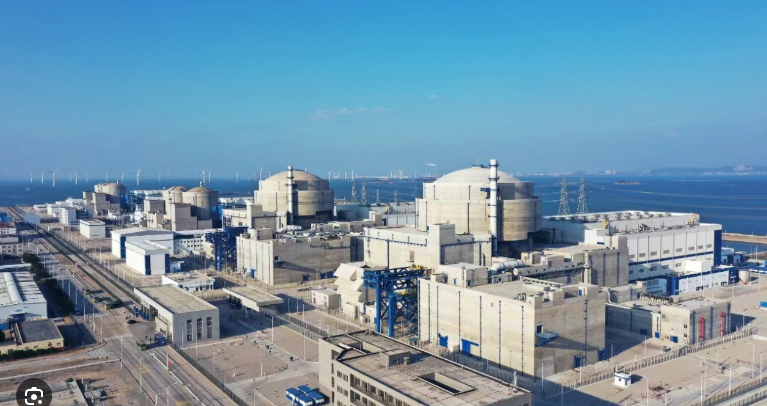
As a third-generation pressurized water reactor nuclear power model with fully independent intellectual property rights, "Hualong One" has undergone a decade of tempering, with 12 units in commercial operation and 35 units approved for construction, bringing the total number of units to the top of the world's third-generation nuclear power rankings and making it a globally shining "national calling card." However, as nuclear power powers in Europe and America find themselves mired in supply chain degradation, runaway construction schedules, and investment black holes, and as the global small modular reactor (SMR) concept remains stuck in the tug-of-war between PowerPoint presentations and early-stage demonstrations, China's nuclear energy sector has not rested on its existing achievements, but has instead taken "Jinqimen Phase II" as its starting point and resolutely pressed the accelerator key for its evolution toward "Generation III+."
Hualong One Version 2.0 is not a castle in the air built by overturning everything and starting from scratch, but rather a "systematic quality improvement and efficiency enhancement" based on ultra-large-scale engineering practice. Behind this leap, what exactly does it contain in terms of safety philosophy reconstruction, engineering cost revolution, technological sovereignty closed loop, and great-power heavy equipment industrial chain synergy? This article will conduct an in-depth analysis from four dimensions: safety mechanisms, engineering economics, underlying autonomy, and industrial matrix.
Qualitative Transformation of Safety Philosophy: From "Mechanical Redundancy Assembly" to "Physical Intrinsic Self-Sustenance"
The most distinctive technical label of Hualong One Version 1.0 is its safety design of "combining active and passive systems." However, at the level of engineering philosophy, Version 1.0 to a large extent juxtaposed mature active safety trains with backup passive systems, resulting in relatively high system complexity.
Hualong One Version 2.0, by contrast, has achieved a fundamental paradigm shift in core safety mechanisms: establishing the absolute dominance of passive systems and transforming active systems into supplementary barriers for defense-in-depth and extreme operating conditions.
1. Engineering Closed Loop of the "Trinity" Passive Defense Matrix
In the Version 2.0 design, the main force for responding to design-basis accidents (DBA) has been fully switched to three major passive systems:
Passive safety injection system: In the event of a loss-of-coolant accident (LOCA), without the intervention of high-pressure injection pumps, it relies purely on pressure differential and gravity head to instantly inject boric acid cooling water into the core;
Secondary-side passive residual heat removal system: Under the extreme condition of a station blackout (SBO) with total loss of AC power, it establishes a closed natural circulation loop through the temperature differential density cascade between the steam generator and the emergency cooling water tank, continuously discharging decay heat to the atmospheric heat sink;
Passive containment heat removal system: High-temperature steam inside the containment is cooled through condensation, gravity reflux, and external wall air convection, keeping containment pressure and temperature firmly suppressed within structural limits.
2. Complete Escape from the "Fukushima-Style Predicament"
The core achievement of this optimization lies in the qualitative leap in "accident self-sustenance capability (Grace Period)." Faced with all-dimensional extreme conditions similar to the Fukushima nuclear accident—"beyond-design-basis major earthquake + massive tsunami + station blackout + road blockage"—Hualong One Version 2.0 does not rely on any external AC power, does not rely on emergency diesel generators, does not rely on any rotating equipment (pumps/fans), and requires no operator intervention for 72 hours or even longer. The system operates autonomously entirely on immutable natural physical laws such as gravity, evaporation, condensation, and pressure differential, achieving physical intrinsic safety with "no core meltdown" and "zero radioactive release."
Breaking the Cost Curse: The Cost Revolution from "Double-Layer Containment" to "Lean Modularization"
On the international nuclear power stage, the main reason why Western third-generation nuclear power projects (such as France's Flamanville 3, the UK's Hinkley Point C, and the US's Vogtle 3/4) have repeatedly suffered setbacks is not theoretical or technical defects, but runaway schedule delays and astronomical cost overruns. For third-generation nuclear power to have commercial viability in the era of global grid parity, it must solve the engineering economics proposition of "being affordable to build and fast to construct."
Hualong One Version 2.0 demonstrates the extremely rare lean optimization courage of China's engineering community: while substantially raising safety levels, it has achieved a "major slimming down" of system configuration.
1. Structural Breakthrough of the Enhanced Single-Layer Prestressed Containment
Version 1.0 adopted a typical "double-layer containment" design. Although the physical isolation was clear, the construction process for the narrow annular space between the inner and outer shells was extremely complicated, with complex high-altitude formwork support, seriously delaying the critical path schedule of main plant civil construction.
Version 2.0 broke through traditional path dependency and innovatively adopted an enhanced single-layer prestressed containment with thickness increased to 1.5 meters;
Combined with the topological optimization of the internal room layout of the containment, the new structure, supported by the mechanical properties of materials and high-ductility prestressed steel tendons, is fully comparable to the original double-layer design in its resistance to malicious impact from large commercial airliners, overpressure resistance, and seismic performance;
This disruptive change directly streamlined the consumption of bulk concrete and special steel, eliminated the complex annular space ventilation, filtration, and monitoring systems, not only causing a precipitous drop in direct engineering costs but also clearing spatial obstacles for equipment installation in the main plant.
2. "Building-Block" Style Factory-Based Super Module Construction
A major crux of the slow construction of Western third-generation reactors is the heavy on-site reliance on manual wet operations (rebar tying, cast-in-place pouring). Hualong One Version 2.0 deeply incorporates China's globally leading modern industrial manufacturing dividends:
Prefabrication of large structural and electromechanical modules: Complex steel plate concrete composite structures (SC structures), large piping galleries, valve group stations, and even entire pump compartments inside the nuclear island are precisely prefabricated in advance at specialized manufacturing bases with constant-temperature and constant-humidity environments;
Ultra-heavy-tonnage lifting and positioning: Thousand-ton-class super crawler cranes are used for direct on-site assembly, with on-site work cycles compressed to the extreme;
This "building-block" assembly mode not only completely eliminates safety and quality hazards of high-altitude cross-operations on site, but also significantly shortens the standard reference construction period to within 50 months, greatly reducing the enormous interest cost during construction (IDC) and substantially boosting the internal rate of return (IRR) over the unit's full lifecycle.
Laying the Foundation of Underlying Sovereignty: Comprehensive De-Vulnerabilization of Software, Standards, and Core Equipment
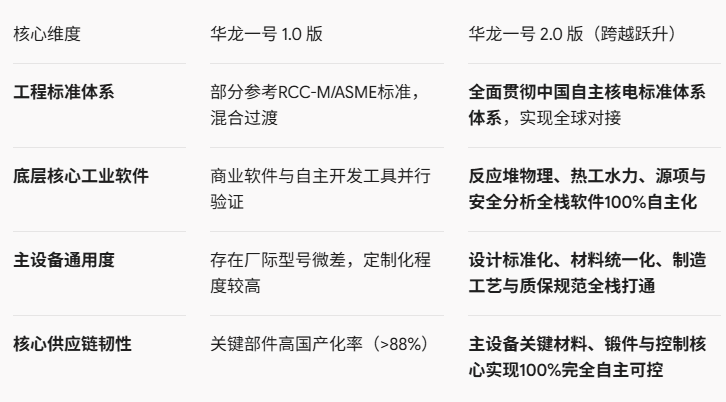
In an era of increasingly fierce technological competition among major powers, competition in industrial systems has long transcended simple OEM manufacturing of physical hardware, extending to comprehensive discourse power over underlying industrial software code, industrial standards, and engineering systems. The "deep-level autonomization" of Hualong One Version 2.0 marks that China's nuclear industry has completely walked out of its psychological reliance on and hidden dependence on overseas technological architectures.
1. Cracking the "Achilles' Heel" of Industrial Software
For a long time, global nuclear engineering calculations have been highly dependent on classic software toolkits dominated by the West. Hualong One Version 2.0 has achieved comprehensive replacement and engineering validation of a full set of independently developed underlying EDA industrial software, including reactor neutron physics transport, transient thermal-hydraulic coupling, severe accident source term evolution, and environmental shielding design. The independent software not only achieves internationally first-class computational accuracy and efficiency, but also completely eliminates the strategic systemic risk of the nuclear industry's underlying algorithms being "choked" or covertly discontinued by external parties.
2. Standardization-Driven Scale Manufacturing Dividends
In the past, subtle barriers existed among different nuclear power owners or manufacturers regarding main equipment technical documents, welding and heat treatment specifications, and inspection and testing standards, constraining the ultimate release of supply chain capacity. Version 2.0, by establishing a unified main equipment standard system (unified materials, unified quality assurance, unified acceptance criteria), enables domestic equipment manufacturing bases to carry out standardized assembly-line mass production. Equipment consistency, interchangeability, and reliability have achieved a qualitative leap, completely bidding farewell to the remnants of the "one furnace, one design; one machine, one process" handicraft workshop era.
Industrial Ecosystem Reshaping: A Trillion-Level Source of Momentum Supported by Nearly 6,000 Enterprises in the Chain
The implementation of Hualong One Version 2.0 is by no means merely the construction of a single power plant project; it is a grand industrial expedition led by chain-leader enterprises propelling China's high-end manufacturing industry as a whole into the deep-water zone of high added value.
1. Manufacturing Upgrade Engine Under the Chain-Leader Model
Hualong One Version 2.0 directly drives deep collaboration among nearly 6,000 upstream and downstream enterprises across the country:
From reactor pressure vessels and steam generators forged by ten-thousand-ton-class hydraulic presses, to millisecond-response nuclear-grade digital instrumentation and control systems (DCS);
From special stainless steel thin-wall tubes and special valves for high-temperature, high-pressure extreme conditions, to nuclear-grade sealing materials and radiation-resistant high-sensitivity sensors—this extremely stringent nuclear industry quality assurance and manufacturing system has forced China's metallurgy, precision machinery, instrumentation, and specialty chemicals industries to achieve cross-generational quality leaps, directly pushing the overall process tolerance bands and quality control levels of China's heavy industry to an entirely new height.
2. Cornerstone of "Dual Carbon" and Source of New Quality Productive Forces
In the construction of new-type power systems, the volatility of wind and solar renewable energy requires strong stable baseload support for hedging. A single Hualong One Version 2.0 unit generates over 10 billion kWh annually, capable of meeting the high-quality clean living and industrial production needs of millions of people.
Of even deeper significance, the basic scientific research paradigms, forward design capabilities, and extreme-condition industrial databases accumulated through Hualong One Version 2.0 are comprehensively integrating with emerging technologies such as artificial intelligence, digital twins, and advanced materials. This independent nuclear power platform not only constructs the main defense line of current third-generation nuclear power, but also continuously delivers core manufacturing processes, standardized specifications, and top-tier engineering talent for the engineering implementation of China's future fourth-generation advanced fission reactors (high-temperature gas-cooled reactors, lead/sodium-cooled fast reactors) and fusion reactor projects.
Conclusion and Future Outlook
Against the backdrop of today's complex reshaping of the global energy geopolitical landscape and an industrial restructuring full of uncertainty, the launch of Hualong One Version 2.0 marks that China's nuclear industry has officially bid farewell to the historical stage characterized by "following, imitating, digesting, and absorbing," and has proudly entered a "leading era" in which it sets its own standards, defines engineering paradigms, and leads industrial iteration.
Facing fiercer international energy market competition and the domestic "dual carbon" battle in the future, based on the successful start of the first batch of demonstration projects such as Jinqimen Phase II, it is recommended that all sectors of the industry grasp the following three strategic pivots in subsequent advancement:
Accelerate the distillation of "first-of-a-kind experience" into mandatory national and industry standards: Attach great importance to the on-site engineering data accumulation at key nodes such as single-layer enhanced containment construction, passive system integrated commissioning, and large module assembly in the first batch of demonstration projects including Jinqimen Phase II. Rapidly transform technical validation into standard drawings and construction method guidelines to ensure seamless introduction into subsequent batch construction, and resolutely prevent the "demonstration reactor engineering pains" from being replicated in subsequent batches.
Build a "Nuclear+" multi-energy coupling and scenario expansion comprehensive value chain: While firmly grasping the primary responsibility of power baseload, leverage the extremely high thermal design margin of Version 2.0 to actively explore non-electric comprehensive utilization scenarios such as high-parameter steam supply for industrial parks, nuclear seawater desalination, nuclear hydrogen production, and synthetic green ammonia, transforming million-kilowatt-class units into large zero-carbon energy complexes with multiple functions of power supply, heat supply, and water supply.
Jointly go global with the "national calling card" to establish an international credibility benchmark: With the confidence of fully mastering underlying software and hardware intellectual property rights and China's independent standards, CNNC, CGN, and key upstream and downstream equipment enterprises should further strengthen the industrial going-global alliance. Package the outstanding safety (physical self-sustenance without electricity), highly competitive construction period, and full-lifecycle cost advantages of Hualong One Version 2.0 into an extremely attractive "turnkey solution," demonstrating the hardcore responsibility of Made in China in Belt and Road partner countries and emerging economies eager to escape energy poverty.
The turning of the soil at Jinqimen is the first track mark of Hualong One Version 2.0 stepping into reality. Reconstructing safety with natural laws, taming costs with industrial power, and forging a great-power heavy equipment with an independent heart—this is precisely the resounding answer that Hualong One Version 2.0 gives to the world.
Disclaimer: Information republished from partner media, institutions or other websites is provided for reference and communication purposes only. It does not imply endorsement of its views or verification of its accuracy. Please contact us if any content infringes rights or requires correction.