
CNNC 24's Micro-Innovation Accelerates Hualong One Construction
 Scan to share
Recently, at the nuclear island construction site of the "Hualong One" Zhangzhou Nuclear Power Project, the CNNC 24 project team successfully resolved a construction bottleneck in the vertical lifting and docking of prefabricated rebar mesh sheets through a self-developed "quick-release tooling for vertical rebar docking." This on-site "micro-innovation," refined through multiple iterations, enables large prefabricated rebar mesh sheets weighing 8 tonnes and standing 6 meters tall to achieve rapid locking with a single "insert-and-buckle" action, significantly reducing tower crane occupancy time by approximately 83%, pressing the "acceleration button" for the batch construction of Hualong One.
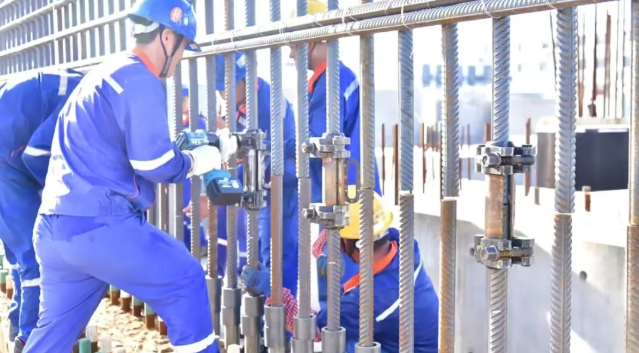
In response to the complex structure and enormous rebar consumption of the Hualong One nuclear island, the project department has vigorously promoted modular construction, moving traditional high-altitude tying operations to the ground and pre-forming large-size rebar mesh sheets before hoisting them into position as a whole. However, the new process encountered a technical bottleneck in its early implementation: after the mesh sheets were positioned, they required vertical docking with the pre-embedded dowel bars at the bottom. The traditional method relied on diagonal bracing for temporary fixation and required waiting until a certain proportion of mechanical connections were completed before the lifting slings could be removed. This step caused the tower crane to remain suspended and waiting for extended periods, severely constraining overall work efficiency.
To address this on-site pain point, the project department's Party Committee promptly formed a cross-team task force and, in less than 20 days, successfully developed a quick-release buckle tooling that requires no welding and no forceful tightening. Relying on a buckle, pin, and quick-lock structure, the tooling enables the mesh sheets to be instantly anchored upon landing without waiting for mechanical connections. Installation requires only a single locking action, and removal requires only a single release action, transforming mesh sheet docking from "waiting for connection" to "flow-line operation."
In response to the problems exposed by the first-generation tooling under real working conditions, the project department's Party member commando team and technical personnel continuously went to the front line to carry out iterative optimization. The technical team first reduced the thickness of the tooling's transverse ribs, strictly controlling it within 5 mm, thereby reserving sufficient clearance for subsequent sleeve connections; secondly, transverse ribs were added at the ends of the components, greatly improving overall anchoring stability; finally, the bell-mouth opening was reduced to within 20 mm, making it perfectly suited for narrow construction areas such as double-layer walls. Through this series of concentrated optimizations, the quick-release tooling achieved the application effects of tight gripping, accurate positioning, and fast removal, and a "Operation Instruction Manual for Quick-Release Tooling for Vertical Rebar Docking" has been formulated to standardize on-site practices.
At present, this quick-release tooling has been combined with multi-functional rebar and embedded part installation equipment, a new roof support system, and other processes to fully implement "human-machine collaboration" at the Zhangzhou Nuclear Power Project. As the critical fourth-quarter sprint period is underway, this series of solid data and lean efficiency gains are powerfully driving the batch construction of Hualong One steadily forward.
Disclaimer: Information republished from partner media, institutions or other websites is provided for reference and communication purposes only. It does not imply endorsement of its views or verification of its accuracy. Please contact us if any content infringes rights or requires correction.