
"Major National Heavy Equipment · Industrial Answer Sheet" In-Depth Analysis of Independent Supporting of Core Parts of China's Hualong One
 Scan to share
According to reports, on October 3, the News Center of the State-owned Assets Supervision and Administration Commission of the State Council of China and the Finance Channel of China Central Radio and Television Station jointly launched "Major National Heavy Equipment · Industrial Answer Sheet," with the first episode focusing on China's nuclear industry. Zhang Tao, General Manager of China National Nuclear Corporation, explained the key components of the Hualong One.
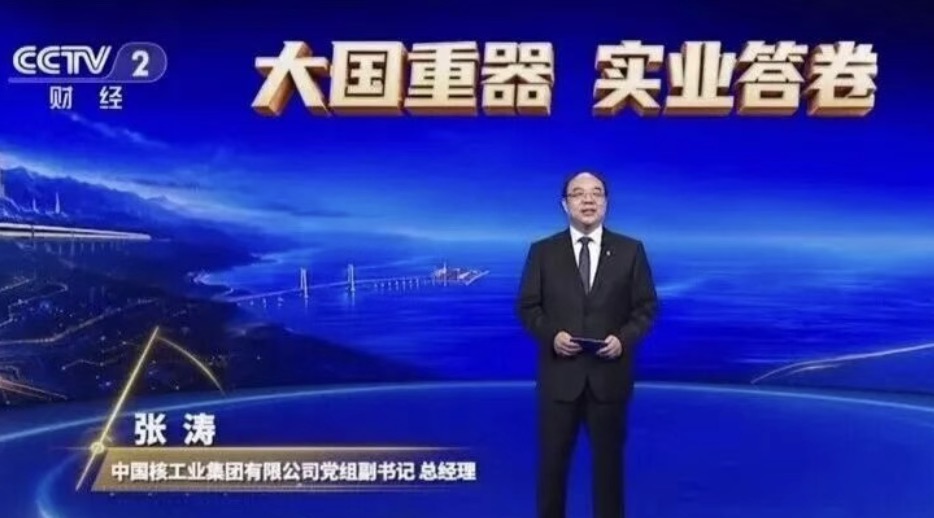
The program disclosed that the steam generator support buffer block is the size of an eraser and weighs less than 80 grams, yet it can withstand an impact force of 45 tons, equivalent to the crushing weight of 10 adult elephants. This detail brings China's nuclear power independence from the narrative of complete units back to the component level. The following analyzes the significance of this breakthrough from several aspects.
Why a small part is the key to the safety chain
This component needs to achieve large-deformation energy absorption under extreme conditions such as earthquakes and pipe rupture, while withstanding 190°C high temperature and boric acid corrosion. It is not an ordinary accessory, but an irreplaceable link in the nuclear island safety chain. China's ability to manufacture it independently and make its performance superior to imported products shows that the breakthrough occurred at the underlying levels of materials, structure, and processes. The biggest fear in complete-unit localization is “localized complete unit, imported key components.” Independent supporting of the buffer block fills this gap.
From import dependence to performance surpassing
This part was long dependent on overseas imports. The Institute of Metal Rubber and Vibration Noise of Fuzhou University, together with China Zhongyuan Engineering Corporation, China Nuclear Power Research and Design Institute, and others, jointly tackled the problem, proposing a spiral winding forming process and overcoming key technologies such as nonlinear stiffness control, high-temperature and high-load stability, and long-life high resilience. Tested by an authoritative third-party institution, all performance indicators are superior to the benchmark imported products, and the overall technology has reached the international advanced level. The core equipment of the Hualong One has achieved full independent Chinese supporting. This industry-university-research-application joint model is more worth replicating than the individual part itself.
What the approval of Version 2.0 means
The program also released a key signal: the Hualong One 2.0 demonstration project has been approved by the State Council of China. On July 31, the executive meeting of the State Council of China approved 8 nuclear power units, and China's Guangdong Province Taipingling Nuclear Power Phase III was designated as the Hualong One 2.0 demonstration project. Version 2.0 comprehensively optimizes 14 safety features on the basis of the original defense-in-depth safety system, and can achieve 72 hours of no operator intervention after an accident and 7 days of accident self-governance, with key equipment possessing 100% independent Chinese manufacturing capability. This shows that China's nuclear power does not stop at the first unit, but uses operating experience to drive design iteration, and the independent supply chain is supporting the upgrade to “Generation III+.”
The real test after ranking first in scale
From the perspective of the global nuclear energy market, China's total installed capacity of nuclear power units in operation, under construction, and approved for construction has reached 125 million kilowatts, ranking first in the world. The Hualong One has 10 units in commercial operation globally, with another 37 units approved and under construction. The total number of units firmly ranks first among Generation III nuclear power units globally, making it the most commercially deployed Generation III nuclear power model in the world. With the global nuclear energy revival and rising energy security demand, what the international market values is no longer just technical parameters, but also delivery capability, cost control, spare parts supply, and long-term operation and maintenance. China's independent supporting capability is the underlying bargaining chip for nuclear power export competitiveness. But being first in quantity does not equal long-term victory. For the Hualong One to participate in international market competition, it still needs to face regulatory review in export destination countries, international standard certification, financing arrangements, and geopolitical variables. Independent core components reduce the risk of supply cutoff, but safety operation and maintenance records and compliance capability are the true source of long-term trust.
It is reported that the independent supporting of the buffer block and the approval of the 2.0 demonstration project disclosed this time change not only the supply source of one part, but also the industrial logic of China's Generation III nuclear power moving from “being able to build” to “being able to continuously iterate, being able to deliver in batches, and being able to participate in global competition.” If the global nuclear energy market continues to recover, China's independent nuclear power supply chain will become an important variable.
Disclaimer: Information republished from partner media, institutions or other websites is provided for reference and communication purposes only. It does not imply endorsement of its views or verification of its accuracy. Please contact us if any content infringes rights or requires correction.