
Nuclear Power Plant Under Shuttered Lights: Exploring the Qidong "Hualong One" Intelligent Manufacturing Base
 Scan to share
Recently, reporters followed the "Green Nuclear Energy" nuclear power science popularization cooperation platform to participate in the "Hualong One Independent Innovation Journey" media tour, gaining an in-depth look at this intelligent manufacturing factory that carries China's nuclear power ambitions and wisdom. From discussing a problem late into the night, to the production line truly running, to the complete closed loop of the data chain, the story behind each achievement reflects China's nuclear power innovation determination to go from catching up to running in parallel and even leading, and also provides a valuable Chinese solution for intelligent manufacturing in the global nuclear energy field.
Inside the "Heneng Intelligent Manufacturing" base at Lusi Port in Qidong City, Jiangsu Province, even as night falls and the lights go out, the production workshop still maintains high-speed operation. Golden welding sparks keep flying, and robotic arms, like tireless "digital craftsmen," are finely grinding nuclear power pipes with millimeter-level precision. This is the first flexible intelligent manufacturing base in China to cover the entire process flow of nuclear power pipes, and it is also an important supporting platform for China's "Hualong One Version 2.0" and other new-generation nuclear power projects. When the precision machining craft of nuclear power pipes is fully handed over to artificial intelligence, the future vision of intelligent nuclear power manufacturing unfolds here.

The journey of this smart factory from nothing to something was not achieved overnight. Its birth began with the real confusion faced by Du Jingping, a "veteran" who has been rooted in the nuclear power frontline for more than 20 years. During the project planning stage, how to scientifically divide the workshop into zones, how to efficiently circulate materials, and how to reasonably configure equipment all required careful consideration. In order to make the base's production line planning deep and solid, Du Jingping chose to seek experience everywhere, knocking on the doors of peers time and again, recording excellent practices such as production line operation and process connection one by one. Through repeated deliberation and exchange late into the night, one blueprint after another finally took clear shape in Qidong.
In the prefabrication process of "Hualong One" pipes, the pipes need to go through six key processes: cutting, beveling, grinding, fitting, welding, and inspection. The biggest challenge among them is that fully automatic fit-up and tack welding of pipes and pipe fittings had long troubled teams at home and abroad. Ding Chao, deputy director of the Engineering Research Institute of China Nuclear Industry Fifth Construction Co., Ltd., explained that because the pipes delivered by the manufacturer themselves have certain ellipticity and wall thickness errors, traditional robots simply cannot align them accurately or weld them well. This places extremely high technical requirements on how robots "see" the pipes, how they track weld seams, and how they judge molten pool conditions. What lies before the team is a series of hard bones that must be gnawed through.
Facing this series of technical barriers, Ding Chao's team spent two consecutive months stationed on site, debugging day and night, accumulating tens of thousands of data points, and ultimately overcame key scientific problems such as real-time perception of the process environment and decision fusion, as well as multimodal perception-driven adaptive control. Through these breakthroughs, the team mastered core technologies including multi-robot collaborative welding and real-time perception and adaptive regulation of welding quality, and built a full-chain technical closed loop from perception and processing to inspection, control, logistics, and traceability, achieving an intelligent leap in the core processes of nuclear power pipes.
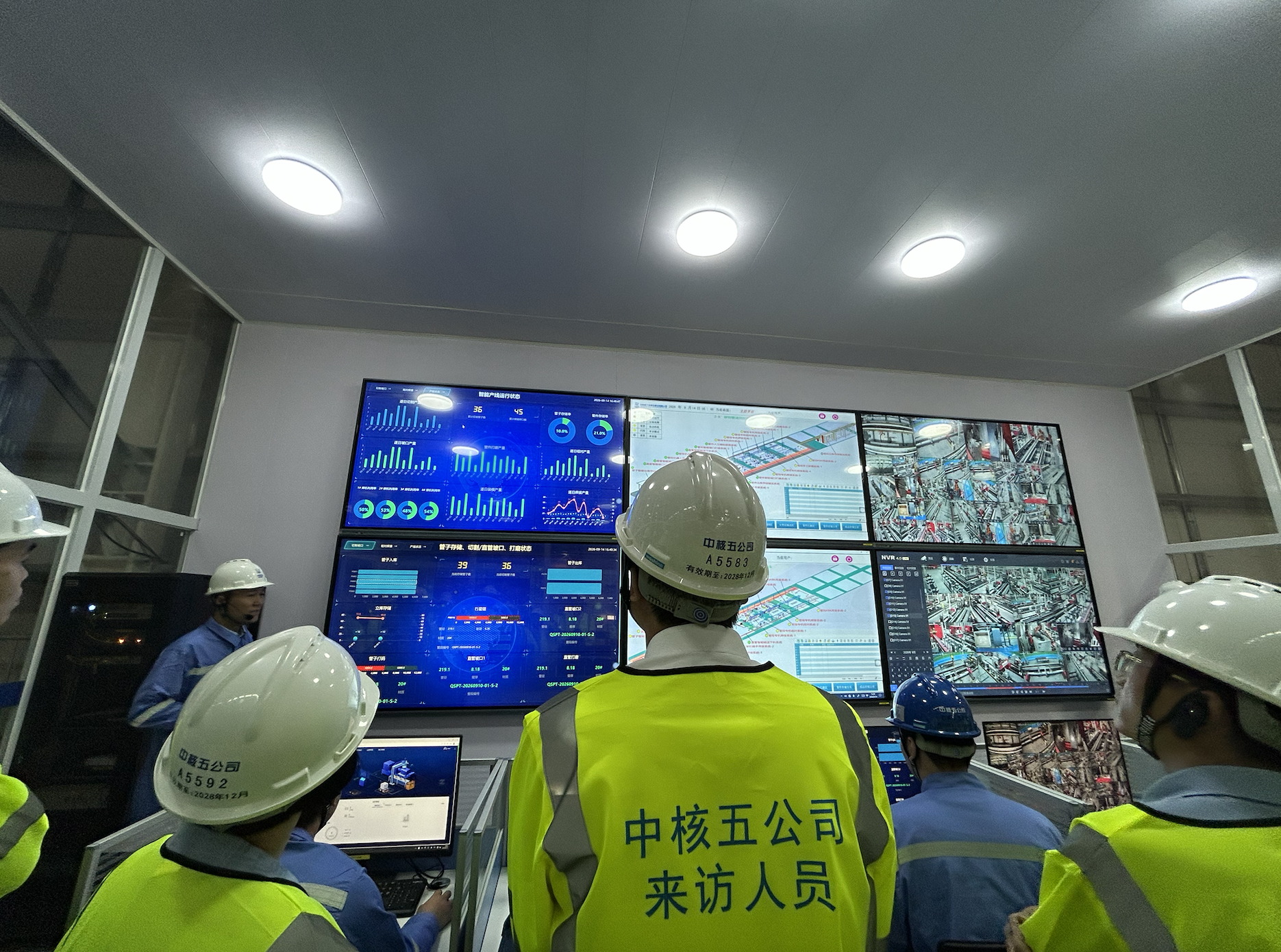
Unlike previous quality assurance models that relied on personal experience, this smart factory breaks the traditional operating logic of nuclear power quality assurance and attempts to use irreplaceable technical capabilities to write the most confident credit certificate for nuclear power quality. At present, 80% of the base's infrastructure construction has been completed. After the overall project is completed and put into operation at the end of 2026, the factory is planned to achieve an annual production capacity of 3 million points of nuclear power pipes and supports, as well as 30,000 tons of other nuclear and non-nuclear modules, marking that nuclear power manufacturing has fully entered a new stage of data-driven development.
At the workshop site, reporters personally witnessed the new scene in which welding of nuclear power main pipes, long dependent on manual operation in the past, has been fully replaced. Chief welding technical expert Kong Liduo pointed out that main pipes now fully adopt automatic welding technology, reducing the amount of deposited metal by nearly half and greatly lowering the subsequent grinding workload. This not only reduces labor intensity and improves the working environment, but also effectively avoids individual deviations in manual operation, making welding parameters fully controllable throughout the process, retained in real time, and weld seam formation uniform and stable.
It is worth mentioning that the outstanding technical performance of these intelligent robots is still inseparable from the underlying data accumulated over time by veteran masters. Chief welding skill expert Luo Kaifeng emphasized that the logic of welding and the boundaries of parameters still need to be summarized and calibrated by experienced masters. Solid manual skills are an important support for automated welding technology. Only by achieving accurate prediction and adjustment can the forming quality of weld seams be guaranteed. This integration of "manual plus intelligent" is precisely the correct path for China's nuclear power engineering to move toward intelligent manufacturing.
Looking ahead, the base is not satisfied merely with becoming a cog in nuclear power manufacturing. General Manager Du Jingping stated that in the future it will build a civil conversion platform for nuclear-grade manufacturing, strive to become a replicable and promotable industry model for intelligent flexible production lines, provide high-reliability prefabricated products for fields such as nuclear power, petrochemicals, and new energy, fully transform and promote the application of "intelligent manufacturing technology for process piping in nuclear power engineering," and realize industrialized application in broader industrial fields.
Disclaimer: Information republished from partner media, institutions or other websites is provided for reference and communication purposes only. It does not imply endorsement of its views or verification of its accuracy. Please contact us if any content infringes rights or requires correction.