
Tennessee's Top Officials Push Hard to Bind Nuclear Energy with Data Centers: Tennessee's Computing Blueprint and the Clash with Reality
 Scan to share
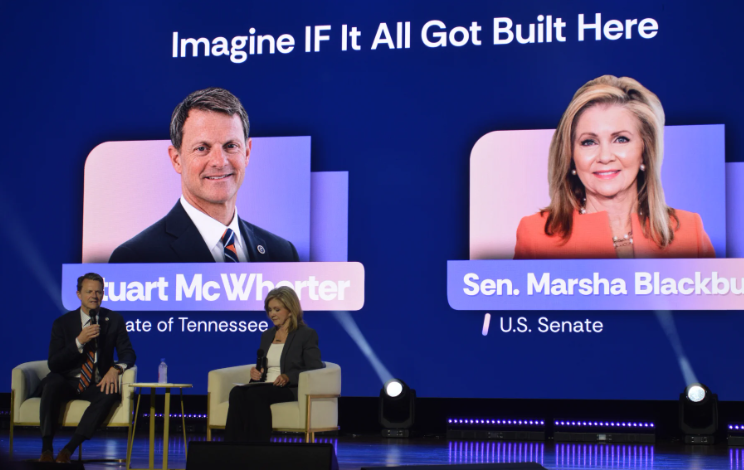
Against the backdrop of an increasingly white-hot global artificial intelligence arms race, competition in computing infrastructure has substantively evolved into competition in energy supply capacity. Recently, at the ImagineIF tech futurism conference held in Nashville, multiple Tennessee political figures collectively spoke out, outlining a strategic blueprint centered on Oak Ridge and relying on nuclear energy and small modular reactors (SMRs) to power hyperscale data centers across the United States. However, beneath the grand framework of a multi-trillion-dollar investment vision and the historical narrative of the “Manhattan Project,” this industrial concept is facing multiple real-world interrogations, including regulatory approval bottlenecks, lagging power grid interconnection, rising community resistance, and environmental equity.
I. The Intersection of Energy Transition and AI Competition: Computing Infrastructure Enters the “Nuclear Age”
With the explosive expansion of generative artificial intelligence, large language models, and advanced intelligent computing clusters, the technology industry is encountering an unprecedented “hard constraint” on electricity supply. Traditional power grids are gradually approaching saturation, and coupled with the decarbonization and net-zero commitments set by tech giants, nuclear energy—which possesses both zero-carbon emissions and round-the-clock baseload power characteristics—has leapt to become the favored new energy darling of decision-makers in Silicon Valley and Washington.
At the ImagineIF conference held at Belmont University in Nashville, technology and political elites from Tennessee clearly signaled this. U.S. Senator Bill Hagerty stated bluntly that in the coming years leading up to 2030, the scale of capital commitments globally required to sustain artificial intelligence and computing expansion will reach as high as $7.5 trillion to $8 trillion, and Tennessee is at the core of this massive infrastructure buildout. From Microsoft, Amazon to Google, the thirst of leading tech companies for stable, uninterrupted clean energy is prompting U.S. states to launch a new round of regional economic competition around “nuclear energy + computing power.”
For a long time, traditional renewable energy sources (such as wind and solar) have been unable, due to their inherent intermittency and volatility, to single-handedly shoulder the responsibility of 99.999% high-reliability operations for hyperscale data centers; energy storage technology also faces engineering ceilings in terms of cost and continuous discharge duration. Therefore, directly “point-to-point” coupling or co-locating nuclear power facilities with data center clusters is moving from conceptual demonstration toward commercial implementation. This logic constitutes the core underlying support for Tennessee's political circles' attempt to build the state into a “new AI engine” for the nation and even the world.
II. Historical Echoes and Industrial Capital: Tennessee's Nuclear Ambitions
Tennessee grounds its computing and nuclear blueprint in deep historical foundations. Oak Ridge National Laboratory (ORNL) and the Y-12 National Security Complex, which served as secret bases for the “Manhattan Project” during World War II, have endowed East Tennessee with incomparable nuclear energy research and development accumulation, a professional talent pipeline, and a highly collaborative military-industrial and scientific research ecosystem. In addition, the abundant land space of the Appalachian Mountains and the ample water resources of the Tennessee River Valley provide excellent natural endowments for high-energy-consumption, high-water-consumption computing centers and nuclear cooling systems.
At this conference, U.S. Representative Chuck Fleischmann of Tennessee and U.S. Senator Marsha Blackburn, who is expected to contend for the governorship, repackaged this set of historical assets. Blackburn predicted that within the next eight years, “the whole world will look to Oak Ridge as the leader of America's nuclear energy renaissance,” and reiterated her neoliberal investment recruitment principles of “low taxes, low regulation, and fewer lawsuits.”
This political narrative is not a castle in the air; behind it there are already substantive capital and regulatory developments:
First commercial SMR license breakthrough: The U.S. Nuclear Regulatory Commission (NRC) previously formally approved the Tennessee Valley Authority's (TVA) early site permit project for deploying the United States' first commercial small modular reactor (SMR) at the Clinch River site.
Industrial chain capital entry: The project received approximately $400 million in capital investment support from GE Hitachi, its partner, becoming a testbed for validating the commercial viability of next-generation nuclear power technology.
Ambition for scaled replication: Fleischmann even publicly declared that the goal is not merely to build one reactor, but to leverage industrial clustering effects to promote the construction of hundreds of modular nuclear reactors across the United States.
This attempt to bind cutting-edge nuclear technology with private technology capital marks Tennessee's effort to leap from a traditional manufacturing and logistics hub to a central node in the nation's intelligent computing network.
III. The Inherent Paradox Between Geopolitical Narrative and Fossil Energy Compromise
In the process of building momentum for hyperscale computing investment, geopolitical competition has become the most core mobilization tool for Washington and local politicians. Multiple decision-makers have repeatedly elevated data center construction to the dimension of “national strategic security,” emphasizing that in the U.S.-China technology competition, the outcome of computing scale will directly determine the ownership of artificial intelligence dominance. In his remarks, Fleischmann explicitly mentioned the enormous energy demand of emerging major powers and the pace of nuclear power expansion, attempting to use a “sense of crisis” to consolidate bipartisan and social consensus, and to provide a legitimacy basis for relaxing regulation and accelerating nuclear power deployment.
However, within this grand strategic vision lurks a technological and policy paradox that cannot be ignored: there is a severe temporal mismatch between the long-term commitments of nuclear energy construction and the immediate demand for computing expansion.
Although small modular reactors are superior to traditional million-kilowatt-class large pressurized water reactors in modular manufacturing and theoretical construction timelines, it typically takes years or even more than a decade from site selection, detailed NRC safety review, establishment of manufacturing supply chains, to final critical operation. By contrast, the iteration cycle of AI large models is measured in months, and the procurement cycle for tech companies' data centers is typically within 18 to 36 months.
To bridge this enormous time gap, Hagerty, Blackburn, and others, while vigorously depicting a zero-carbon nuclear energy future, have had to publicly defend the “life extension” and “short-term increased output” of coal-fired and natural gas power plants. This compromise directly exposes a dual contradiction: on the one hand, relying on high-carbon fossil energy to fill short-term power gaps runs counter to the ESG (environmental, social, and governance) decarbonization timelines proclaimed by large tech companies; on the other hand, frequently fluctuating natural gas prices and the high maintenance costs of aging coal-fired units further exacerbate the economic burden on regional power grids. An artificial intelligence revolution claimed to be driven by “clean nuclear energy” may, in its initial stage, have no choice but to remain mired in traditional fossil energy.
IV. Real-World Bottlenecks: Multidimensional Barriers Blocking the Blueprint's Implementation
From grand visions in conference rooms to implemented industrial clusters, the Tennessee plan faces four deep-seated real-world obstacles, spanning institutional, economic, social, and supply chain dimensions.
1. Regulatory Approval Deadlock and Political Polarization
Hagerty acknowledged at the conference that “permitting reform” at the federal level has suffered substantive setbacks. For a long time, the complex interagency assessment procedures of the U.S. National Environmental Policy Act (NEPA), as well as the extremely stringent licensing process of the NRC, have often plunged energy projects into years of administrative litigation and compliance quagmires. Even though Congress has attempted to promote simplified permitting processes under bipartisan compromise, against the backdrop of fierce electoral politics and partisan maneuvering, the advancement of any key legislation is extremely difficult, and institutional resistance has become the most destructive uncertainty factor for major energy projects.
2. Community NIMBY Effect and Electricity Cost Shifting
With the massive expansion of hyperscale data centers across various regions, the “NIMBY” (Not In My Backyard) effect is spreading from the marginal appeals of environmental groups to mainstream public opinion. Multiple national polls show that the public generally opposes the construction of giant data center clusters in proximity to residential areas.
The sharper conflict centers on the shifting of utility rate costs. To meet the grid interconnection needs of high-load data centers, utility agencies (such as TVA) typically need to invest heavily in upgrading transmission and distribution networks. Critics point out that although Hagerty and others vigorously promote a “Ratepayer Protection Pledge,” in actual accounting practice, it is often ordinary residents and small and medium-sized commercial and industrial households who foot the bill for infrastructure expansion in their monthly electricity bills, while tech giants take away enormous profits through complex tax abatement agreements. This structural imbalance of privatized gains and socialized costs can easily inflame local social resistance.
3. Resource Competition and Local Ecological Carrying Capacity
Although East Tennessee is relatively rich in water resources, hyperscale data centers are not only “electricity tigers” but also “water tigers.” A single large data center using evaporative cooling can consume millions of gallons of fresh water per day, creating direct competition with surrounding agricultural irrigation and municipal residential water use. In addition, regional water temperature increases (thermal pollution) caused by cooling system discharge, as well as long-term low-frequency noise and particulate matter generated by server cluster exhaust and backup diesel generators, are continuously challenging the ecological carrying limits of the Appalachian region.
4. Commercial Nuclear Supply Chain Breakpoints
At the techno-economic level, small modular reactors (SMRs) remain in an early demonstration stage and have not yet formed a mature supply chain and economies of scale. The high-assay low-enriched uranium (HALEU) fuel supply on which they depend still faces serious production capacity bottlenecks globally. Risks of cost overruns and schedule delays in forward-looking projects are widespread, causing Silicon Valley capital to remain cautious when signing long-term fixed power purchase agreements (PPAs).
V. Analysis and Outlook: Building a Sustainable Collaborative Path
Tennessee's attempt to reconstruct regional competitive advantage by combining its Cold War-era nuclear industrial heritage with the new-generation artificial intelligence technology wave aligns with the macro logic of infrastructure evolution over the next decade. However, to prevent the multi-trillion-dollar industrial vision from degenerating into geopolitical slogans and false prosperity, it is urgent to establish a more refined and sustainable balance among governance mechanisms, commercial contracts, and public interests.
1. Establish Precisely Targeted Grid Interconnection Investment and Rate Isolation Mechanisms
State-level regulatory agencies and utility management should establish strict cost-sharing rules for computing grid interconnection. Large data center operators must fully bear the costs of transmission corridor expansion, grid reinforcement, and new substation facilities triggered by their own load surges, and must be strictly prohibited from implicitly shifting capital expenditures into the residential electricity rate base. Through transparent special contracts, truly protect the rights and interests of ratepayers and ordinary consumers.
2. Promote Cooling Technology Transformation and Tiered Closed-Loop Water Resource Management
To address the problem of insufficient local ecological carrying capacity, local governments should mandatorily raise the energy and water efficiency access thresholds when issuing project permits:
Gradually phase out traditional evaporative open cooling schemes, and vigorously guide the adoption of closed-loop circulating water cooling or cutting-edge immersion liquid cooling technology.
Mandatorily require data centers to build supporting reclaimed water reuse and recycling systems, substantially reduce the extraction of native groundwater and surface freshwater resources, and alleviate water resource competition.
3. Innovate “Nuclear-Computing Direct Connection (Behind-the-Meter)” Microgrids and Tiered Heat Energy Utilization
To circumvent the grid interconnection queues and lengthy congestion of traditional public transmission networks, exploration can be made of building “behind-the-meter direct connection” computing island systems in proximity within nuclear power plant sites. This microgrid model can not only significantly reduce line losses and interconnection friction from long-distance transmission, but also enable tiered capture of the large amount of medium- and low-grade waste heat generated by reactor discharge and data centers, for use in district heating or industrial auxiliary heating, creating integrated energy complexes.
4. Improve Benefit-Sharing Mechanisms and Rational, Scientific Information Disclosure
In response to widespread community opposition sentiment, decision-makers cannot simply characterize it as “misleading external disinformation,” but should squarely address the public's legitimate concerns about living environment and economic burden. Local governments should mandatorily require tech companies to inject a portion of their project tax increments in the form of special funds directly into local public education, healthcare, community green spaces, and other public facilities; at the same time, establish third-party real-time public monitoring platforms covering nuclear safety, electromagnetic radiation, environmental noise, and water quality monitoring, to rebuild social trust through institutionalized transparency.
Conclusion: Computing power is the source of momentum in the intelligent era, and nuclear energy is the key cornerstone supporting its long-term development. Tennessee's ambition represents a radical attempt by humanity to fuse the highest energy density of nuclear power from the 20th century with the highest information density of computing power in the 21st century. However, historical experience shows that the success or failure of any technological leap depends not only on breakthroughs in physics and engineering, but also on whether it can properly address the complex considerations of social equity, institutional efficiency, and ecological ethics. Only by crossing the numerous ravines of regulation, community, and environment can Oak Ridge's vision of a nuclear energy renaissance truly transform into a solid engine supporting the future intelligent economy. (This article provides objective analysis based on public information and statements from relevant parties, aiming to present multidimensional perspectives. Some content has been organized with the assistance of artificial intelligence technology; the specific factual determinations and election information involved in the text still require further independent verification and validation.)
Disclaimer: Information republished from partner media, institutions or other websites is provided for reference and communication purposes only. It does not imply endorsement of its views or verification of its accuracy. Please contact us if any content infringes rights or requires correction.