
World Nuclear Industry Status Report: The Global "Nuclear Renaissance" Is in Fact "Single-Engine Driven by China," with Regions Outside China in "Substantial Stagnation"
 Scan to share
Recently, the latest edition of the World Nuclear Industry Status Report (WNISR), led by independent energy analyst Mycle Schneider, pointed out in its analysis: the so-called global "nuclear renaissance" is in essence a localized expansion driven by a single engine—China; if China's strong engineering momentum is stripped away, nuclear power in the rest of the world is in a state of structural "substantial stagnation and slight contraction."
The report notes: as the global nuclear industry remains mired in delays and cost overruns, a wave of retirements of aging units, and the "paper-only" commercialization of small reactors, China has become the unquestionable absolute driving force and construction center of the global nuclear power industry.
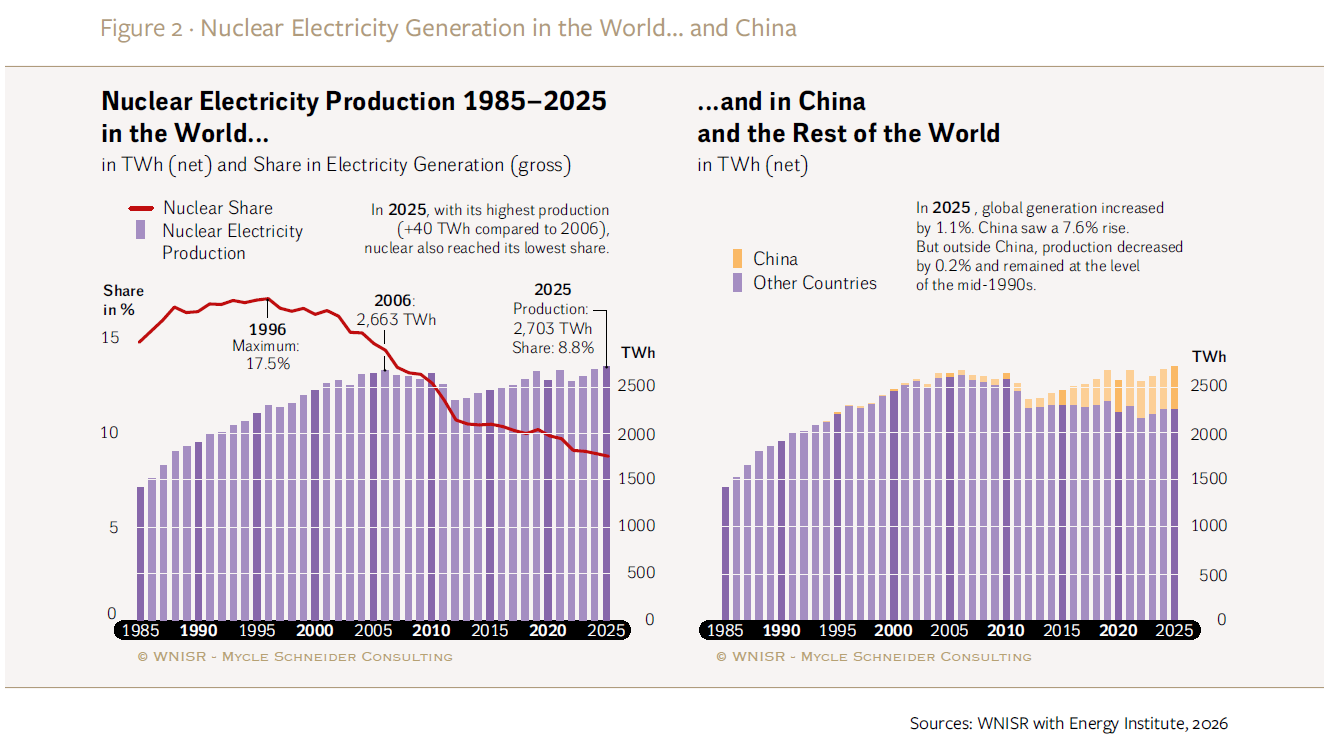
The report's core statistics reveal China's decisive impact on the global nuclear power landscape:
The single pillar of global growth: In 2025, global nuclear power generation edged up 1.1% to 2,703 terawatt-hours (TWh), with all of that growth driven by China's 7.6% increase in generation. Excluding China, nuclear power output in the rest of the world not only fell 0.2% year-on-year but also shrank 14% from its historical peak in 2006 (a net decrease of 369 TWh), with its actual scale falling back to mid-1990s levels.
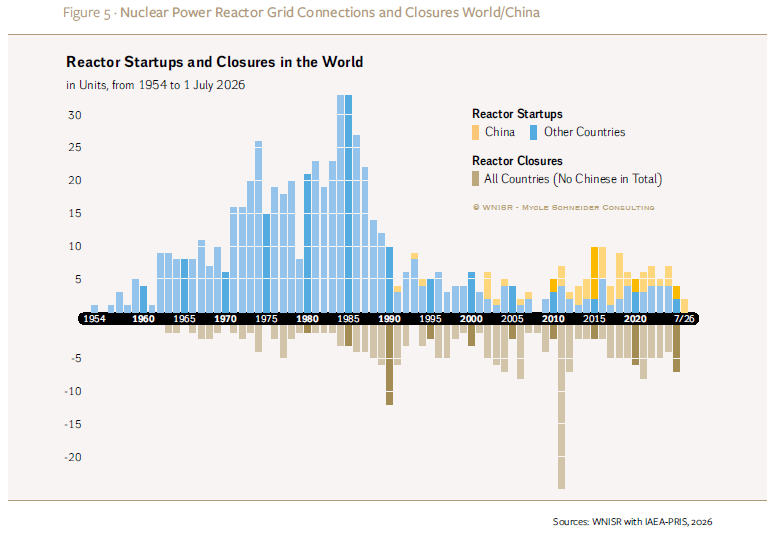
A 20-year scissors gap: Over the two decades from 2006 to 2025, a total of 104 units were put into operation globally and 106 were shut down. Among them, China connected 53 to the grid and shut down zero; this means that outside China, there was a cliff-like net reduction of 55 nuclear units worldwide, with a net loss of nearly 30.7 gigawatts (GW) in net installed capacity.
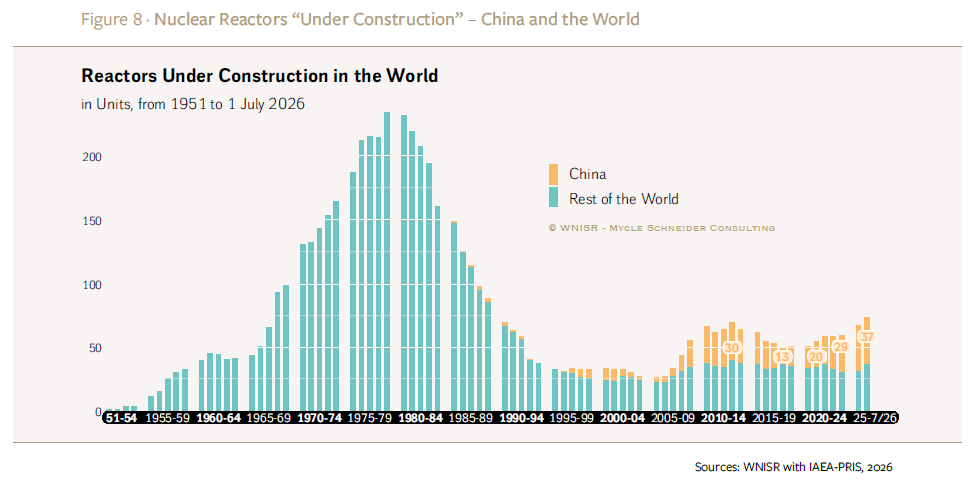
Absolute dominance in projects under construction: As of mid-2026, of the 73 units under construction worldwide, China alone accounts for 37, more than half (about 50.7%). Of the 52 reactors that began construction globally between 2020 and 2025, all except one in South Korea were undertaken domestically or overseas by Chinese or Russian sovereign nuclear industry groups.
The report also notes: China's nuclear industry's delivery efficiency and supply chain control have broken the curse of nuclear power's "delays and cost overruns"
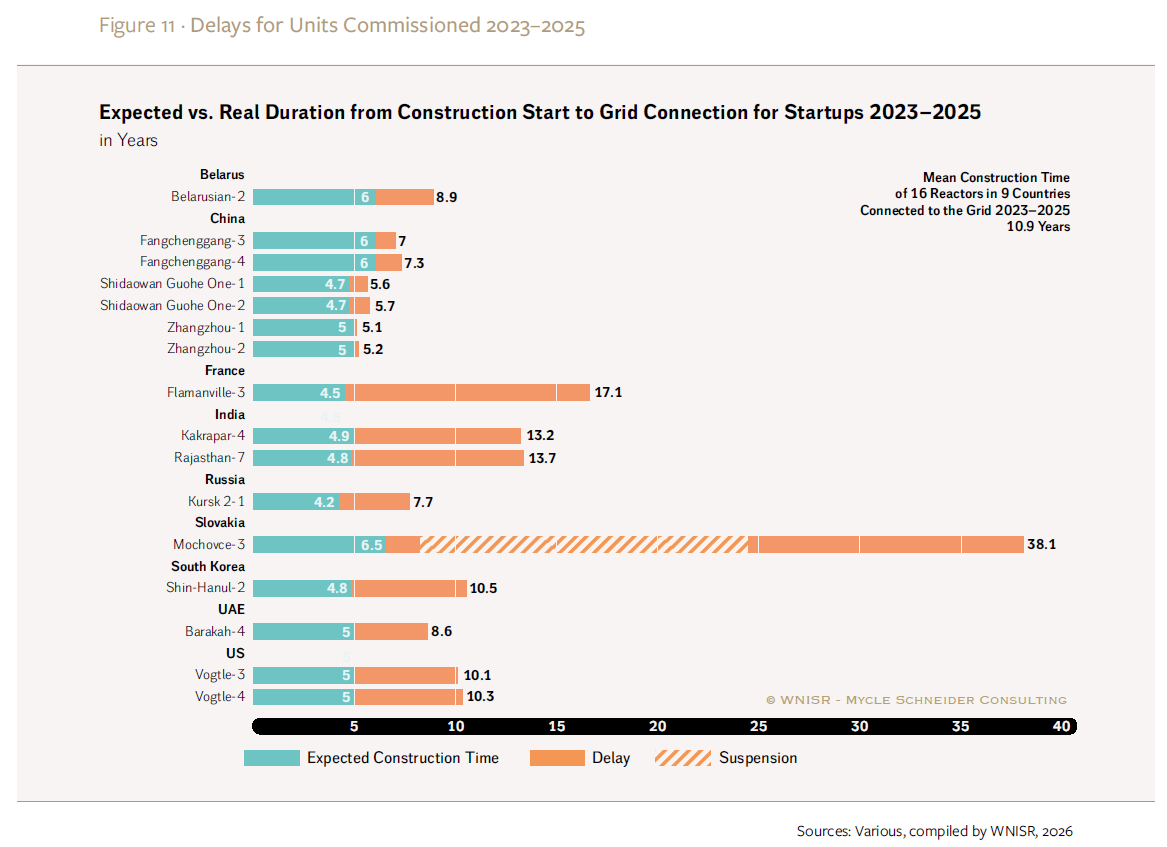
In stark contrast to nuclear projects in Europe and the United States, which are generally mired in an average construction period of 10.9 years with none delivered on schedule, China's nuclear power demonstrates extremely strong engineering delivery efficiency and supply chain control:
Stable construction cycles: Over the past decade (2016–2025), the average construction period for newly commissioned units worldwide was 9.5 years (France's FL3 took as long as 17.1 years, and Finland's OL3 took 16.6 years), while the average construction period for the 31 units completed in China was only 6.4 years. Even amid the challenges of the pandemic, the domestically developed third-generation reactor types "Hualong One" and "Guohe One" generally maintained a commercial operation cycle of about 5 to 6 years (60–75 months).
A moat for cost control: Relying on nearly three decades of uninterrupted engineering practice and a mature and complete localized manufacturing supply chain, the overnight construction cost of China's third-generation nuclear power (such as "Hualong One") has remained stable at around US$1,670–2,580 per kilowatt (about 16,000 yuan per kilowatt), only one-sixth that of the same-generation Vogtle project in the United States (about US$15,000 per kilowatt).
Technological sovereignty and patent monopoly: Global nuclear energy intellectual property data for 2024–2025 show that nearly half (48%) of the world's nuclear patents over the past two decades came from China. In the face of U.S. supply chain sanctions and the "Entity List," China has completely defused the risk of being choked off by shifting to reactor types with independent intellectual property rights ("Hualong One," "Guohe One") and localizing the entire equipment chain.
Reactor type breakthroughs: from fourth-generation advanced reactors to the physical realization of commercial small modular reactors (SMRs)
While most Western small modular reactors (SMRs) remain stuck in PowerPoint concept studies, design approval, and lobbying for government subsidies (only Canada's Darlington project has truly broken ground in all of the U.S. and Europe), China has already taken the lead in advancing advanced reactors to the stage of physical pouring and grid connection:
Leading in fourth-generation nuclear commercialization: The Shidaowan High-Temperature Gas-Cooled Reactor Pebble-Bed Module demonstration power plant (HTR-PM) in Shandong has officially entered commercial operation, becoming the world's first commercial fourth-generation reactor; in January 2026, the "HTR-PM600" multi-module joint reactor project for industrial heating and steam production officially began pouring concrete in Xuwei, Lianyungang, Jiangsu.
Physical realization of multipurpose SMRs: The world's first onshore commercial modular small pressurized water reactor—"Linglong One" (ACP100, 125 MW) in Changjiang, Hainan—completed cold functional testing in 2025 and is scheduled to officially load fuel and enter commercial operation in 2026, making it the first to turn the SMR concept into a physical power engineering project.
Closed fuel cycle layout: With the follow-up advancement of the fast reactor (CFR-600) and large spent fuel reprocessing facilities in Jinta, Gansu, China is substantively building a complete fast reactor closed nuclear fuel cycle industrial chain.
The internal game behind the boom:The squeeze between the flood of new energy and baseload power
Although China's nuclear industry leads the world in manufacturing and construction speed, from the perspective of China's overall energy structure, nuclear power still faces enormous development tensions and external squeeze:
Nuclear power "dwarfed" by the massive growth of wind and solar: In 2025, China's total nuclear power generation reached 485 TWh, but accounted for only 4.6% of the country's total electricity consumption of 10,368 TWh. Compared with nuclear power's annual increase of 2.5 GW and 33 TWh of additional generation, China's solar installations alone surged by about 314 GW that year, with newly added solar generation reaching 330 TWh—the single-year increase in solar generation alone was close to 70% of China's total annual nuclear power output. China's total wind and solar generation has reached nearly five times that of nuclear power.
Peaking challenges and grid absorption: China's nuclear units are mainly concentrated in coastal economic centers and are accustomed to serving as baseload power sources with high load factors above 90%, lacking rapid and flexible peaking capability. However, with the rapid expansion of coastal distributed solar at an annual growth rate of nearly half, and the explosive growth of new lithium-ion and sodium-ion battery storage (China's new-type energy storage capacity exceeded 145 GW in 2025), grid dispatch coordination and market-based electricity price competition between nuclear power and new energy are intensifying.
Minor adjustments in the five-year plans and overseas pioneering: By the end of 2025, China's installed nuclear power capacity in operation was about 62.5 GW, falling short of the "around 70 GW" target set in the 14th Five-Year Plan. Although the 15th Five-Year Plan has raised the 2030 target to 110 GW (at which point China will surpass the United States to become the world's largest), in terms of international exports, constrained by a complex geopolitical environment, apart from the continued advancement of the Chashma project in Pakistan, China's nuclear industry still faces strict international certification and geopolitical precautionary thresholds for a full overseas breakthrough.
Conclusion
The WNISR 2026 report objectively reveals a harsh industry truth: the "global nuclear renaissance" hotly discussed in Western public opinion is to a large extent a false boom accompanied by the retirement of aging units and the bleeding of fiscal subsidies; in the East, China, with its world-class large-scale industrial integration capability, cost control, and strategic resolve, is evolving against the tide into a veritable "nuclear power superpower." However, in the face of the torrent of the affordable green electricity revolution unleashed by its own solar and energy storage technologies, even a nuclear industry as strong as China's must face the long-cycle challenge of redefining its future baseload positioning and economic boundaries.
Disclaimer: Information republished from partner media, institutions or other websites is provided for reference and communication purposes only. It does not imply endorsement of its views or verification of its accuracy. Please contact us if any content infringes rights or requires correction.