
Fuel R&D System Upgrade: From a Signboard, Examining the Engineering Closed Loop Among Materials, Manufacturing, and Power Plants
 Scan to share
Whether a fuel rod can operate stably in a reactor for many years depends not only on materials, but also on whether information can be shared in a timely manner among design, manufacturing, and operation. On October 13, the CNNC Nuclear Fuel and Materials R&D Center held an unveiling ceremony at China Atomic Energy, and the public arrangement emphasized substantive operation, integration of R&D, production, and operation forces, and the introduction of the integrated product development concept. The China Atomic Energy Authority had already released news in 2018 about the establishment of a center with the same name, so the focus of observation for this event should be the optimization and upgrading of the organizational system: whether it can bring power plant needs into design earlier, return manufacturing deviations and operational feedback to the R&D side faster, and ultimately improve fuel reliability and economics.
The reliability of nuclear fuel comes from co-design under multiple constraints
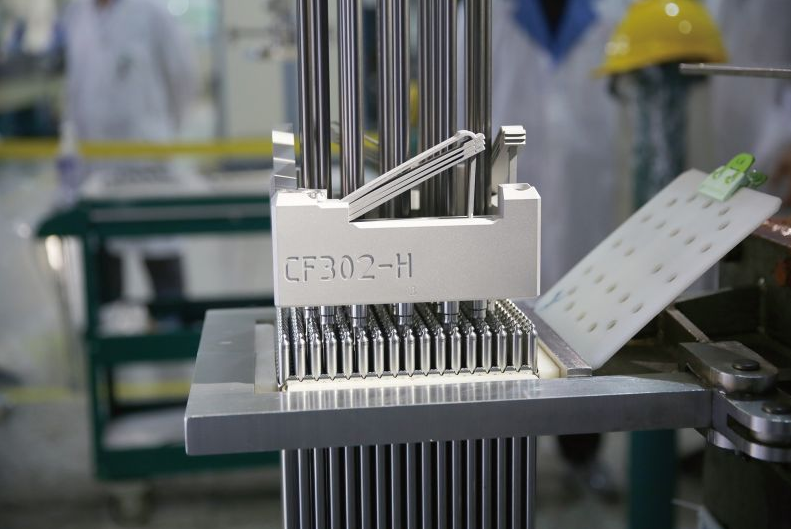
Taking pressurized water reactor (PWR) fuel as an example, uranium dioxide pellets are loaded into metal cladding tubes, and many fuel rods are then assembled into fuel assemblies with components such as spacer grids. The pellets generate heat, which is transferred through the cladding to the flowing coolant. The cladding not only performs heat transfer but is also an important barrier limiting the release of radioactive fission products, so material performance cannot be ranked by only a single indicator such as high-temperature resistance or strength; neutron absorption, corrosion, dimensional stability, and post-irradiation changes must also be considered.
When fuel is in service in the core, thermal, mechanical, irradiation, and chemical environments continuously interact. The dimensions and contact state of the pellets and cladding change, and coolant conditions and power changes also alter local loads. A cladding material that performs well in out-of-pile corrosion tests does not automatically prove that it can adapt to all in-core conditions. Likewise, fuel assembly design must simultaneously ensure cooling, support, and control rod insertion requirements, and local improvements cannot come at the expense of weakening other safety functions.
This explains why nuclear fuel R&D requires multiple types of testing. Material specimens are used to identify mechanisms, out-of-pile assembly tests are used to verify structural and hydraulic performance, and lead test assemblies inserted into the core subject the design to real-environment challenges, after which inspection and analysis are still required. Each type of evidence addresses a different question, and one excellent test cannot replace the entire verification system. To improve efficiency, R&D organizations should first reduce rework caused by information disconnects between stages, rather than treating necessary in-service qualification as time that can be cut.
From N36 to the CF series, verification must run through materials and assemblies
Domestic fuel already has clear historical cases. Publicly disclosed records of poolside inspections at the Qinshan Nuclear Power Plant in 2017 show that the inspection objects included N36 characterization assemblies, CF2 lead test assemblies, and CF3 lead test assemblies, totaling 10 boxes; at that time, after CF3 completed two irradiation cycles, it still needed to return to the core for one more cycle. This is a historical progress record and cannot be treated as the latest achievement in 2026, but it concretely presents the way fuel verification advances: complete stage operation, obtain information such as appearance, dimensions, and oxide film, and then use it to support the next stage of evaluation.
The N36 zirconium alloy materials published in the same year also distinguished engineering preparation of tubes and rods, assembly manufacturing, and subsequent irradiation testing. Making materials into qualified specimens is not the same task as stably manufacturing large quantities of cladding tubes. Composition, processing, heat treatment, and inspection jointly determine batch consistency; if problems found on the manufacturing side cannot be traced back to material and design conditions, then even if R&D results can be demonstrated, stable delivery may be difficult to maintain. Independent nuclear fuel capability needs to cover this evidence chain.
Integrated product development must bring power plant needs into the laboratory in advance
The practical significance of Integrated Product Development (IPD), introduced in this reform, in the nuclear fuel field is to make different stages face the same product goal as early as possible. Power plants want to improve reliability and optimize refueling arrangements, the design side needs to maintain safety boundaries, and the manufacturing side must explain process capability and delivery conditions. If these requirements meet only after the design is finalized, subsequent adjustments may involve equipment, test pieces, and even already arranged in-core qualification, expanding both time and funding costs.
Taking burnup improvement as an example, burnup measures the cumulative energy released per unit mass of fuel. Increasing burnup may reduce the number of fuel assemblies required per unit of electricity generation, but it also means the fuel must withstand more severe in-service changes. Whether it is economical depends simultaneously on whether materials and design can support it, how front-end procurement and manufacturing costs change, and the cooling, transport, and storage requirements for discharged fuel. Merely stating that “fuel is used more fully” is not enough to prove that full-cycle costs will necessarily decline.
Long-cycle refueling also has similar constraints. Reducing the frequency of shutdowns for refueling may increase sellable electricity time, but the refueling plan also involves enrichment, core power distribution, reactivity control, and operational limits. Even if the unit price of assemblies rises, better operational performance may still produce overall benefits; conversely, a lower-purchase-price option may not be more economical if it brings additional outage or inspection requirements. If the R&D center is truly product-oriented, it should translate these trade-offs into comparable design options and verification plans.
The effectiveness of organizational coordination must ultimately be tested by in-core performance
Centralized organization can provide common arrangements for test facilities, inspection capabilities, and data management, but it cannot blur technical review and quality responsibility together. Which material batch was used in the test, which design version was adopted, and under which conditions the results were obtained all need to be traceable. When anomalies occur, it should also be possible to distinguish the effects of design assumptions, manufacturing deviations, and operating conditions. The value of coordination lies in identifying problems faster and unifying the basis for handling them, while retaining necessary independent judgment.
For batch construction of nuclear power, stable fuel supply capability also affects unit refueling plans and inventory arrangements. The design side understanding manufacturing capability and the production side understanding power plant time windows helps reduce disconnects between changes and delivery. However, the currently public information on the center's adjustment does not provide directly calculable reductions in development cycle, product cost reductions, or operational reliability gains. Institutional integration provides the conditions for achieving improvement, but the improvement itself still needs to be proven by specific models and actual batches.
To measure this system upgrade, the key lies in whether the same model can reduce cross-unit rework, whether test results can effectively support safety evaluation, whether batch products remain consistent, and whether power plant feedback enters the next round of design. The competitiveness of nuclear fuel must be formed through long-term service. If the center can turn requirements, processes, and operational data into the basis for joint decision-making while fully preserving quality responsibility and verification requirements, then the organizational change behind a signboard will be transformed into verifiable product progress in the core.
(This article is based on information on the 2026 system adjustment of the Nuclear Fuel and Materials R&D Center, the center establishment and fuel verification records kept by the China Atomic Energy Authority, and the IAEA safety guide on core design, and was independently written after AI-assisted organization to explain the relationship between R&D organization and fuel engineering. Historical cases are all clearly marked with dates, and the potential benefits of organizational reform are analytical and cannot replace the safety evaluation and operating performance of specific products.)
Disclaimer: Information republished from partner media, institutions or other websites is provided for reference and communication purposes only. It does not imply endorsement of its views or verification of its accuracy. Please contact us if any content infringes rights or requires correction.