
ITER magnet energized to 34,000 amperes: why must a 330-tonne coil be verified starting from half rated current?
 Scan to share
On October 30, at the International Thermonuclear Experimental Reactor (ITER) construction site in southern France, a 330-tonne D-shaped coil was transferred from the cryogenic test facility to a transport frame. ITER Organization announced on November 2 that this No. 17 toroidal field coil had been energized to 34,000 amperes at approximately 4 kelvin, reaching half of its rated operating current. The focus of the test was to compare the deformation measured under electromagnetic loads with structural models. For a magnet that will eventually be installed together with the vacuum vessel into a confined space, millimetre-scale shape changes, local heating at electrical joints and identification of quench signals all warrant separate verification before final assembly.
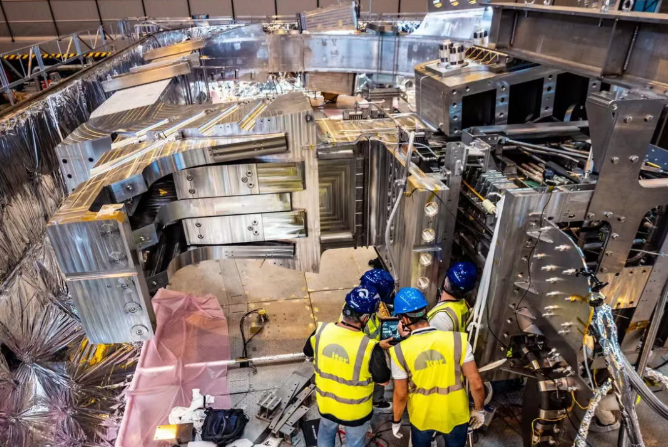
To confine plasma in a ring, the coil must first withstand the forces it generates itself
A tokamak uses magnetic fields to confine charged particles. Toroidal field coils are arranged around the vacuum vessel to establish the main magnetic field along the toroidal channel direction, which together with other magnetic field components forms the magnetic field structure used for plasma confinement. The stronger the magnetic field, the greater the electromagnetic forces borne by the coil conductors and support structures. When current passes through the conductors, the coil interior experiences compression, tension and bending tendencies. If the displacement under actual loading deviates from the model, loads at assembly interfaces may be redistributed, affecting adjacent coils, supports and insulation.
Half rated current is particularly easy to misread as half load. Using a simplified model with fixed geometry and a magnetic field that varies mainly with this coil's own current, the electromagnetic force caused by the self-field increases roughly with the square of the current. When the current is halved, this type of load is approximately one quarter. In actual tests, support constraints, coil geometry and test facility layout must also be considered. In the complete machine, the combined effects of adjacent coil magnetic fields and connecting structures will also appear. The test of No. 17 coil provided measured data for model validation. Only after the model has been validated at this stage can it be more reliably used to plan high-current tests and identify more highly stressed structural locations.
Superconducting coils can also start heating from an ordinary joint
Superconductivity enables conductors to carry large currents within appropriate ranges of temperature, magnetic field and current, but electrical joints connecting different sections still have finite resistance that must be measured. Because resistive heating rises with the square of the current, a small amount of extra resistance at a contact surface can amplify the local heat load at high currents. During preparatory work, ITER identified a feeder joint with higher-than-expected resistance, and inspection traced the cause to oxidation of the contact surface. Only after treatment did the team resume cryogenic and energization work. The value of finding this problem early is avoiding its entry into the final assembly stage, where access for inspection and repair would be more difficult.
Quench is the process by which a conductor locally leaves the superconducting state. Once resistance appears in a region where current is still flowing, new heat may continue to expand the quench zone. The protection system must distinguish voltage signals during normal current ramp-up from abnormal signals, and detect and trigger controlled energy discharge within a specified time. The energy discharge process also imposes requirements on insulation. In May this year, ITER cooled the No. 7 coil and energized it to 10,000 amperes, checking joint resistance and quench detection under different operating conditions. The No. 17 coil pushed the platform to a higher current, with emphasis on adding structural deformation evidence, reflecting how the same test stand progressively expands the verifiable range.
The next spare coil will test the entire protection chain
ITER plans to conduct further tests with the No. 19 spare toroidal field coil, with cooling scheduled to begin in April 2027. The plan is to first check electrical insulation using a feeder connection configuration closer to that of the main machine, then configure additional support structures for a 68,000-ampere test. The team also plans to locally heat the coil to actively trigger a quench, in order to measure the temperature margin and system response under the corresponding conditions. Insulation assessment in vacuum is particularly important, as the evacuation process or local gas pressure changes may alter discharge conditions, and electrical interfaces must be verified in the environments they may actually encounter.
This test programme involves cryogenics, vacuum, power supplies, measurement, control and large tooling. It takes time, but also gives problems a chance to be addressed before final assembly. If problems are found after the coil is installed onto the vacuum vessel sector, interfaces would need to be reopened, potentially affecting subsequent lifting, thermal insulation and piping work. Taking these dependencies into account in the schedule, the cold test stand serves both quality and construction scheduling objectives. As for fusion plasma operation and power generation, these belong to different stages; coil test data can only demonstrate progress in the corresponding equipment and operating conditions.
The next step is to see insulation, deformation and quench data all pass simultaneously
After the No. 17 coil test, the most noteworthy results will be the three outcomes for the No. 19 coil at higher current. Whether structural displacement continues to match the model, whether joints and ground insulation remain stable under different temperature and pressure conditions, and whether detection and energy discharge during actively triggered quench coordinate as designed. Even if a single coil completes rated current verification, the complete machine must still assess the forces and protection coordination among multiple coils. For assembly progress, being able to repeatedly verify these interface behaviours is more important than reaching a current peak once.
(This article is based on ITER Organization's two-stage test descriptions and project updates from the China International Nuclear Fusion Energy Program Execution Center, and was independently written after AI-assisted compilation, aiming to explain the graded verification of fusion magnets. The square relationship of self-field loads is a simplified physics explanation and cannot replace structural calculations of the test tooling or the complete machine.)
Disclaimer: Information republished from partner media, institutions or other websites is provided for reference and communication purposes only. It does not imply endorsement of its views or verification of its accuracy. Please contact us if any content infringes rights or requires correction.