
China Develops the Fusion "Cryogenic Heart": How a 20 kW Helium Refrigerator Strengthens China's Initiative in Building Large-Scale Facilities
 Scan to share
In a superconducting tokamak, high temperature and deep cryogenic conditions must coexist. Inside the toroidal vacuum vessel, the plasma needs to be heated to extremely high temperatures; outside the vacuum vessel, the superconducting magnets responsible for magnetic confinement must be kept in an environment close to absolute zero. Supporting this coexistence of two temperature regimes is a complex engineering system comprising thermal insulation, shielding, magnets, and cryogenic systems. Among these, the large helium refrigerator continuously supplies cooling capacity to the cryogenic system and is an indispensable “cryogenic heart” of the facility.
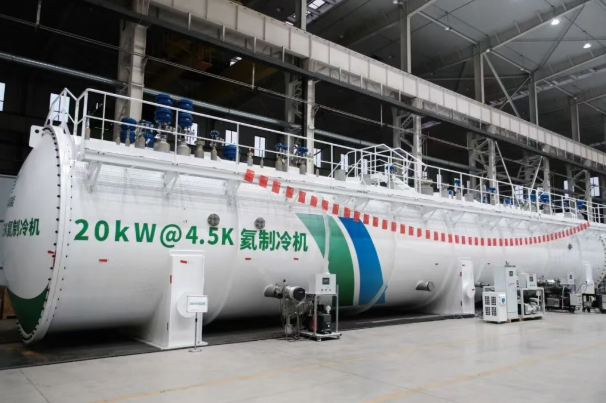
On November 5, 2026, a development summary meeting was held in Hefei for the 20 kW, 4.5 Kelvin ultra-large helium refrigerator jointly developed by Henan Zhongke Qingneng Technology Co., Ltd. and the Institute of Plasma Physics, Chinese Academy of Sciences. The developers disclosed that the equipment has met the established development goals and is ready for official rollout and delivery. This progress has advanced the domestic independent development capability for large helium refrigeration equipment to a new power level, and has also presented China's fusion industry with a more concrete proposition: as main facilities continue to scale up and operational requirements continue to rise, can key supporting equipment keep pace with the construction schedule?
From High-Temperature Plasma to Cryogenic Magnets: Why Fusion Needs It
The tokamak uses magnetic fields to confine high-temperature plasma. Large-scale facilities employ superconducting magnets, which can carry large currents with minimal resistive losses, but superconductivity requires strict conditions. For low-temperature superconducting materials such as niobium-titanium and niobium-tin, temperature, magnetic field, and current density must all remain within permissible ranges simultaneously, making the cryogenic environment a fundamental operating requirement.
The helium refrigerator is tasked with continuously removing heat. Even after the magnets have been cooled down, external heat still enters through support structures, current leads, and piping, and magnetic field changes may also generate losses. Under deuterium-tritium fusion conditions, nuclear heating caused by neutrons adds further burden. The cryogenic system must operate continuously to maintain the necessary operating margin for the magnets.
The 4.5 Kelvin in “20kW@4.5K” is approximately minus 268.65 degrees Celsius; 20 kW is the cooling capacity provided at this temperature level, not the power consumption of the equipment. Moving heat from such a low temperature to ambient temperature requires very high power consumption, which is why deep cryogenic equipment cannot be directly compared with ordinary air conditioners by power rating.
The total helium refrigeration capacity of the International Thermonuclear Experimental Reactor (ITER) is 75 kW at 4.5 Kelvin, provided by multiple units working together. This reference shows that cooling capacities of tens of kilowatts already represent an important scale in large fusion cryogenic engineering, but total system capacity and individual unit specifications still have different boundaries, and simple numerical ranking cannot be used to judge technological superiority.
Caption: Official schematic of the ITER cryogenic distribution system, illustrating the connections among the refrigeration station, cryogenic lines, and cooling equipment; not an actual photograph of Zhongke Qingneng equipment. Source: ITER cryogenic system technical page; the page does not indicate an image publication date. The original photograph from this development could not be reliably retrieved at this time.
From Imported Equipment to Independent Supply: Breakthroughs Occur Across the Entire System
Large helium refrigeration equipment has long been dominated by a small number of international companies with mature supply capabilities; Air Liquide of France and Linde Group of Germany have accumulated extensive engineering experience in this field. Entering this market requires crossing thresholds that include not only key components but also the ability to organize components into a reliable complete unit.
The cryogenic turboexpander is a key device for generating low temperatures. Its operating efficiency, rotor stability, and applicable flow range must match the entire refrigeration process. The cold box must integrate heat exchangers, expanders, and piping under good insulation conditions while addressing issues such as thermal contraction, heat leakage, and maintenance space. Components working individually is still a step away from the complete unit achieving design performance—system integration is the hurdle in between.
Therefore, scaling up from low power to the 20 kW level means larger flow rates, more complex control, and more demanding manufacturing requirements. The developers disclosed that this development focused on high-power deep cryogenic refrigeration processes, cryogenic turboexpanders, and integrated cold boxes, and its importance lies in forming mutually supporting capabilities rather than merely achieving substitution of a single part.
For domestic fusion projects, independent supply increases procurement options for key equipment and also makes it more feasible to complete design adjustments, on-site commissioning, spare parts supply, and maintenance services through domestic collaboration. If the magnet design changes, cryogenic suppliers can participate earlier in interface modifications, making it easier for projects to maintain schedule control and technical responsiveness.
This provides a substantive basis for reducing dependence on foreign sources for key equipment. As for whether all components, all operating conditions, and the complete service cycle have been covered, detailed lists and engineering records are still needed as proof; independent development moving toward delivery has already given domestic projects a new supply pathway.
Toward the "15th Five-Year Plan": Why Supporting Capabilities Must Be Established in Advance
The construction of fusion main facilities and the development of cryogenic equipment need to be coordinated in time. Large cryogenic systems involve not only magnet temperature but also compressor buildings, power supply, cooling water, and helium storage and recovery facilities. Waiting until the main facility is fully built before procuring refrigeration equipment often means missing the window for interface optimization and joint verification.
Facing the fusion engineering needs during the "15th Five-Year Plan" period, the significance of a domestically produced 20 kW-class helium refrigerator is that it gives the domestic industrial chain an equipment capability that can enter engineering design in advance. It can potentially serve related facilities and also provide cryogenic conditions for test verification of large superconducting magnets, helping main facilities and supporting systems mature in tandem.
This support is particularly important during the magnet testing phase. After large magnets are manufactured, their current-carrying, cooling, and protection performance must be verified at the appropriate temperature. A delay in refrigeration equipment delivery may affect a whole series of subsequent test arrangements; insufficient cryogenic conditions may also limit test coverage. The schedule of supporting equipment thus becomes part of the main facility verification schedule.
At the same time, demand cannot be simply aggregated by the number of fusion projects. Low-temperature superconducting and high-temperature superconducting magnets may use different operating temperatures and cooling configurations, and each facility's heat load and experimental pace also differ. What domestic suppliers need to provide is a system that can be designed and adjusted around specific operating conditions, not just standard equipment of the same specification.
When suppliers can participate in projects from the early design stage, localization begins to extend toward joint engineering. The magnet team proposes operating requirements, the cryogenic team provides feedback on capacity, power consumption, and control constraints, and both parties jointly determine the solution. This collaboration helps reduce later modifications and also accumulates reusable experience for subsequent facilities.
From First Delivery to Continuous Operation: How Independent Capability Truly Takes Hold
The successful development of the first unit is an important milestone toward engineering application. The next stage of value needs to be demonstrated through on-site operation by users: how much electricity is consumed at rated cooling capacity, how temperature and pressure respond to load changes, how long continuous operation is possible before maintenance is needed, and how long recovery takes after a fault.
These indicators directly affect facility utilization efficiency. Cryogenic system downtime can disrupt experimental plans, and re-establishing stable operating conditions also takes time. For future power generation facilities, refrigeration power consumption is part of auxiliary power and must be deducted from total power generation. Therefore, improving refrigeration efficiency and shortening maintenance downtime are as important as reducing initial procurement prices.
The developers claim that equipment procurement costs are more than 30% lower than comparable imported products, but the reference materials do not disclose the comparison models, years, and contract scope, so the investment reduction for an entire fusion facility cannot yet be calculated on this basis. A more complete cost evaluation requires comparing operating power consumption, spare parts, helium losses, and maintenance services under identical conditions.
What can truly expand the impact of this achievement in the next step is generating verifiable operating data and transforming first-unit experience into stable delivery capability. When domestic fusion projects can obtain equipment according to construction schedules, receive maintenance according to operational needs, and complete adjustments according to design changes, the significance of the 20 kW helium refrigerator will extend from a development achievement to a long-term construction capability for China's fusion engineering.
(This article is based on development progress materials provided by the developers, combined with publicly available technical information on fusion cryogenic systems and superconducting magnets, and was independently written with AI-assisted material organization and principle explanation. It aims to explain the engineering role and independent supply value of large helium refrigeration equipment; the scope of equipment localization, energy efficiency, long-term reliability, and cost reduction magnitude still need to be judged in conjunction with detailed technical documents, test conditions, and user operating data.)
Disclaimer: Information republished from partner media, institutions or other websites is provided for reference and communication purposes only. It does not imply endorsement of its views or verification of its accuracy. Please contact us if any content infringes rights or requires correction.