
Zhongneng Jukong and Fusion Diagnostics: From a Single Discharge to Continuous Operation, How Measurement Systems Affect Device Performance
 Scan to share
After a fusion device completes a discharge, researchers must first answer what actually happened in that experiment: how temperature and density changed, where the input energy flowed, whether instabilities appeared in the plasma, and which conditions should be adjusted for the next experiment. These judgments must be built on diagnostic data. As devices advance toward longer pulses and higher parameters, measurement systems must also take on a new task——providing information that can support control decisions in a timely manner before the experiment has ended.
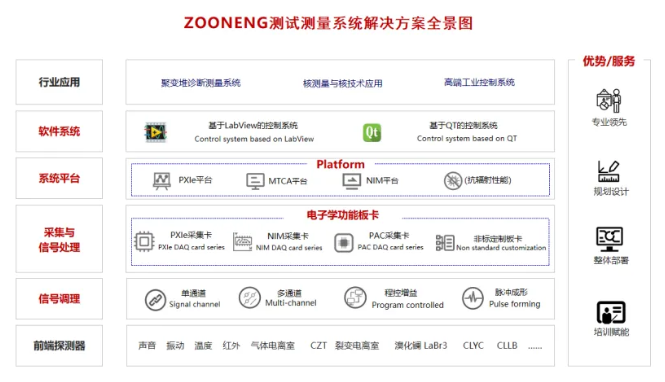
Anhui Zhongneng Jukong Technology Co., Ltd. operates precisely at this link connecting detection, computation, and device operation. Founded in 2022, the company focuses on test and measurement systems and electronic equipment engineering, with publicly disclosed products covering neutron-gamma mixed radiation measurement, fusion diagnostics, and data acquisition and control platforms. Its technical value must be observed along a complete chain: after the detector receives a signal, can the system convert it into trustworthy physical quantities and deliver them within the required time to the people and equipment that actually need this information.
From Electrical Signals to Physical Judgments: Diagnostic Systems Must First Prove "Measurement Is Trustworthy"
The current, voltage, or pulses output by a detector are not inherently equivalent to plasma temperature, density, or fusion power. Signals must pass through front-end electronics, acquisition, and processing, and then be combined with detection efficiency, geometric relationships, and calibration results to form physically meaningful data. Certain parameters also need to be obtained through inversion algorithms, and their credibility depends on whether the measurement information and model assumptions are sufficient.
Taking neutron diagnostics as an example, the counts recorded by a detector are affected by the neutron energy spectrum, response efficiency, surrounding structures, and background radiation. For deuterium-tritium fusion, neutron measurements can provide an important basis for judging the intensity of fusion reactions, but converting counts into total yield or power requires calibration. ITER specifically plans neutron diagnostic calibration work precisely to establish the relationship between detector readings and known references, rather than treating instrument output directly as the final answer.
Higher signal intensity does not necessarily make measurement easier. Adjacent pulses may pile up, the front end or acquisition system may approach saturation, and a mixed neutron-gamma field also requires the system to identify different signals. The mixed radiation measurement products publicly introduced by Zhongneng Jukong involve high-speed hardware and signal discrimination algorithms, but specific capabilities should still be based on test results under the corresponding conditions. How fast hardware can acquire and how accurately it can ultimately measure are two performance aspects that need to be proven separately.
From Post-Experiment Analysis to Real-Time Feedback: Speed Is Meaningful Only When It Enters the Complete Chain
Researchers can repeatedly analyze data after a discharge ends, but a real-time control system must complete its judgment before the device state changes. Once diagnostics participate in feedback, their performance evaluation expands from sampling rate to the entire chain: detector response, data transmission, algorithm processing, and command execution each take time, and any uncertain delay in any segment may affect control effectiveness.
Different physical processes have different requirements for time response and cannot be uniformly summarized as "millisecond-level" or "microsecond-level." Fast boards can shorten part of the processing time, but certain measurements need to accumulate enough signal to reduce statistical error, and complex inversion also requires computing resources. System design must make choices among speed, accuracy, and available information, and clarify which results can be used for feedback and which are more suitable for post-experiment physics analysis.
Field-Programmable Gate Arrays (FPGAs) can undertake tasks such as pulse identification, filtering, and feature extraction, allowing part of the processing to be completed near the acquisition end. However, using an FPGA does not by itself prove that a technical advantage has been formed; independent design of boards and firmware also cannot be directly equated with independent development of underlying chips. What truly needs to be tested is whether the system can stably produce correct results under the specified input range and operating load, and whether it can identify its own state when signals are abnormal.
This also involves the boundary of protection functions. A diagnostic channel used for scientific research analysis cannot automatically become a safety protection channel simply because it is fast enough. Systems undertaking protection tasks need to undergo reliability, fault response, and verification according to their functional requirements, avoiding directly inferring "can guarantee safety" from "can measure."
From Short Pulses to Long-Time Operation: Diagnostics Must Recognize Their Own Drift and Failure
A measurement system that performs well in a single experiment may face different problems when entering longer pulses. Temperature changes may affect gain, background signals may change with operating conditions, and continuous data streams will also test synchronization, caching, and transmission capabilities. For components close to the device, irradiation and thermal loads may also alter performance. Therefore, long-pulse diagnostics require continuous checking of measurement conditions and cannot merely confirm that equipment is normal before the discharge begins.
Future reactor environments will impose even higher requirements. Where detectors and front-end electronics are installed, which components need shielding, how observation channels are preserved, and whether they can be replaced after damage will all enter engineering design. Electromagnetic interference resistance and radiation tolerance are different capabilities, and cannot be broadly replaced by "adapting to extreme environments" without testing. Suppliers need to specify the environment, duration, and allowable error under which products have been verified.
Cross-checking among multiple diagnostics can help identify problems that are difficult to recognize through a single channel. ITER plans to use more than one measurement method for many important parameters, one purpose of which is to create redundancy. However, installing an additional set of equipment also occupies interfaces and increases calibration and maintenance work. A more reasonable direction is to determine key measurement combinations based on control and protection requirements, and to enable the system to judge when data are trustworthy and when degraded use is required.
For diagnostic companies, this means product competition is extending into full-lifecycle services. After equipment delivery, calibration, software versions, repairs, and configuration changes may all affect data consistency. Only by maintaining clear records and reconfirming performance after device upgrades can data from different experimental stages remain comparable.
From Research Customization to Industrial Products: Reproducible Capability Determines Market Space
The industrialization question for Zhongneng Jukong also needs to be understood from this technical chain. A publicly disclosed investment case by Hefei High-Tech Investment shows that the company's business orders in 2025 were approximately 12 million yuan. This is an order-based figure and cannot be directly treated as revenue or profit for the same period, nor can it be used to calculate the market size of pure fusion diagnostics, but it indicates that the company has already faced real customers, project delivery, and application adaptation issues.
Diagnostic needs for fusion devices differ markedly. Observation geometry, detectors, interfaces, and data systems vary, often requiring suppliers to participate in customization. Early projects can help companies accumulate experience, but may also make R&D and delivery highly dependent on a small number of engineers. If every additional customer requires redesigning the entire system, revenue growth may be accompanied by similar increases in manpower and commissioning input, making it difficult to form economies of scale.
A more valuable industrial path is to gradually distinguish the parts that can be generalized from the parts that must be customized. Acquisition platforms, clock synchronization, some signal processing, and software interfaces have opportunities for reuse, while detector layout, shielding, and physical calibration still need to adapt to specific devices. Standardization therefore needs to be built on a full understanding of differences, both reducing repeated development and avoiding sacrificing measurement effectiveness for the sake of unified products.
Diagnostic systems also affect costs through experimental efficiency and availability. The purchase price of a set of equipment is only an explicit input; the time occupied by repeated calibration, fault localization, and invalid experiments must also be borne by the project. However, there is currently insufficient public data to provide a definite reduction in the levelized cost of electricity for fusion attributable to diagnostic systems. What companies can prove should first be delivery cycles, measurement stability, fault recovery time, and the degree of cross-project reuse.
The most noteworthy aspects for Zhongneng Jukong and similar companies going forward are whether calibration errors can remain traceable, whether feedback latency can remain stable under actual load, and whether the system can restore consistent performance after maintenance. These indicators together determine whether diagnostic data can enter operational decision-making over the long term. The closer fusion devices come to continuous operation, the more suppliers need to use continuous verification and repeated delivery to prove that research experience has become reliable products.
Disclaimer: Information republished from partner media, institutions or other websites is provided for reference and communication purposes only. It does not imply endorsement of its views or verification of its accuracy. Please contact us if any content infringes rights or requires correction.