
Uzbekistan Sets Uranium Output Doubling Target: Ore Underground, Why the Wait for Delivery?
 Scan to share
On November 5, 2026, the Presidential Administration of Uzbekistan published the latest mining development strategy designation. The state-owned uranium giant Navoiyuran proposed, according to the latest reporting basis, a plan to raise annual natural uranium production from an estimated 7,500 tonnes in 2026 to 15,000 tonnes by 2030. Notably, at the mining conference in March of the same year, the Presidential Administration had set an interim target of 8,000 tonnes for 2026——this slight adjustment in the reporting basis reflects the dynamic revision of planned targets under complex geological and engineering scheduling.
As one of the core supplier countries in the global natural uranium supply chain, Uzbekistan's grand blueprint of "doubling output" has drawn close attention from global nuclear power buyers. However, in uranium mining development and the nuclear fuel front-end supply chain, between underground resource volumes and the final deliverable natural uranium products lies an extremely stringent engineering evolution logic.
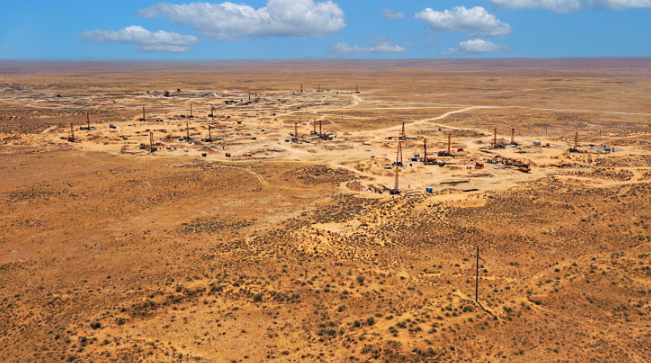
From 7,500 Tonnes to 15,000 Tonnes: Engineering Load Superimposed on the Entire Production Chain
Leaping from 7,500 tonnes to 15,000 tonnes per year is by no means merely a doubling of numbers on a mining financial statement, but an exponential reconstruction of the load on the entire metallurgical and mining engineering production chain.
According to the November reporting materials of the Uzbek Presidential Administration, to support this target, Navoiyuran needs to simultaneously advance exploration expansion, increased process well drilling density, production infrastructure expansion, and additional adsorption facilities. Converting natural uranium from underground ore and rock into final bookable and deliverable yellowcake (U3O8) must follow a rigorous physical and chemical sequence:
Deposit geological evaluation and hydrogeological characterization: While verifying the recoverable resource volume of the ore body, it must be confirmed whether the permeability of the sandstone aquifer meets the conditions for hydraulic circulation.
Wellfield Development: Constructing hundreds to thousands of injection wells and extraction wells to form a closed-loop controlled leaching grid.
Surface adsorption and metallurgical processing: Relying on surface ion exchange adsorption columns (Ion Exchange) and precipitation equipment to continuously convert low-concentration uranium-bearing solution into qualified products.
In this long-cycle chain, a one-quarter delay in any link will produce a chain reaction, postponing the ramp-up progress of the entire mining area. Therefore, the primary prerequisite for assessing the feasibility of this plan lies in distinguishing geological resources, nameplate capacity, and contracted deliverables of natural uranium products.
Technical Logic of In Situ Recovery (ISR): Leaving Ore Underground, Yet Wellfields Must Be Continuously Built
Uzbekistan's natural uranium mining fully adopts In Situ Recovery (ISR) technology. Unlike traditional underground mines or open-pit mining, ISR technology does not require transporting millions of tonnes of ore to the surface for crushing; instead, acidic or alkaline leaching solutions are injected through injection wells into uranium-bearing aquifers, dissolving uranium elements in situ underground, and then uranium-rich solutions are extracted to the surface through extraction wells for processing.
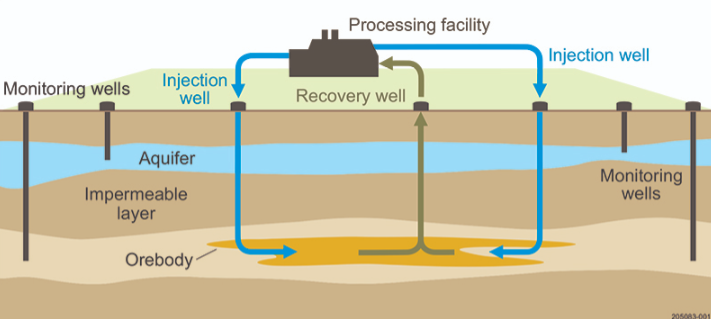
Although ISR technology greatly reduces civil engineering workload, its ore recovery efficiency is highly dependent on the complex underground physical and hydrogeological environment:
Permeability and heterogeneity: Ore bed permeability determines whether the leaching solution can flow uniformly. If the ore body distribution is uneven, mudstone barriers exist, or preferential flow channels (short-circuiting) form, the leaching solution cannot effectively contact the ore, seriously impairing recovery rates.
Wellfield decline curves and replacement pressure: The output curve of a single ISR wellfield follows a pattern of "ramp-up period—plateau period—natural decline period." As solution concentrations in old well areas decline, high-intensity process well drilling must be maintained so that new well areas can replace them on schedule.
Exponential expansion of supporting facilities: More wellfields mean geometric increases in pipeline network topology, high-voltage power supply, automated monitoring, and water balance management systems. The successful trial operation of a single new wellfield represents only local progress; whether the entire mine can maintain high-load continuous production is the decisive factor for annual deliveries.
Reagent Substitution, Hydrological Monitoring, and Surface Processing: Jointly Determining Marginal Costs
In the plan published by the Uzbek Presidential Administration, it is proposed to increase the proportion of sulfuric acid substitute reagents to 40% by 2030. While this policy target certainly helps alleviate the strong acid supply bottleneck, its impact on overall production costs still requires comprehensive assessment.
At the leaching chemistry level, the mineral composition of different deposits varies enormously. The introduction of substitute reagents may alter leaching kinetics; if the reagent consumption per tonne of product decreases but is accompanied by prolonged recovery cycles or increased subsequent water treatment loads, the actual all-in sustaining cost may not decline as expected.
Meanwhile, surface adsorption and environmental governance constitute another hard constraint. The expansion of surface resin adsorption facilities must perfectly match the wellfield feed rate. In terms of environmental protection and hydrological monitoring, as wellfield scale expands exponentially, the groundwater dynamic monitoring system in the area and future closed-loop restoration fund provisions must keep pace. If unit cost calculations include only reagent and electricity expenses during the production period, the long-term environmental compliance costs that must be borne during the mine closure period will be seriously underestimated.
Fuel Buyers' Practical Considerations: Locking in Annual Delivery Schedules and Conversion Windows
For global nuclear power operators (buyers), a paper target of doubling output does not equate to usable nuclear fuel safety margins. Natural uranium is only the first step in the nuclear fuel front-end; after delivery, natural uranium products must also strictly match international contract windows for subsequent conversion, enrichment, and fuel assembly fabrication.
From the perspective of commercial procurement performance, the core indicators that nuclear power buyers focus on are:
Specific timelines for new wellfield construction and ramp-up;
Actual capacity utilization rates of surface metallurgical processing plants;
Annual, performable physical delivery schedules for natural uranium.
Only by precisely translating Uzbekistan's incremental natural uranium output into specific years and contract batches can power companies effectively assess whether it can fill future supply gaps and ensure seamless alignment with established nuclear reactor refueling and maintenance cycles.
Disclaimer: Information republished from partner media, institutions or other websites is provided for reference and communication purposes only. It does not imply endorsement of its views or verification of its accuracy. Please contact us if any content infringes rights or requires correction.