
South Korea Adds 1 Trillion Won in Fusion Investment: From 48-Second High-Temperature Plasma to an Industrial System Capable of Building Reactors
 Scan to share
Inside the KSTAR device in Daejeon, South Korea, the duration of high-temperature plasma is measured in seconds; in Naju, a newly approved national R&D project has placed construction and technology verification on a ten-year timetable. On November 5, South Korea confirmed the advancement of a fusion core technology development and demonstration infrastructure construction project with a total scale of 1.4813 trillion won, with an implementation period from 2027 to 2036. What is more noteworthy about this investment is the attempt to complete the verification chain from plasma experiments to energy engineering: what has South Korea already accumulated, and for which unresolved problems is it preparing to build test conditions?
What capabilities will the trillion-won budget be directed toward first?
To understand this round of investment, one must first distinguish between research devices, technology verification facilities, and commercial power plants. The focus of South Korea's project this time is to enhance the verification capability of core technologies under extreme environments approaching those of a fusion reactor, and to build corresponding demonstration centers. Of the total, national fiscal funding amounts to 1.2877 trillion won. This ten-year R&D and construction scope cannot be directly converted into the engineering cost of a fusion power plant, nor does it mean that all funds have already been disbursed.
The site arrangements in public information also indicate what stage the project is currently at. Naju City announced follow-up land work on November 10, planning to begin negotiated acquisition from February 2027, with the goal of providing land for research facilities by February 2028. Land delivery remains to be completed, and equipment procurement, installation and commissioning, and the formation of test capabilities still require further progress. Therefore, directly describing the 2027 project start as a fusion reactor entering a ten-year construction period would confuse the boundary between the R&D plan and main unit construction.
The 100-megawatt-class demonstration reactor mentioned in reference information requires even more clarification of power attributes. Fusion power, thermal power, generator output, and net plant export power represent different engineering results. Without a clear design definition and a complete energy balance, a megawatt figure cannot prove how much electricity a device can deliver to the grid. At the current stage, this budget first supports the verification foundation, not a commercial asset with already determined costs, schedules, and electricity sales capability.
KSTAR Has Accumulated Operating Experience, but a Power Plant Still Needs Another Set of Proof
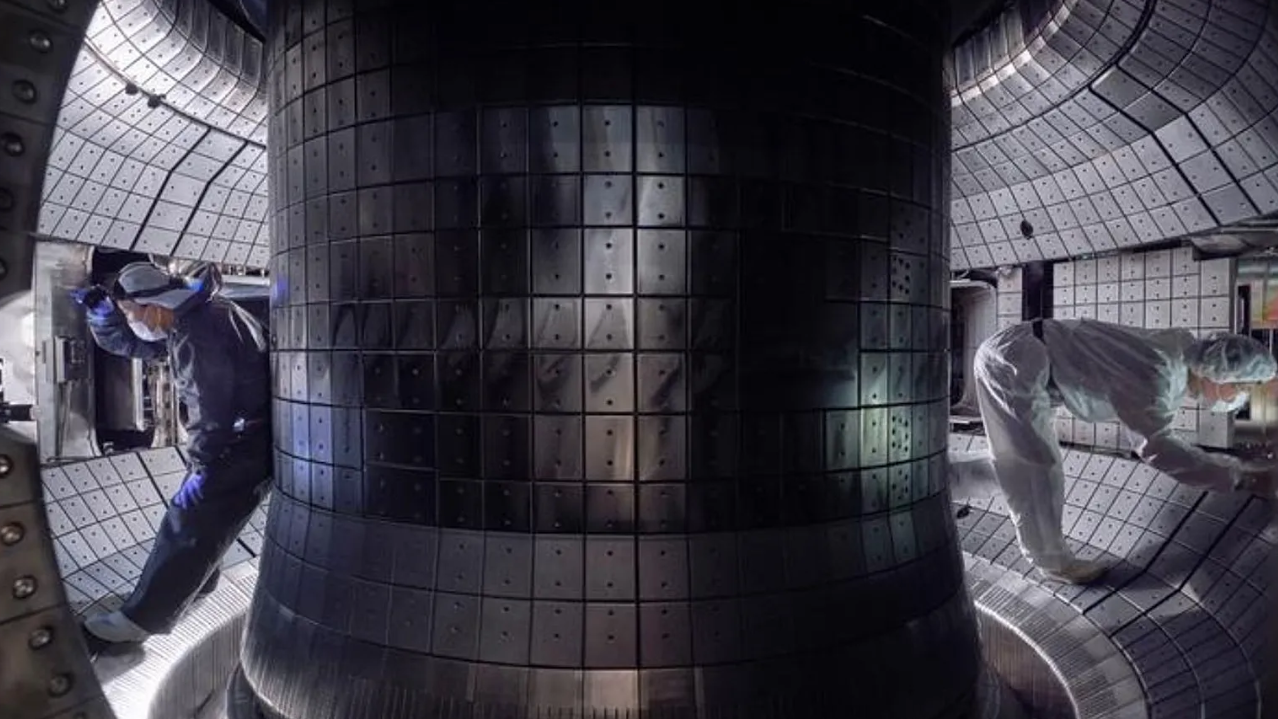
The Korea Superconducting Tokamak Advanced Research (KSTAR) is central to understanding South Korea's technological accumulation. Institutional materials from the Korea Institute of Fusion Energy (KFE) record that KSTAR completed construction in 2007 and obtained first plasma in 2008. Its value lies in long-term operation of an integrated system, allowing magnet, heating, diagnostic, and control teams to iterate together around real discharges.
The experimental results announced in 2024 were ion temperatures reaching 100 million degrees Celsius sustained for 48 seconds, while also reporting high-confinement mode exceeding 100 seconds. These are performance statements under two different conditions and cannot be combined into "100 million degrees Celsius for over 100 seconds," much less written as net electricity generation of equivalent duration. High-Confinement Mode (H-mode) describes the plasma confinement state; a commercial power plant must also prove the relationship among energy output, sustained operation, and plant auxiliary power consumption.
Temperature alone is not a pass either. Fusion reactions require appropriate temperature, density, and energy confinement time to work together; extending pulses in a device also continuously tests wall heat loads, impurity control, and auxiliary systems. Achieving better parameters in a single discharge and reproducing those parameters throughout the year are tasks at different levels. What South Korea needs to accumulate in the next stage is precisely data in which operating conditions, component lifetimes, and maintenance arrangements can be mutually explained.
From Heat Exhaust to Fuel Cycle, the Real Challenges Lie at System Interfaces
The divertor is the most intuitive component on this verification chain. It directs heat and particles from the plasma edge to designated areas, helping to exhaust impurities and reaction products. KSTAR completed an upgrade of the lower divertor tungsten components in 2023 and subsequently conducted experiments. Tungsten can withstand higher temperatures, but whether components can work long-term also depends on cooling, connections, thermal stress, and surface erosion—not just the material's melting point.
The design requirements of the International Thermonuclear Experimental Reactor (ITER) can be used to understand this difficulty: its divertor vertical targets are expected to withstand steady-state heat flux of 10 megawatts per square meter and slow transient heat flux of 20 megawatts per square meter. These are ITER design conditions, not KSTAR measured values. At this magnitude, surface materials, heat-bearing structures, and cooling channels must work together, and damage caused by repeated thermal cycling also needs to be evaluated through testing.
Even if heat can be exhausted, future deuterium-tritium power plants still need to solve fuel and materials problems. The breeding blanket needs to use neutrons interacting with lithium-containing materials to produce tritium and transfer heat to the cooling system; the fuel cycle system also needs to complete extraction, processing, metering, and recovery. Being able to produce tritium in a localized experiment is not the same as a power plant maintaining fuel balance over the long term—processing losses, inventory, and equipment downtime all affect the outcome.
This is precisely the industrial significance of building public verification facilities. A single university device can study a certain physical mechanism, and a specialized test bench can evaluate a certain component, but a power plant requires multiple systems to work under shared boundary conditions. If test platforms can provide verifiable load conditions, fault records, and acceptance methods, suppliers have a basis for improving products. Without such evidence, there remains a gap between R&D results and industrial equipment capable of committing to lifetime and delivery schedules.
After Manufacturing Large Components, How to Form Sustainable Reactor-Building Capability?
South Korea has already entered the large-scale fusion equipment manufacturing chain through ITER procurement tasks. ITER's project introduction in July 2026 confirmed that four of the nine vacuum vessel sectors were manufactured by South Korea. This participation allows companies to engage in the manufacturing, inspection, and interface coordination of large nuclear-grade components. However, completing a procurement package does not equal having plant-level integration capability: after components arrive, they still need to undergo assembly, system integration testing, and operational assessment before the design at the whole-machine level can be verified.
If the new round of investment can form sustained and open test capabilities, its role will not be limited to supporting a single device. It can help companies transform one-time delivery experience into stable processes and reduce the burden of repeatedly building test conditions. However, park area, the number of contracted companies, and procurement amounts cannot replace qualification rates and reliability. Real industrial capability should be manifested as reproducible component performance, traceable problems, and predictable delivery rhythms.
For economics, there is still no direct conversion relationship between a ten-year R&D budget and future electricity prices. Commercial power plants also bear construction financing, auxiliary power, component replacement, and outage costs; even if plasma can be sustained, frequent replacement of blankets or divertors would reduce annual electricity sales. The earlier engineering verification identifies lifetime and maintenance problems, the more opportunity there is to adjust subsequent designs, and only then can the value of public R&D investment be reflected in reducing project uncertainty.
The effectiveness of South Korea's investment round will depend on whether the verification platform can translate experimental results into operating boundaries that equipment can bear: how long heat loads can be maintained, how long component replacement takes, how much fuel recovery loss occurs, and whether multiple systems can stably coordinate. If such data can enter design and procurement standards, only then is South Korea accumulating industrial capability usable for reactor construction. Budget approval provides the conditions; engineering delivery must still be proven through continuous testing and actual delivery.
(This article is based on public reports on South Korea's project budget and land progress, institutional introductions from the Korea Institute of Fusion Energy, and ITER engineering materials. It was produced through AI-assisted retrieval, cross-checking, and independent writing, aiming to explain how fusion R&D investment translates into engineering verification and industrial capability. Budget approval, experimental records, and commercial power generation belong to different stages; the article does not treat planned power, target years, or technology routes as already-achieved operating results. The full original approval document for the project budget was not obtained; relevant amounts and implementation periods use information consistent across multiple public reports.)
Disclaimer: Information republished from partner media, institutions or other websites is provided for reference and communication purposes only. It does not imply endorsement of its views or verification of its accuracy. Please contact us if any content infringes rights or requires correction.