
Turkey Studies Introduction of CANDU Heavy Water Reactors: How Much Can the Natural Uranium Route Change Energy Dependence
 Scan to share
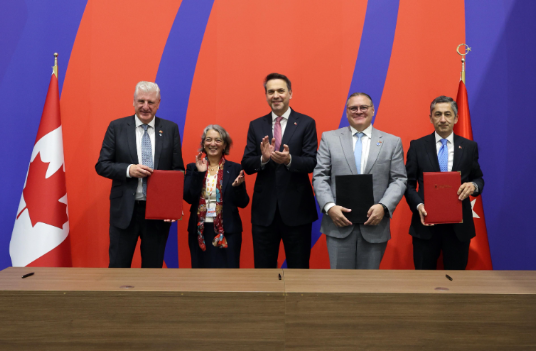
Turkey and Canada signed a new nuclear energy cooperation agreement on November 12, putting the feasibility study and front-end engineering design of CANDU heavy water reactors on the agenda. The publicly discussed plan involves up to six units and approximately 4.5 million kilowatts of installed capacity, but it currently remains a potential project study and is not a decision to begin construction. The significance of this news is not merely that Turkey has engaged another nuclear power supplier, but that the fuel supply approach is becoming an important variable in reactor type selection: what external dependencies can heavy water reactors that can use natural uranium reduce, and what new engineering and industrial requirements will they bring?
The key to natural uranium being usable for power generation lies in how heavy water utilizes neutrons
CANDU comes from the English name Canada Deuterium Uranium and belongs to the Pressurized Heavy Water Reactor (PHWR) category. The hydrogen in heavy water is mainly deuterium, which absorbs fewer neutrons when moderating them, making it favorable for using natural uranium to maintain a chain reaction. Compared with light water reactors that widely use enriched uranium fuel, a typical CANDU design can eliminate the uranium enrichment step in the front end of the fuel cycle. The advantage here lies in a different supply chain structure, not in the reactor being able to do without the nuclear fuel industry.
Natural uranium still requires mining, purification, conversion, and fuel fabrication, and must meet nuclear material management and quality requirements. The geometry, cladding, and manufacturing consistency of fuel assemblies also cannot be directly guaranteed by natural uranium raw material. Even if a country obtains uranium resources, it does not necessarily already possess qualified fuel supply capability. Therefore, assessing the role of heavy water reactors in energy security requires listing raw materials, processing, technology licensing, equipment, and long-term services separately, and one must not write "no enrichment required" as "completely free of external supply dependence."
Reducing the enrichment step also means establishing another set of equipment and operations and maintenance systems
This fuel capability is built on a specific reactor structure. A typical CANDU places fuel in many horizontal fuel channels, through which pressurized heavy water coolant flows, carrying heat to steam generators; the moderator is in a separate, lower-pressure system. The pressure tube structure differs from large pressure vessel light water reactors, and each imposes different requirements on materials, inspection, and maintenance. Choosing a reactor type is in effect also choosing the equipment system and operations and maintenance capability for the following decades.
Heavy water itself is an input that requires management. Initial inventory, leakage control, recovery, and system maintenance all enter the plant's full life-cycle arrangements; tritium generated during operation also requires appropriate monitoring and protection. Reducing one external dependency in the fuel stage does not mean other inputs are automatically reduced. Feasibility studies must compare the costs and risks of the complete system, rather than selecting only one favorable element in fuel procurement.
On-Power Refuelling is another feature of CANDU. Dedicated refuelling machines connect to fuel channels and can transfer fuel during operation, reducing the need to shut down for batch refuelling. However, the refuelling machines, channel interfaces, and fuel transport systems must also work reliably, while maintaining pressure boundaries and cooling conditions. On-power refuelling does not mean the plant never shuts down; maintenance, inspection, equipment failures, and grid scheduling will still affect availability.
Studying six units does not mean construction conditions for six units have already been established
The stage of Turkey's agreement particularly needs to be identified. The Feasibility Study and Front-End Engineering Design (FEED) are used to gradually translate technical concepts into site, infrastructure, environmental conditions, engineering scope, and financing plans. They provide the basis for investment decisions and may either confirm that the project is worth advancing or reveal conditions that require modification or even suspension. Signing a study agreement cannot replace site approval, construction permits, or a final investment decision.
A multi-unit plan has the opportunity to spread the investment in some shared facilities, personnel training, and supply chain preparation, but the construction sequence will affect cash flow. If multiple units are advanced simultaneously, early funding demand is greater; if implemented in phases, subsequent construction and already operating units need to be coordinated. The discussed scale of approximately 4.5 million kilowatts cannot be directly converted into electricity supply added at present, nor can its competitiveness be judged by a single unified cost indicator. The time structure of a nuclear power project is often as important as the installed capacity scale.
Local manufacturing also needs to be translated into specific procurement packages. Civil works, conventional mechanical and electrical equipment, fuel fabrication, and key nuclear equipment impose different requirements on enterprise capabilities. An existing industrial base can provide a starting point, but nuclear-grade quality assurance, specialized personnel, and inspection capabilities still need to be prepared. If localization commitments do not have corresponding technology transfer, process validation, and sustained orders, they may only appear as percentages in contracts and fail to form stable equipment and service supply capability.
The benefits for energy security need to be measured together with the full project cost
Cost comparisons should also cover arrangements beyond power generation. Construction-period financing, heavy water inputs, fuel procurement, equipment replacement, waste management, and decommissioning all affect long-term economics. The current public agreement does not provide a complete project budget and financing conditions that can be accounted for, so it cannot be asserted on this basis that heavy water reactor electricity prices are lower than those of other reactor types. The natural uranium route may change part of the fuel costs and supply risks, but capital expenditure and actual operating performance may still determine the final ranking.
Grid conditions then limit how the project can be commissioned. New large units require sufficient transmission and dispatch capability, and the system must also prepare reserve resources for the sudden withdrawal of a single unit. Nuclear power can provide long-term low-carbon electricity, but it cannot alone replace all flexibility resources. Site cooling conditions, extreme weather, and water use arrangements will also enter design and operational evaluation. A technology supplier's mature experience cannot cancel the verification tasks of the new site itself.
The more valuable result of this agreement will be translating fuel diversification from policy intention into comparable engineering options: clarifying what costs and responsibilities are borne by natural uranium supply, heavy water management, equipment maintenance, and local industry respectively. If the study can simultaneously provide credible site design, financing boundaries, and construction sequence, CANDU will become an option with executable conditions. Reducing dependence on the enrichment step has strategic significance, but complete energy autonomy still needs to be built through long-term manufacturing and operation.
(This article is based on the cooperation release by Turkey's Ministry of Energy and Natural Resources and AtkinsRéalis, as well as CANDU technical documents, and was independently written after AI-assisted retrieval and organization, explaining the relationship between the natural uranium fuel route and the energy supply chain. The approximately 4.5 million kilowatts and up to six units are publicly discussed plans and are not yet an approved construction scale; typical CANDU technical characteristics do not replace the specific design and safety review of future Turkish projects.)
Disclaimer: Information republished from partner media, institutions or other websites is provided for reference and communication purposes only. It does not imply endorsement of its views or verification of its accuracy. Please contact us if any content infringes rights or requires correction.