
Superconducting Accelerators Reduce Liquid Helium Dependence: How Niobium-Tin Materials Change Cooling and Operating Conditions
 Scan to share
To reduce the dependence of superconducting accelerators on liquid helium, what must change first is not helium procurement, but the materials of the accelerating cavity and the method of heat extraction. The progress of a domestically developed niobium-tin thin-film radio-frequency superconducting electron accelerator, disclosed on November 10, has once again brought this route into public view. It should be clarified that the Institute of Modern Physics had already announced the achievement of stable beam loading in a prototype as early as April 2024, and this recent report is not the first completion of the test. Its long-term value lies in demonstrating that, through superconducting materials better suited to higher cryogenic temperature ranges and mechanical refrigeration, some accelerators have the opportunity to break away from liquid helium bath cooling; however, industrialization still needs to overcome the thresholds of average beam power and long-term reliability.
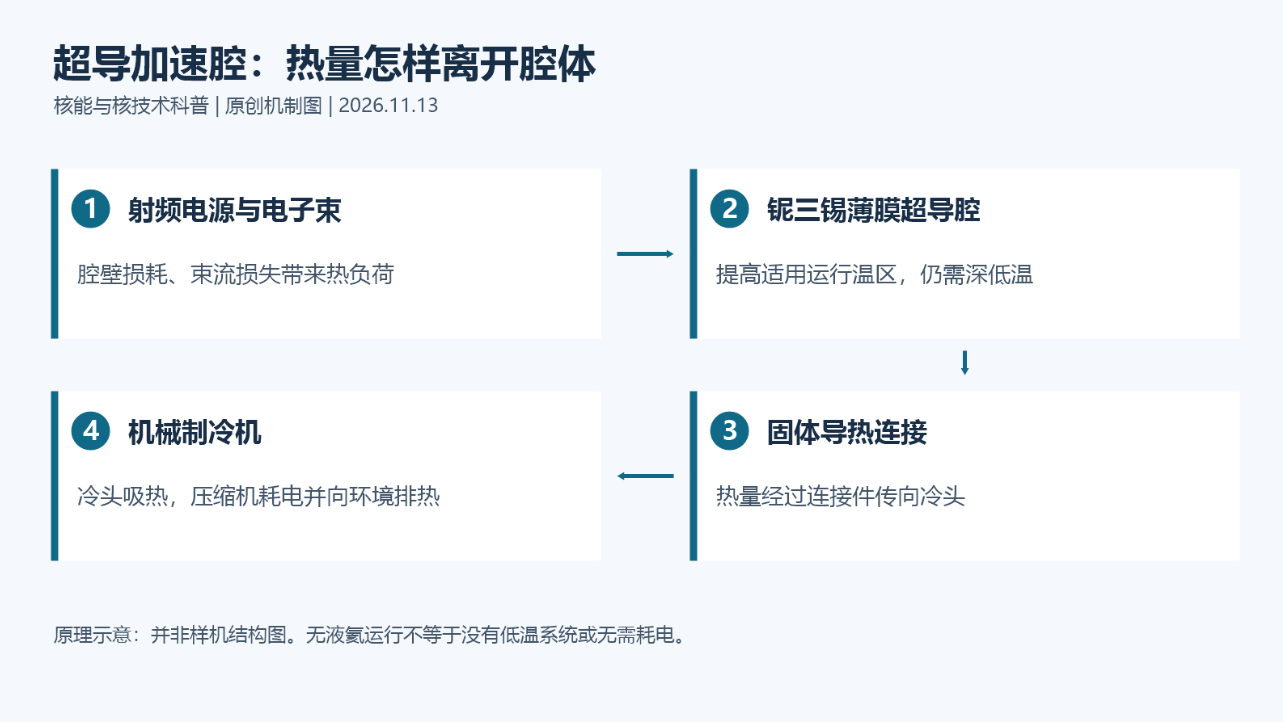
Superconducting materials reducing losses does not mean the entire machine no longer consumes electricity
Superconducting Radio Frequency (SRF) accelerators use the alternating electric field in the cavity to add energy to charged particles. Superconducting cavity walls can reduce radio-frequency losses, but they do not turn the entire device into a machine that consumes no electricity. There are still surface losses under high-frequency electromagnetic fields, and the electron gun, radio-frequency power supply, beam transport, and cooling system also consume electricity. When discussing efficiency, it is necessary to distinguish how much heat is reduced at the cavity wall from how much useful power the entire machine delivers to the beam.
The advantage of niobium-tin (Niobium-Tin, Nb3Sn) is that it can maintain attractive radio-frequency performance at a higher cryogenic temperature range than commonly used niobium cavities. The superconducting transition temperature is a material property, but the engineering operating temperature must leave a margin and is also affected by magnetic fields, surface defects, and thermal stability; the transition temperature cannot be treated as a directly usable operating temperature. Film uniformity and surface condition are therefore very important: an increase in loss in a small area may form a local hot spot and limit the performance of the entire cavity.
From liquid helium bath to solid conduction, the cooling challenge has shifted location
Traditional liquid helium bath schemes allow the cavity to remove heat through liquid helium; solid conduction cooling (Conduction Cooling) transfers heat through thermally conductive connections to the cold head of a mechanical refrigerator. It reduces the need for liquid helium storage, replenishment, and related facilities, but increases dependence on the thermal conduction path. Contact thermal resistance at connections, the dimensions of thermally conductive components, and the distribution of heat on the cavity all affect the temperature at the hottest location. The ability of the cold head to provide cooling does not automatically prove that the entire cavity is sufficiently cold.
The research team's 2024 preprint described a validation system composed of a 650 MHz five-cell cavity and 10 mechanical refrigerators, with a maximum electron beam energy gain of 4.6 MeV. These parameters indicate that the prototype has completed system integration of materials, cryogenics, and beam, rather than merely testing a single thin-film sample. However, they cannot directly prove that a compact, low-cost, long-term continuously operating industrial product has already been formed; the number of refrigerators, interfaces, and maintenance requirements should still be included in the overall evaluation.
What is especially easy to misread is the beam current. The publicly disclosed test involves the current within a macro-pulse, which is different from the average current of all-day continuous operation. Average beam power depends on particle energy and time-averaged current; pulse duration, repetition frequency, and downtime all affect the latter. Without a complete operating time sequence, one cannot multiply a certain pulse current by the maximum energy and claim that the prototype has already delivered the corresponding industrial power over the long term. Between the peak performance and the sustained processing capability of an accelerator, a clear metrological boundary is needed.
What industrial users buy is processing capability, not a single record
Continuous Wave (CW) cavity testing is also not equivalent to continuous high-power beam loading. The former can verify the state of the cavity under sustained radio-frequency excitation, while the latter still needs to address issues such as beam loading, power coupling, beam loss, and the target station. A small number of electrons lost at unintended locations will become local heat sources and increase radiation protection pressure. Whether the equipment can stably deliver the beam to the target position and whether it can accelerate electrons in the cavity are interrelated but different validation tasks.
Taking wastewater irradiation as an example, what users buy is how much water is treated per unit time and to what level pollutants can be reduced, not a cavity gradient record. Electron energy affects penetration and energy deposition, beam power affects throughput, and water layer thickness, flow rate, and pollutant composition affect dose distribution. Treatment effects obtained in laboratory water samples still need to be reproduced under real water quality and continuous flow conditions before the electricity consumption per ton of water, equipment depreciation, and maintenance costs can be calculated.
Isotope production is yet another set of requirements. Target material selection, nuclear reaction energy range, radiochemical separation, and product quality control all affect usable output; one cannot assume that an electron accelerator is suitable for all medical nuclides just because it is an electron accelerator. Irradiation sterilization also requires verification of dose uniformity and material compatibility. The same accelerator platform can target multiple markets, but each application must establish its own process evidence; an application list cannot replace product validation.
The economics of the helium-free route must be compared under the same output conditions
Economically, reducing liquid helium facilities may lower the construction and operation thresholds for some users, but the purchase, electricity consumption, maintenance, and vibration management of mechanical refrigerators must also be included. Truly comparable costs should be calculated under the same beam energy, average power, availability, and service life. Current public information is insufficient to provide an industrial processing unit price for the domestic prototype, and it is even less possible to judge solely on the basis of “helium-free” that it must be cheaper than room-temperature or other superconducting accelerators.
The more noteworthy industrial change along this route is that the cryogenic system has the opportunity to shift from large centralized facilities to equipment units that are easier to deploy. If materials and conduction paths can be stably mass-produced, factories or application institutions may reduce their dependence on dedicated liquid helium infrastructure. However, miniaturization does not eliminate high-voltage, vacuum, and radiation protection requirements; a complete product still needs to incorporate maintenance, shielding, fault handling, and user operating capability into the design.
To judge whether the next stage of niobium-tin accelerators is close to industrial application, one should look at average beam power under specified load, continuous operating duration, energy stability, and overall electricity consumption, and verify performance recovery after maintenance. The helium-free prototype has already provided system principle validation; the next step is to turn this validation into repeatable manufacturing and sustained operating capability. Only when the beam ultimately completes real process tasks will innovations in materials and cooling methods be transformed into production value that users can account for.
(This article is based on the achievement release of the Institute of Modern Physics, the research team's 2024 preprint, and related news in 2026. It was independently written after AI-assisted retrieval and organization, explaining the relationship among superconducting materials, conduction cooling, and beam applications. The first public disclosure time of the stable beam loading achievement and the recent report time have been distinguished; prototype parameters are not equivalent to the continuous rated capability of industrial equipment.)
Disclaimer: Information republished from partner media, institutions or other websites is provided for reference and communication purposes only. It does not imply endorsement of its views or verification of its accuracy. Please contact us if any content infringes rights or requires correction.