
A New Approach to Fusion Magnets: Can Flattening Stellarator Coils Reduce Power Plant Manufacturing Difficulty?
 Scan to share
On the manufacturing floor of a fusion device, whether a coil can be delivered on schedule often depends on whether winding, insulation, support, and cryogenic testing can each pass inspection. For stellarators that require three-dimensional magnetic fields, turning a physics design into reproducibly manufacturable hardware is especially difficult. On November 4, the U.S. company Thea Energy announced a new magnet testing collaboration with MIT to validate the encircling coils for its Eos device. This development raises a specific question: if complex coils are decomposed into planar coils that are easier to manufacture, can fusion devices truly reduce the burden of construction and maintenance?
Coils Flattened, Yet the Magnetic Field Must Still Maintain a Three-Dimensional Structure
A stellarator relies on external coils to form a magnetic field with spatial torsion characteristics, confining charged particles within high-temperature plasma. It has relatively low dependence on the large plasma current required to maintain confinement, and therefore offers the advantage of exploring long-pulse continuous operation. However, this advantage must be realized through the magnetic field structure. Deviation of the magnetic field distribution from the design can alter particle orbits, increase energy losses, and may also affect the locations where the plasma interacts with the wall.
Traditional advanced stellarators often use non-planar coils with complex shapes. The bending and twisting of coils in space directly encode the required magnetic field into the geometry, while leaving the difficulty to manufacturing and assembly. Winding positions, support structures, and cryogenic contraction must all be coordinated. Even if dimensions are qualified at room temperature, deformation after cooling and energization may still affect the magnetic field, so acceptance testing must cover actual operating conditions.
The planar coil approach proposed by Thea attempts to superimpose simple coils at different positions, orientations, and currents to produce the required magnetic field. Its published Eos design uses 12 encircling coils and approximately 300 programmable shaping magnets. Here "planar" describes the geometry of individual coils; the overall coil system still needs to be arranged around three-dimensional space. The goal is to reduce the variety of complex parts while retaining room for magnetic field adjustment.
From Nine Coils to a Complete Device, the Test Boundary Cannot Be Skipped
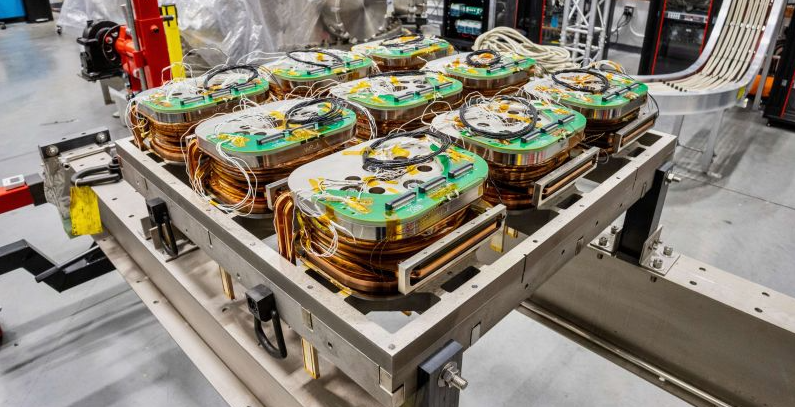
This approach already has small-scale hardware evidence. The Canis test publicly disclosed by the team in 2025 used nine high-temperature superconducting shaping coils arranged in three rows and three columns, operating at 20 kelvin, and achieved approximately one percent consistency with predictions for the magnetic field on the measurement plane. This result supports the magnetic field adjustment capability of planar coil arrays, but the test did not reproduce the closed flux surfaces of a complete stellarator, and it cannot be concluded from this that the entire device has achieved high-performance confinement.
What this collaboration plans to examine is another type of key component: the encircling coils. MIT's Plasma Science and Fusion Center (PSFC) will participate in testing under full magnetic field and full force conditions. The announcement of the collaboration means that the validation schedule is moving forward; it cannot yet be written that the coils have passed all assessments, nor can it be inferred that the fusion device already has power generation capability.
Why must magnets validate both magnetic field and forces simultaneously? Because the current that produces the confinement magnetic field also subjects conductors and structures to electromagnetic loads. A slight displacement of supports could alter local stress and magnetic field errors; friction, joint resistance, or other local heating would erode the temperature margin for superconducting operation. Reaching a target current once only answers whether operation is possible under specific conditions; it does not yet answer the question of reliability after repeated operation.
The "high temperature" in High-Temperature Superconductivity (HTS) is relative to conventional superconducting materials and does not mean room-temperature operation. A full-size shaping coil announced by the company in May of this year produced a magnetic field exceeding 6 tesla at 20 kelvin; this is the test condition for that coil and cannot be directly taken as the Eos plasma central magnetic field, nor can it be regarded as the test result for the encircling coils in this collaboration. Values for different components must correspond to their respective measurement locations and boundaries.
Manufacturing Complexity Reduced, System Integration Responsibility Increases Accordingly
Whether more easily manufactured coils can deliver low-cost electricity still depends on the ledger of the entire system. Standardized parts are expected to reduce tooling varieties, allow inspection procedures to be reused, and facilitate spare parts inventory. But hundreds of adjustable magnets mean corresponding power supply, measurement, connection, and control requirements. Whether the remaining coils can compensate within allowable current ranges after one magnet drops out, and whether compensation sacrifices confinement performance, both require device-level validation.
Software also has physical boundaries. It can correct currents based on measurement results, but it cannot indefinitely increase conductor carrying capacity or eliminate structural damage. Adding adjustment degrees of freedom simultaneously demands more reliable sensors, calibration, and fault identification. If the control system misinterprets sensor drift as magnetic field change, the adjustment itself may deviate from the target, so adjustability must be designed together with independent protection and fault handling.
For the supply chain, the practical value of standardization lies in stable production quality. A single prototype can absorb substantial manual rework, but batch equipment must demonstrate that results across different batches of conductors, joints, and insulation processes are predictable. Only when yield rates, rework counts, and test occupancy times form a continuous record can manufacturers judge whether adding production lines is worthwhile, and can project owners incorporate equipment delivery schedules into credible construction plans.
After Parts Become Easy to Manufacture, It Must Still Be Proven That the Power Plant Is Easy to Maintain
What a fusion power plant ultimately sells is continuously deliverable electricity. Even if magnet procurement costs decline, if maintenance requires long downtime, the capital cost allocated per unit of electricity sold may still rise. The planar coil approach emphasizes modular maintenance, but detachable parts do not equal rapid repair: warming up, disconnecting, component handling, re-evacuation, and cool-down may all occupy maintenance windows.
For future power plants using deuterium-tritium fuel, neutron shielding, material activation, and remote maintenance space must also be considered. Connection locations that are accessible in the laboratory may not be suitable for manual handling once inside the reactor environment. Magnet layout should be optimized together with the blanket, piping, and maintenance access routes; otherwise, local manufacturing convenience may be offset by whole-plant maintenance difficulties. Currently available public materials are insufficient to provide a verifiable commercial levelized cost of electricity for this approach, and the direction of cost reduction cannot be written as an already-realized price advantage.
The value of this collaboration lies in advancing a manufacturing concept to hardware testing closer to operating loads. Its next step in persuasiveness should come from geometric and performance changes before and after energization, fault protection behavior, and whether repeated tests yield consistent results. If planar coils can simultaneously safeguard magnetic field quality, manufacturing yield, and maintenance time, then it may be possible to translate component-level simplification into an engineering advantage for the entire fusion device.
(This article is based on publicly disclosed corporate information on the magnet testing collaboration, equipment test descriptions, and publicly available research team papers, and was independently written with AI-assisted retrieval and verification, aiming to explain the relationship between stellarator magnet manufacturing and system integration. The device architecture and development direction published by the company do not mean that whole-device performance has been achieved; the analysis regarding maintenance and cost is a discussion of engineering conditions and does not represent verified commercial operating results.)
Disclaimer: Information republished from partner media, institutions or other websites is provided for reference and communication purposes only. It does not imply endorsement of its views or verification of its accuracy. Please contact us if any content infringes rights or requires correction.