
Unit 2 of Sanao Nuclear Power Plant Completes First Fuel Load
 Scan to share
Recently, China General Nuclear Power Group (CGN) announced that Unit 2 of the Sanao Nuclear Power Plant, located in Cangnan, Wenzhou, Zhejiang Province, has successfully completed the loading of fuel assemblies into the reactor core, marking the unit's official entry into a new phase of commissioning and preparation for operation with nuclear fuel, and representing a key step toward full construction and commercial operation.
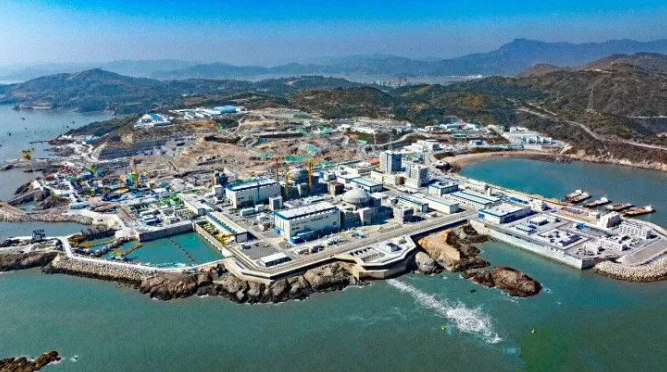
As the second of six “Hualong One” (HPR1000) third-generation nuclear power units planned for the Sanao site, Unit 2 officially poured its first batch of concrete in late December 2021. Prior to this, the unit had successively completed cold functional tests and hot functional tests, comprehensively verifying the equipment performance of the reactor system under severe temperature and pressure conditions. According to the construction schedule, the unit is expected to officially begin generating and connecting to the grid in 2027.
During this nuclear fuel loading operation, the project team innovatively adopted semi-automated equipment and a self-developed floating lighting device. By precisely programming the loading sequence and inputting it into the control system, operators safely and efficiently moved 177 fuel assemblies from the cooling pool racks into the reactor core in sequence. The floating underwater lighting provided clear and stable visual assurance for the narrow working area, ensuring the smooth and orderly progress of the entire loading process.
The Sanao Nuclear Power Project is not only the first nuclear power project in the Yangtze River Delta region to adopt the “Hualong One” reactor design, but also the first project in China's nuclear power sector to introduce private capital (Geely Technology Group holds a 2% stake). Once all six units planned for the site are fully completed, they will deliver more than 54 terawatt-hours (TWh) of clean electricity to the Yangtze River Delta region annually, reducing standard coal consumption by more than 16 million tons per year and cutting carbon dioxide emissions by more than 51 million tons per year, providing strong support for the region's green and low-carbon transition.
Disclaimer: Information republished from partner media, institutions or other websites is provided for reference and communication purposes only. It does not imply endorsement of its views or verification of its accuracy. Please contact us if any content infringes rights or requires correction.