
Multiple meetings focus on the *Convention on Supplementary Compensation for Nuclear Damage* as the global nuclear liability regime continues to advance.
 Scan to share
Several meetings centered on the Convention on Supplementary Compensation for Nuclear Damage (CSC) have recently taken place. The International Atomic Energy Agency (IAEA) stated that key topics of discussion included strengthening cooperation under the CSC framework, expanding participation in the convention, and supporting the further development of a global nuclear liability regime.
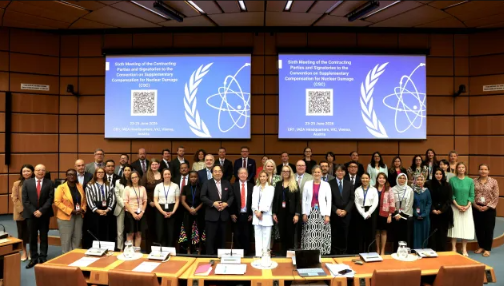
The sixth annual meeting of CSC Contracting Parties and Signatories was held from June 23 to 25 at the IAEA headquarters in Vienna, Austria. Approximately 120 representatives attended, including delegates from 11 of the 12 Contracting Parties, five Signatories, and 23 observer states, as well as representatives from international organizations and industry stakeholders.
Participants included Contracting Parties such as Argentina, Canada, Ghana, India, Japan, Montenegro, Morocco, Romania, the United Arab Emirates, the United Kingdom, and the United States; Signatories such as Australia, Indonesia, Lithuania, Peru, and the Philippines; and observer states such as Brazil, France, Germany, Kenya, Malaysia, Mexico, Nigeria, Poland, Saudi Arabia, South Africa, and Vietnam. Representatives from the nuclear industry, insurance and financial institutions, academia, law firms, and the OECD Nuclear Energy Agency (OECD/NEA) also attended as observers.
The meeting reviewed progress regarding the CSC amendments adopted in January 2026 and discussed next steps for expanding the convention's membership. Several countries currently considering accession or advancing their accession processes outlined their key areas of interest regarding the convention, as well as the challenges they face in aligning domestic laws, regulations, and policies.
Industry representatives noted that establishing a global nuclear liability regime based on the CSC helps provide greater legal certainty for stakeholders such as nuclear power plant operators, insurers, suppliers, and investors. Participants also exchanged views on CSC implementation practices and discussed the impact of nuclear liability arrangements on the costs of nuclear projects.
In addition to the annual meeting in Vienna, the IAEA visited Kenya from February 10 to 13 at the request of the Republic of Kenya's nuclear energy agency to provide an overview of the CSC. During the visit, the IAEA held discussions with Kenyan entities—including the Ministry of Energy and Petroleum, the Ministry of Foreign and Diaspora Affairs, Kenya Power, the Insurance Regulatory Authority, and the national disaster management agency—focusing on the establishment of a legal framework for nuclear liability as Kenya prepares to launch its nuclear power program.
A sub-regional workshop on the Convention on Supplementary Compensation for Nuclear Damage (CSC) was also held during the visit, attended by over 45 representatives from Ethiopia, Ghana, Kenya, Namibia, Nigeria, Rwanda, Uganda, and the United Republic of Tanzania. Through thematic presentations, case studies, and discussions, the workshop helped participants gain a deeper understanding of the institutional arrangements regarding civil liability for nuclear damage.
On December 9–10, 2025, the IAEA also held a national workshop on the CSC in Brasília, Brazil. Organized in cooperation with the Brazilian government through the National Nuclear Safety Authority (ANSN), the workshop focused on the role of the CSC in establishing a global nuclear liability regime. Participating entities included the ANSN, the National Nuclear Energy Commission (CNEN), the Ministry of Mines and Energy, the Ministry of Foreign Affairs, the Ministry of Science, Technology and Innovation, the Ministry of Defence, the Brazilian Navy, and nuclear power companies.
Following the workshop, the IAEA held discussions with senior representatives from relevant Brazilian government departments, the Chamber of Deputies, and the National Congress. These discussions aimed to support Brazil in further evaluating the possibility of acceding to the CSC and to clarify the Convention's position within the existing international nuclear liability framework.
Currently, nuclear liability instruments adopted under the auspices of the IAEA include the *Vienna Convention on Civil Liability for Nuclear Damage*, the *Protocol to Amend the Vienna Convention*, the *Joint Protocol Relating to the Application of the Vienna Convention and the Paris Convention*, and the *Convention on Supplementary Compensation for Nuclear Damage* (CSC). Additionally, instruments established under the framework of the OECD Nuclear Energy Agency include the *Paris Convention on Third Party Liability in the Field of Nuclear Energy* and the *Brussels Supplementary Convention*.
IAEA General Conference Resolution GC(69)/RES/7 notes that these instruments can provide a foundation for establishing a global nuclear liability regime based on nuclear liability principles and encourages Member States to consider acceding to the relevant instruments as appropriate. The IAEA International Expert Group on Nuclear Liability (INLEX) has previously recommended that Member States with nuclear installations adhere to one or more nuclear liability instruments incorporating common international principles and expand the scope of treaty relations as widely as possible, with a view to fostering a more universal global nuclear liability regime.
Disclaimer: Information republished from partner media, institutions or other websites is provided for reference and communication purposes only. It does not imply endorsement of its views or verification of its accuracy. Please contact us if any content infringes rights or requires correction.