
Lü Zhaoping's team advances research on radiation-resistant metallic materials to meet the needs of advanced nuclear energy systems.
 Scan to share
Recently, the "High-Performance Metallic Materials" Innovative Research Group project—funded by the National Natural Science Foundation of China and led by Lv Zhaoping, an Academician of the Chinese Academy of Sciences and President of the University of Science and Technology Beijing—concluded its funding period with an outstanding evaluation. Centered on fundamental research into high-performance metallic materials and addressing major national needs, the project fostered the interdisciplinary integration of alloy design, material characterization, and intelligent design, with radiation-resistant materials serving as a key area of focus.
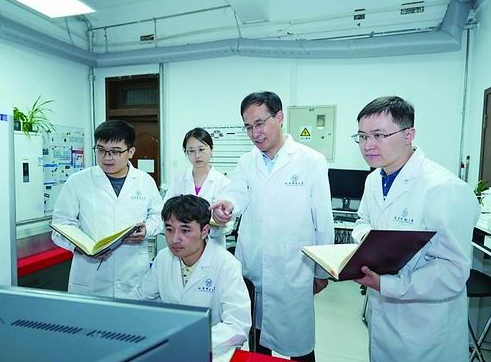
Lv Zhaoping (second from right) and team members in the laboratory. Photo courtesy of the interviewee.
In the field of nuclear energy materials, advanced nuclear systems operate under harsh conditions, such as high temperatures and high-dose radiation. Materials used in these systems are prone to void formation and swelling under prolonged irradiation, leading to performance failure. While traditional materials rely primarily on interfaces to absorb radiation-induced defects, high-temperature irradiation can cause strengthening particles to undergo irreversible dissolution, making it difficult to ensure material stability. The lack of high-performance radiation-resistant materials has become a critical bottleneck hindering the development of nuclear energy equipment.
To address this challenge, Lv Zhaoping’s team proposed a material design strategy characterized by "low mismatch" and "strong ordering." "Low mismatch" emphasizes the high compatibility between strengthening particles and the matrix, while "strong ordering" highlights the stability of atomic arrangements within the strengthening particles, ensuring they continue to provide a strengthening effect. Unlike traditional mechanisms, the strengthening particles in these materials can dissolve into the matrix under irradiation and re-precipitate once the radiation subsides. Through this dynamic "dissolution-precipitation" process, the material eliminates radiation-induced defects while maintaining the density of strengthening particles, thereby achieving a balance between high strength and radiation resistance.
In the realm of fundamental research on high-performance metallic materials, Lv Zhaoping’s team also used high-entropy alloys as a model to investigate the role of oxygen. By introducing oxygen during the alloy melting process, the team discovered that oxygen atoms did not form detrimental, brittle oxides. Instead, leveraging the unique chemical short-range ordering effect inherent to high-entropy alloys, the oxygen atoms bonded with zirconium- and titanium-rich clusters to form nanoscale "ordered oxygen complexes." Experiments demonstrated that the high-entropy alloy’s tensile strength increased by 48.5% while maintaining good ductility, offering a novel pathway to overcome the long-standing challenge of simultaneously achieving high strength and ductility in metallic materials. Lü Zhaoping holds that the actual service environment is a complex system shaped by the coupled effects of multiple factors—such as high temperatures, high stresses, and intense radiation. Consequently, materials research should not merely pursue the limits of a single property; instead, it should focus on practical application scenarios and drive the extension of basic research into applied basic research. Guided by this perspective, he proposed the concept of "Conjugate Materials Science," which emphasizes the dynamic synergy among multiple properties and mechanisms within complex environments, thereby offering a new research direction for the design of high-performance metallic materials.
Disclaimer: Information republished from partner media, institutions or other websites is provided for reference and communication purposes only. It does not imply endorsement of its views or verification of its accuracy. Please contact us if any content infringes rights or requires correction.