
Important Breakthrough Made in Research on Key Structural Materials in China's Reactors
 Scan to share
It was learned from CNNC that the China Institute of Atomic Energy, leading a collaboration with Nanchang University, Shanghai Jiao Tong University and other institutions, has achieved an important breakthrough in research on the volatilization behavior of materials under high-temperature ultra-high vacuum conditions, quantitatively revealing for the first time the volatilization anisotropy mechanism of nickel-based alloys under high-temperature ultra-high vacuum. This provides important theoretical basis and experimental data support for the microstructure optimization, life prediction, and reliability design of high-temperature structural materials used in extreme thermal vacuum environments, and is of great significance for promoting the independent and controllable development of high-temperature ultra-high vacuum materials in China. The related research paper was published in the internationally leading journal in the field of corrosion and oxidation, Corrosion Science.
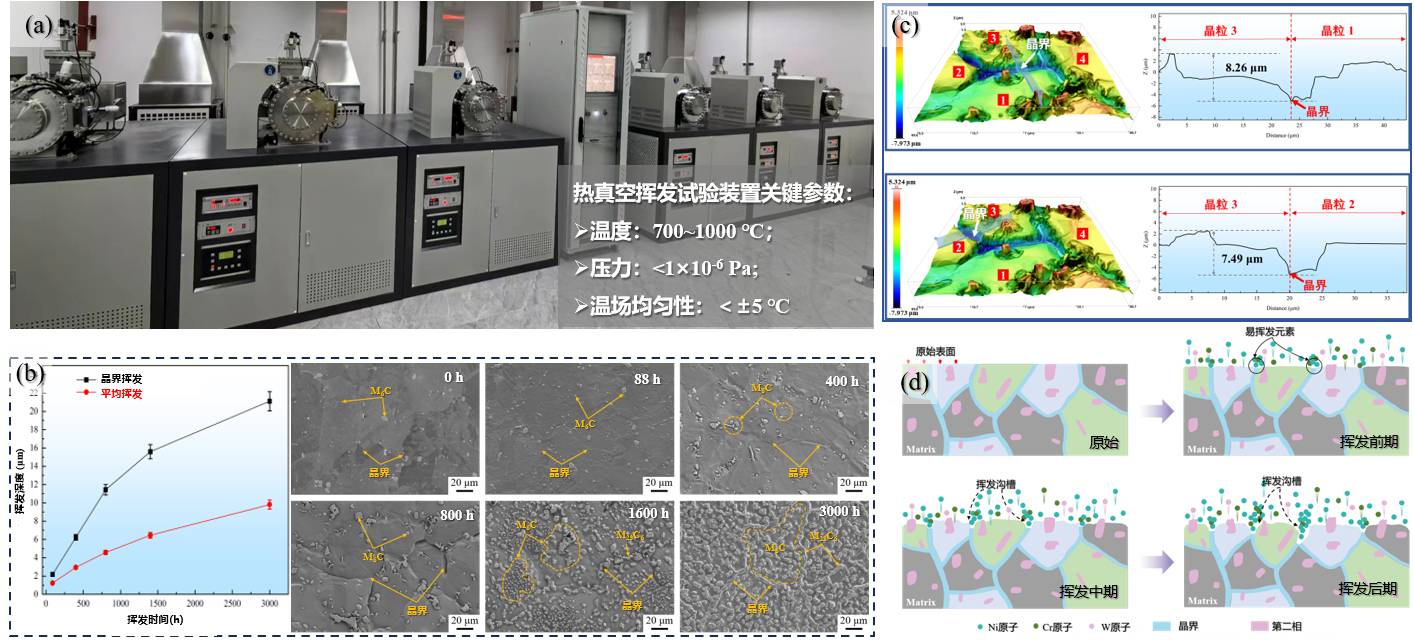
Nickel-based alloys are key structural materials in reactors, and they can undergo thermal vacuum volatilization behavior in high-temperature ultra-high vacuum environments, leading to element loss and performance degradation. To improve the service duration and reliability of nickel-based alloys under extreme service conditions, it is crucial to systematically carry out research on the volatilization behavior and mechanism of nickel-based alloys under high-temperature ultra-high vacuum.
The Reactor Materials Corrosion and Protection Research Laboratory of the Reactor Engineering Research Institute of the China Institute of Atomic Energy designed and built a high-temperature ultra-high vacuum volatilization test apparatus integrating ultra-high vacuum acquisition, programmed temperature control, volatilization product collection, and real-time monitoring, achieving an extreme thermal vacuum environment with a maximum operating temperature of 1000°C, a hot-state vacuum level better than 10⁻⁶Pa, and temperature field uniformity better than ±5°C. Based on this apparatus, the research team used the nickel-based superalloy Hastelloy 230 as the research object and conducted volatilization experiments lasting up to 3000 hours under a thermal vacuum environment of 800°C and ~10⁻⁶Pa. Based on experimental and theoretical calculation results, they elucidated the synergistic controlling effect of crystal orientation and grain boundary type on volatilization behavior. The research results indicate that by regulating grain orientation and grain boundary character distribution, it is expected to improve the volatilization resistance of materials at the microstructural level.
It is reported that the related research results have been published in a paper titled "Microstructure-dominated volatilization behavior of Hastelloy 230 alloy under high-temperature ultra-high vacuum environment," with the first author being Yang Wanhuan, assistant researcher at the China Institute of Atomic Energy, and the corresponding authors being Zhong Weihua, researcher at the China Institute of Atomic Energy, Li Shen, lecturer at Nanchang University, and Shen Chao, associate professor at Shanghai Jiao Tong University.
Disclaimer: Information republished from partner media, institutions or other websites is provided for reference and communication purposes only. It does not imply endorsement of its views or verification of its accuracy. Please contact us if any content infringes rights or requires correction.